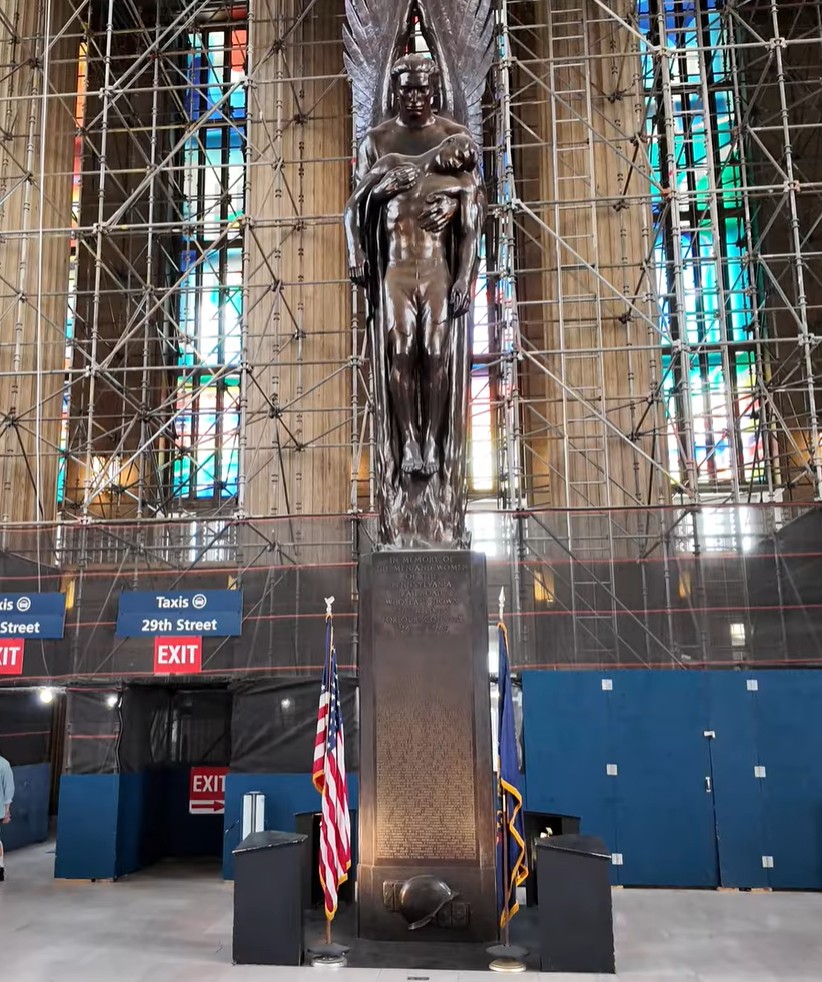
William H. Gray III 30th Street Station Item Info

- Title:
- William H. Gray III 30th Street Station
- Creator:
- DYLspotter
- Date Created:
- 10/18/2024
- Subjects:
- architecture
- Location:
- William H. Gray III 30th Street Station
- Latitude:
- 39.9560
- Longitude:
- -75.1819
- Source:
- https://commons.wikimedia.org/wiki/Main_Page
- Rights:
- This file is made available under the Creative Commons CC0 1.0 Universal Public Domain Dedication. The person who associated a work with this deed has dedicated the work to the public domain by waiving all of their rights to the work worldwide under copyright law, including all related and neighboring rights, to the extent allowed by law. You can copy, modify, distribute and perform the work, even for commercial purposes, all without asking permission.
- Standardized Rights:
- https://creativecommons.org/publicdomain/zero/1.0/
William H. Gray 30th Street Station
Why 30th Street Station?
William H. Gray III 30th Street Station, also known as 30th Street Station, is one of Philadelphia’s major transit stations. In addition to being an important part of Philadelphia’s transportation, over the years 30th Street Station has also gained the status of being one of the city’s iconic landmarks for its architectural style and visibility. I became interested in researching 30th Street Station as although I used it frequently, I realized I did not know much about its history, and because I wanted to learn more about its connections to Italian architectural styles, and specifically Neoclassical architecture.

What does it look like?
As previously mentioned, part of 30th Street Station’s identifiability comes from its monumental scale. Standing 116 feet tall, 639 feet long, and 327 wide, 30th Street Station was one of the last major railway passenger stations built in America. 1 The station’s exterior, constructed from a iron frame and travertine limestone, features 71 feet high Corinthian-style columns that create a large portico which is flanked by the east and west wings.2 The interior of the portico allows for vehicles to easily drop off and pick up passengers in front of the entrance. The Corinthian columns point to one aspect of 30th Street Station’s Roman inspired Neoclassical style of architecture. Additionally, another aspect that points to 30th Street Station’s Neoclassical style is that the initial iteration of its exterior was directly based on the Roman Baths.3 This was likely due to inspiration from earlier transit stations such as Washington D.C.’s Union Station and from architects like Charles Atwood, both of which took inspiration from the Baths, particularly elements such as arches, thermal windows, and building materials like limestone.4 However, 30th Street Station strayed from previous designs like Union Station in that it had less Classical ornamentation.5 The interior, on the other hand, notably contrasts against the exterior due to being designed in an Art Deco style. While maintaining the monumental feeling of the building, with the Main Concourse’s ceiling measuring at about 95 feet high, the fluted columns inside are much more ornamented and feature gilded capitals.6 The flat, coffered ceiling is decorated in red, gold and cream and overlooks the Tennessee marble flooring.7 The Main Concourse is also illuminated by large, rectangular windows and Art Deco style lighting fixtures that reflect on the marble floors.8

Who Designed it?
30th Street Station was designed by Alfred P. Shaw of the Chicago based architectural firm Graham, Anderson, Probst, and White.9 Shaw was born May 13, 1895 in Dorchester, Massachusetts and died December 1, 1970, and became chief designer for Graham, Anderson, Probst and White after William Peirce Anderson’s death in 1924 until 1936.10 In addition to designing 30th Street Station, he is also well known for designing many buildings in Chicago,such as the Civic Opera House, the Field Building, and the interior of the Museum of Science and Industry, as well as being a fellow of the American Institute of Architecture.11
Where is it?
30th Street Station is located at 2955 Market Street in Philadelphia, Pennsylvania. It is close to both Center City and the Schuylkill River in the heart of Philadelphia, as it was meant to be seen as a “symbolic entrance” to those coming into the city.12 The location also allows for trains to depart in four different directions: to Boston in the north, Florida in the south, Atlantic City in the in the east, and finally to Chicago in the west.13 in multiple directions helps reinforce 30th Street Station both as an integral part of Philadelphia’s infrastructure and as a gateway for visitors.

How and Why Was It Built?
In 1924, the City of Philadelphia and the Pennsylvania Railroad created a formal agreement called the Pennsylvania Improvements Project, which were a series of projects meant to ease congestion in Center City and improve travel efficiency for passenger trains.14 The Pennsylvania Railroad had hired Graham, Anderson, Probst and White as the head architects for the project.15 One of the plans included in the project was replacing Broad Street Station, which in addition to having been heavily damaged from a fire two years prior, its location and design as a stub-end terminal meant that in order to reach the center of the city, all through trains had to be backed up, costing significant amounts of time.16 Two train stations were planned to replace Broad Street: Suburban Station, which opened on September 28th, 1930, and 30th Street Station, which opened December 15th, 1933.17 Upon completion, 30th Street Station improved upon Broad Street by having modern and more efficient technology such as central heating and an auxiliary power plant.18
What Message does 30th Street Station want to send?
30th Street Station is not only a critical part of Philadelphia’s transportation but also is an important historical landmark and is like a gateway to the city itself. 30th Street Station’s exterior being based on the Roman Baths points to the desire to show 30th Street Station, and by extension, Philadelphia, as a social hub for all. Additionally, the monumental scale of the station itself carries “the traditional connotations of metropolitan arrival.”[^19] However, 30th Street Station differs from other contemporary major transit stations based on the Roman Baths such as Union Station in D.C. in that Alfred P. Shaw used simplified forms and shaper lines, likely due to the influence of Art Deco styles. The interior of the station being more heavily based on the Art Deco style also differentiates it from other contemporary major transit stations and creates a feeling of grandeur and radiance because of the high ceilings, large windows, gilded column capitals, and reflective marble floors. Furthermore, like how the Roman Baths were architectural innovations for their time, 30th Street Station is similar: it replaced the outdated infrastructure of Broad Street Station and made travel more efficient in and out of Philadelphia for both passenger and freight trains.
Footnotes
-
Sally Anderson Chappell, “Thirtieth Street Station,” in Architecture and Planning of Graham, Anderson, Probst, and White, 1912-1936: Transforming Tradition, (Chicago, IL: University of Chicago Press, 1992), 200; John Hepp, “Railroad Stations,” Encyclopedia of Greater Philadelphia, 2015, https://philadelphiaencyclopedia.org/essays/railroad-stations/. ↩
-
Great American Stations,“Philadelphia, PA - William H. Gray III 30th Street Station (PHL),” accessed November 24, 2025, https://www.greatamericanstations.com/stations/philadelphia-pa-phl/. ↩
-
Ben Leech, “William H. Gray III 30th Street Station,” Nomination of Public Interior Portion of Building or Structure, October 1st, 2018, Philadelphia Register of Historic Places, Philadelphia Historical Commission, Philadelphia, Pennsylvania, 54. ↩
-
Leech, “30th Street Station,” 54; Sally Anderson Chappell, “Urban Ideals and the Design of Railroad Stations.” Technology and Culture 30, no. 2 (1989): 356. ↩
-
Leech, “30th Street Station,” 54. ↩
-
Great American Stations, “William H. Gray III 30th Street Station”; Leech, “30th Street Station,” 4. ↩
-
Chappell, “Thirtieth Street Station,” 201. ↩
-
Leech, “30th Street Station,” 4; Chappell, “Thirtieth Street Station,” 201. ↩
-
Chappell, “Urban Ideals,” 371. ↩
-
Chicago Tribune, “Architect Alfred P. Shaw Dies,” December 2nd, 1970; Chappell, “Urban Ideals,” 371. ↩
-
Chicago Tribune, “Architect Alfred P. Shaw Dies.” ↩
-
Chappell, “Thirtieth Street Station,” 200. ↩
-
Great American Stations, “William H. Gray III 30th Street Station.” ↩
-
Great American Stations, “William H. Gray III 30th Street Station.” ↩
-
Leech, “30th Street Station,” 52. ↩
-
Chappell, “Thirtieth Street Station,” 200; Eric A. Sibul, “Meeting an Emergency: The Pennsylvania Railroad and the Broad Street Station Fires of 1923 and 1943,” Railroad History, no. 213 (2015): 14. ↩
-
Sibul, “Meeting an Emergency,” 17. ↩
-
Chappell, “Thirtieth Street Station,” 200. ↩
Works Cited
Chappell, Sally Anderson. “Urban Ideals and the Design of Railroad Stations.” Technology and Culture 30, no. 2 (1989): 354–75. https://doi.org/10.2307/3105108.
Chappell, Sally Anderson. “Thirtieth Street Station.” In Architecture and Planning of Graham, Anderson, Probst, and White, 1912-1936: Transforming Tradition, 199–203. Chicago, IL: University of Chicago Press, 1992.
Chicago Architecture Center. “Graham, Anderson, Probst & White.” Accessed November 24, 2025. https://www.architecture.org/online-resources/architecture-encyclopedia/graham-anderson-probst-white.
Chicago Tribune. “Architect Alfred P. Shaw Dies.” December 2nd, 1970. https://www.newspapers.com/article/chicago-tribune-architect-alfred-p-shaw/20258137/
Great American Stations. “Philadelphia, PA - William H. Gray III 30th Street Station (PHL).” Accessed November 24, 2025. https://www.greatamericanstations.com/stations/philadelphia-pa-phl/.
Leech, Ben. “William H. Gray III 30th Street Station”. Nomination of Public Interior Portion of Building or Structure, October 1st, 2018. Philadelphia Register of Historic Places, Philadelphia Historical Commission, Philadelphia, Pennsylvania. https://www.phila.gov/media/20190514132443/1-N-30th-St-interior-nomination.pdf
Hepp, John. “Railroad Stations.” Encyclopedia of Greater Philadelphia, 2015. https://philadelphiaencyclopedia.org/essays/railroad-stations/.
Sibul, Eric A. “Meeting an Emergency: The Pennsylvania Railroad and the Broad Street Station Fires of 1923 and 1943.” Railroad History, no. 213 (2015): 4–25. http://www.jstor.org/stable/44678135.