Fountain of the Sea Horses Item Info

- Title:
- Fountain of the Sea Horses
- Creator:
- Smallbones
- Date Created:
- 06/08/2011
- Subjects:
- sculpture
- Location:
- Fountain of the Sea Horses
- Latitude:
- 39.96753
- Longitude:
- -75.18364
- Source:
- https://commons.wikimedia.org/wiki/File:Sea_Horse_Fountain_Fairmount.jpg

- Rights:
- This file is made available under the Creative Commons CC0 1.0 Universal Public Domain Dedication. The person who associated a work with this deed has dedicated the work to the public domain by waiving all of their rights to the work worldwide under copyright law, including all related and neighboring rights, to the extent allowed by law. You can copy, modify, distribute and perform the work, even for commercial purposes, all without asking permission.
- Standardized Rights:
- https://creativecommons.org/publicdomain/zero/1.0/
The Fountain of Seahorses
Located on Fairmount Park, Waterworks Drive, along a well trafficked footpath, the Fountain of Seahorses is a little-known hidden gem located right in the museum district of Philadelphia. Situated behind the Philadelphia Art Museum’s back entrance and close to Schuylkill River, the fountain can come across as unassuming— beautiful, yes — but no different than any other fountain in the city. In actuality the Fountain of Seahorses is a time capsule of diplomacy: it serves as lasting evidence of the dynamic relationship that existed between the United States and Italy at the turn of the 20th century while simultaneously serving as a reminder of the fascist era that existed in Europe, one that the United States initially turned a blind eye to.

Physical Description
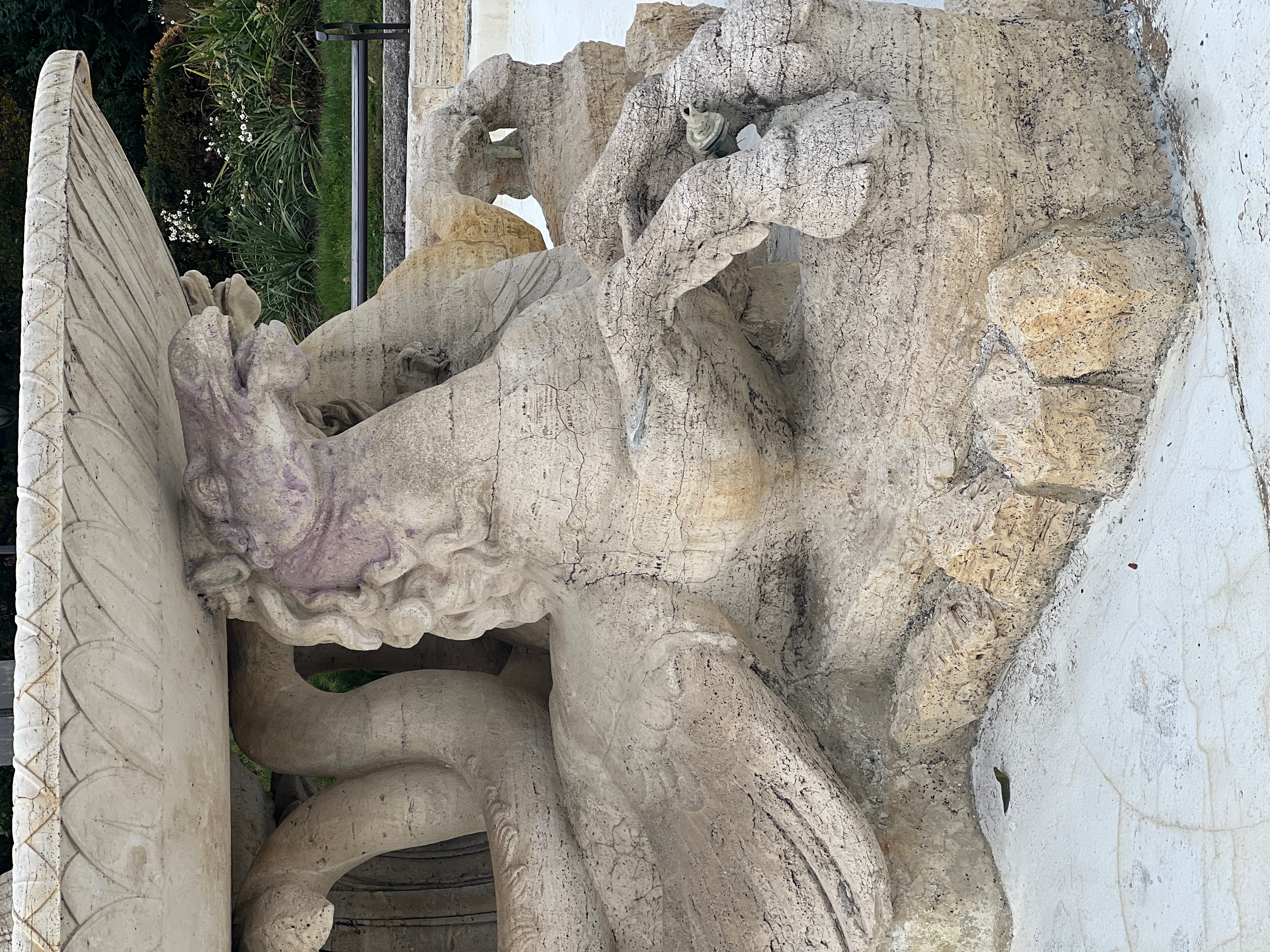
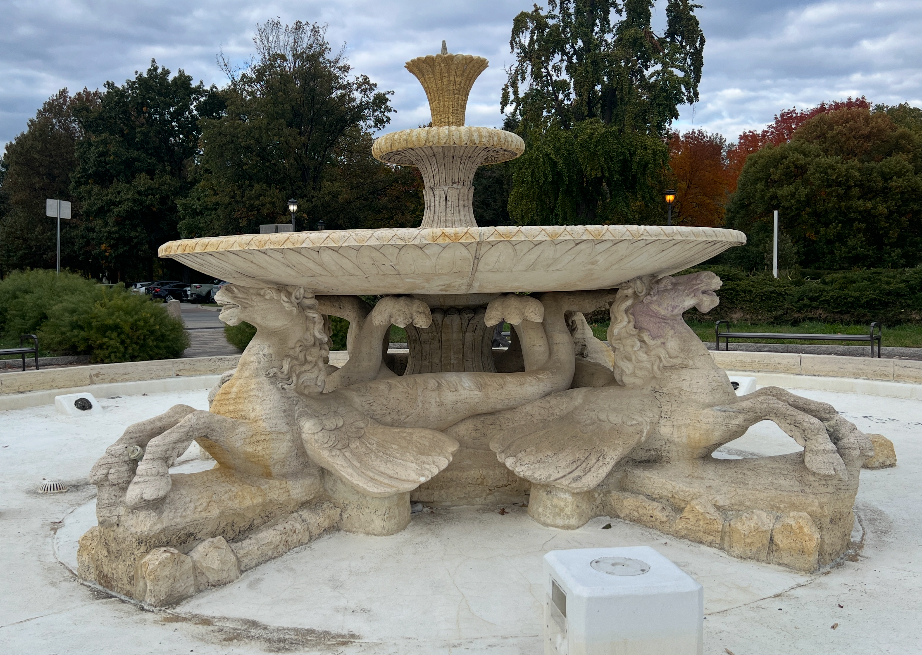
Aptly named, the Fountain of Seahorses can be described visually as a white carved fountain with a large basin containing four seahorses. Resting on top of the horses’ heads and tails is an additional round basin with a detailed column and spout for water in its center. The basin of the fountain is 64’ in diameter, and the four horses are 128” high. There is an inscription carved into the rim of the basin, that reads “La Nazione Italiana Alliazione Americana Nel 150 Annuale Della Dichiarazione Indipendenza 1776-1926 To the American Nation Upon the Sesquicentennial Anniversary of the Declaration of Independence 1776-1926.” There is a typo in the English word, Independence (Philadelphia Parks and Recreation). Despite being new to the United States, the fountain is not an original work, it is a replica of La Fontana dei Cavalli Marini, built in Rome’s Villa Borghese in 1758, which was designed in the Baroque style and commissioned by Marcantonio IV Borghese (1730-1809) who reworked the entirety of the villa, requesting that this new fountain be placed upon the foundation of the last (Sciaretta). This replica was made of Italian travertine and transported to the United States in 76 pieces. Each horse individually weighs over 5000 pounds and the four divided sections of the fountain bowl weigh 4000 pounds apiece. The basin of the fountain is formed with 36 coping stones. Due to restoration work that had to occur, the fountain currently contains new travertine stone from Turkey after the most recent conservation work that was conducted in 2012 (Hahn).
Object and Creator Background
The original fountain, La Fontana dei Cavalli Marini, was a replacement of the previous fountain at the center of Rome’s Villa Borghese. The villa was reworked by Marcantonio IV Borghese when he acquired it around 1758, intending the new fountain to represent both neoclassical ideals of strength in history and the baroque fashion of beautifully adorned emotion. This challenging commission was undertaken by two principal artists. The first was Christopher Unterberger, born on the 27th of May 1732 in what is now Trentino Italy. While little is known about his early life, it is known that Unterberger studied under the artist Giambettino Cignoreli at some point in the 1750s. After his education, Unterberger settled in Rome where he was inspired by the work of Pietro da Cortona and was mentored by Aton Rafael Mengs. In 1772 he was part of commission to design the papyrus room at the Vatican Library. In 1780 he worked closely with the Vatican again, this time participating in replica work on the Vatican Loggia for Russia. Due to the nature of his commissions, Unterberger focused on historical realism. Unterberger helped design The Fountain of Seahorses in 1791, and he experimented with “simulated ruins” as sculpture around this same time. Unterberger passed away on January 25th, 1798, at the age of 67; his legacy was preserved by artists like Antonio Longo, who he helped teach (Bryan 600).
Unterberger collaborated on this fountain with Vincenzo Pacetti, another incredibly adept artist, and sculptor. Born on the 3rd of April 1746 in Castel Bolognese, Pacetti studied at the Accademia del Nudo and after in the studio of sculptor-restorer Pietro Pacili. Pacetti took over Pacili’s studio upon his death. As an independent sculptor, Pacetti served as the director for the Accademia di San Luca and assisted many high-profile clients with sculptural restorations and creations. He was the favored sculptor/restorer for Prince Marcantonio Borghese, for whom he worked on La Fontana Dei Cavalli Marini and many other projects. He died in Rome in 1820, leaving behind an expansive diary.
While the main design and creation of the fountain was spearheaded by these two men, a public fountain on this scale almost always requires a larger team. This detail work on the original fountain was assisted by three more artisans and craftsman, Luigi Salimei who worked on the horses, Antonio Isopi who worked on the central support column and, Giovanni Antonio Berté who worked on the basin (Ai Bene Culturali). We acknowledge similar unrecognized labor work by the Italian American craftsmen who re-constructed the replica from its transported pieces, onsite in Philadelphia when the fountain arrived in 1928.
Material and Form
As stated, Fountain of Seahorses in Philadelphia is a replica of the c. 1740 work Fontana dei Cavalli Marini, as a result, this structure was constructed in Tivoli, Italy and had to be taken apart and shipped to Philadelphia. The fountain was split into 76 pieces for shipment, and it was reassembled on site by Italian craftsmen. Like many neoclassical fountains, The Fountain of Seahorses construction and design drew inspiration from drawings and paintings depicting iconography related to Classical antiquity, this means there would be an inherent focus on symmetry, distinct proportion, and elegance. Despite being a replica, this fountain is not a plaster or bronze casting, as is typically the case. Therefore, the creation would have involved classic stone carving techniques (using chisels and hammers) to create the form and shape. In the case of the Fountain of Seahorses, the stone used was Italian Travertine, which is a white stone made from Calcium Carbonate (CaCO 3). The full project required more than 40 tons of marble (Philadelphia Parks and Recreation).
The climate of Philadelphia does not suit Travertine Stone. As such, over the decades since its unveiling, the fountain has had to undergo significant restoration. This restoration was achieved through a variety of methods. Early restoration involved creating casts of alternate materials and applying them to the fountain. However, modern restoration must be conducted differently and involves taking large segments and completely re-carving them, due to loss of the original material and seams. The restoration material of choice continues to be Travertine stone, but the place of origin is now Turkey rather than Italy. By the time modern restoration began, the fountain was missing 75 percent of its original material. According to Philadelphia Parks and Recreation, the restoration of the fountain also involved a slight change in design which involved the “[elimination] of physical barriers to [the] fountain, adding new paving surfaces and seating area and changing the basin grade more in keeping with the fountains original intent”(Philadelphia Parks and Recreation).
Historical Background
Made in Italy and donated to the city of Philadelphia for the Sesquicentennial International Exposition, this replica fountain was meant to be present at the Philadelphia World’s fair commemorating the 150th anniversary of the signing of the Declaration of Independence. The fountain did not arrive until two years after its intended unveiling. Since 1928, It has continually served as a Fairmount park fountain feature since the location of its original placement has fallen into disrepair multiple times and occasionally must be hidden from public view. What about the original fountain in Rome? Why was this specific fountain chosen to be replicated as a gift for the U.S.? While it is quite difficult to explain the true reason behind the choice, some analysis of Italian art history may lead us to a valid iconographical reading of this gesture.
Neoclassical themes have been present throughout Italian history starting in the Renaissance. The power and connection that Italian art has to classical roman styles is a foundational aspect of its national identity, especially in the years following Italian unification in 1861, and even more so in the strength-centered identity of Mussolini’s fascist regime throughout the early 1900s. The use of strong, thrashing seahorses on this fountain represented the power of Prince Marcantonio Borghese when he commissioned them originally (Ai bene Culturali). Additionally, the use of monstruous sea creatures was a trend along the sculpting port cities of Italy during the height of baroque style. Thus, the neoclassical styling and baroque figures of Fontana dei Cavalli Marini combined two powerful styles of Italian art and additionally, brought up one more reference in the minds of Philadelphian Americans as they took in its replica. The presence of sea creatures, and the fact that fountains such as this one were incredibly common in the main piazzas of seaport towns in Italy would have reminded the American audience of the long-lasting communication and trading culture between Italy and the U.S. These are bonds that Mussolini would have wanted to remind the U.S. public of, particularly on the occasion of an international exhibition which would have spoken to larger political undertones of the period.

Connections with Fascism and American Reception
To create a diplomatic understanding of the role the Fountain of Seahorses played within American Italian relations in the 20th century, one must also reckon with the larger geopolitical factors at play. While the United States role in the fight against fascism during World War II cannot be denied, this vehement opposition was not the initial attitude the American public or the American government took. This was particularly true in the first decade following the end of World War I. In the 1920’s the United States government (and the public) at best ignored Mussolini and the fascism he was developing, and at worst favored his anti-communist ideals while simultaneously being intrigued or even enamored with the way he presented himself to the world. For Italian American communities at the time, this cautious interest was full-fledged support.
In many ways the American relationship with Italian fascism began in Philadelphia, due to its deep Italian influence. The influence was not subtle at the time, and the first fascist event in Philadelphia was held as early as November 11th, 1922 (Sessolo). This ease of embrace was due to the Italian American immigrant populations around the time. These Italian populations represented communities who were repeatedly rejected and mistreated by the general American public. The urge to fall back on idealized homeland nationalism is not beyond comprehension. Mussolini’s role in American culture did not end with these migrating communities. In subsequent years, Mussolini only became more present in American media: he appeared on the cover of Time magazine twice throughout the 1920’s (and no less than eleven times throughout his decades of power).1 Mussolini was nothing if not a showman, and the American media played into this. Mussolini was careful to associate himself with youth and strength when placed in front of the camera; in fact, he practically invented the understanding of what we now call a “publicity stunt” (Sessolo). These facets of his character created the path for a new “modern” way to portray power, one that was in extreme contrast to the versions that were associated with wisdom and age.
Mussolini’s image in America was also supported by the false ideal of the “American dream” and what it meant to be an “American hero.” Mussolini was a self-made man, a trait that Americans, and especially American immigrants valued more than anything. This is afterall, the types of achievements that had been promised to come with immigration to America. A true American hero would be self-made, and even more importantly he would be inherently undemocratic (Sessolo). To the average American this was a dream that could be grasped far more easily than the idea of becoming a Roosevelt, a family who was born with the silver spoon. Mussolini was careful to present these idealized “heroic” traits when pandering to the public, so his true behavior could go unchecked.
To put it simply, America was enamored with Mussolini; they were playfully intrigued to see what he would do next. Italian American communities played a significant role in perpetuating these ideas of goodwill and support for the idea of Italian fascism in America. This was the result of numerous factors, nationalism of course being one of them, but none more important than the benefit of distance (Sessolo). Italian Americans could not comprehend the true issues fascism was creating in Italy, this factor, coupled with the vast amounts of propaganda that flowed within their communities made it easy for them to offer what was blind support.
This goodwill would not last. By 1935, the United States (and most Italian American’s) ended any cordial relations or ideals that had existed towards fascist Italy, due to Mussolini’s invasion of Ethiopia coupled with Italy’s more aggressive actions (Sessolo). All that to say, these early years of Mussolini and America cannot be ignored in favor of the rest of history. Contextually, it is vital to any reflection of the political landscape that would have underscored the Fountain of Seahorse’s arrival to the United States and thus impacted any public reception to it.
When the Italian ambassador Giacomo de Martino presented this fountain to Philadelphia officials in 1928, he had this to say about the connection between Italy and the U.S.,
“Created by two national revolutions, America and Italy are destined to understand each other. I feel happy to say that probably no country in the world has shown more interest in understanding the value and significance of the present régime in Italy and the personality of Signor Mussolini, and probably no country in Europe has understood more clearly the value and significance of American ideals and achievements in the modernworld.”(NYT, 1928)
While integral when garnering insight, quotes like these say both a lot and a little about the intention of the gesture for the time. It is not improbable that Mussolini and his advisors wanted this connection to be made and thus intended for some of the sentiments that Martino expressed. However, the engraving on the fountains base gives us a closer look at the halfhearted nature of this gesture. The typo, or Italian spelling, of the word Indipendenza in the English translation of the engraving shows a bit of carelessness in this act of connection between Philadelphia and Italy, even if the bold addition of the engraving in both Italian and English speaks to the power of connection between the two countries. Furthermore, the statement by Martino contains a lot of conciliatory political speak, it would require suspension of disbelief to argue that this donation of the fountain truly impacted the people of Philadelphia, let alone the political decisions moving forward for the U.S.

Conclusion
It is undeniable that this fountain represents a political display of respect between Mussolini’s Italy and Philadelphia’s leaders at the time. However, the intention of the fountain becomes muddled when we take into account the fact that it was delayed two years on its arrival, and thus, any true understanding from the public of the sentiment written on the basin was lost and not much city wide attention or adoration was given to the fountain in the years that followed. Nonetheless, the Fountain of the Sea Horses represents something of national pride to Italians living in Philadelphia and continues to serve as a reminder of the history between the two nations during a tumultuous period. It contains neoclassical stylistic choices, while also reminding us of the Baroque era, where detailed grotesques of sea monsters and fluid creatures were common. The fountain is an artistic reminder of Italy and the magnificent history of marine-themed fountains throughout Italian art history.
Footnotes
-
For comparison, Adolf Hitler, was only featured on the cover five times. ↩
Works Cited
Italian Foundation Restoration, Philadelphia Parks, and Recreation. (nd.) https://www.phila.gov/newsletters/parksnrecsnewsletter/pdfs/italianfountainrestoration.pdf
“Presents Fountain at Philadelphia - June 7, 1928 - The New York Times.” New York Times Archives. (1928, June 7). https://www.nytimes.com/1928/06/07/archives/presentsfountain-at-philadelphia-italy-through-envoy-gives-a-copy.html
“Fontana.” Sovraintendenza Capitolina: Ai Bene Culturali (2017) https://www.sovraintendenzaroma.it/i_luoghi/ville_e_parchi_storici/ville_dei_nobili/villa_borghese/fontane
Sessolo, Fredrico. “Fascism: The View from America (1925-1945).” Department of Transnational Italian Studies, 11/11/2025, Bryn Mawr College, Bryn Mawr, PA. (Lecture).
Sciaretta, Fabrizio. Villa Borghese: La Fontana dei Cavalli Marini. ArtePiù, 14 Mag, 2017. https://artepiu.info/villa-borghese-fontana-cavalli-marini/
Bryan, Michael. A Biographical and Critical Dictionary of Painters and Engravers: With a List of Ciphers, Monograms, and Marks. Edited by George Stanley. London: Printed for Carpenter and Son; J. Booker; and Whittingham and Arliss. (1816).
“The Art and Craftsmanship Behind Handcrafted Fountains.” Luxury Fountains for Your Home, Garden or Business. (2024, July 1). https://fountains.com/the-art-and-craftsmanshipbehind-handcrafted-fountains-a-detailed-exploration/
Hahn, A. (2013, May 31). “Italian fountain restored, getting ready to splash again this summer.” WHYY. https://whyy.org/articles/italian-fountain-restored-getting-ready-to-splash-againthis-summer/