The Cast Hall of Pennsylvania Academy of the Fine Arts Item Info

- Title:
- The Cast Hall of Pennsylvania Academy of the Fine Arts
- Creator:
- Difference engine
- Date Created:
- 05/26/20217
- Subjects:
- architecture
- Location:
- The Cast Hall of Pennsylvania Academy of the Fine Arts
- Latitude:
- 39.9555967158042
- Longitude:
- -75.1631452820868
- Source:
- https://commons.wikimedia.org/wiki/File:Pennsylvania_Academy_of_the_Fine_Arts_building.jpg

- Rights:
- CC BY-SA 4.0
- Standardized Rights:
- https://creativecommons.org/licenses/by-sa/4.0/deed.en
The Cast Hall of Pennsylvania Academy of the Fine Arts (PAFA)
The Cast Hall at the Pennsylvania Academy of the Fine Arts (PAFA) constitutes a significant historical and pedagogical artifact. It functions not as a mere assemblage of objects but as a comprehensive pedagogical environment—a room that is itself an instrument of art education. This space embodies a 19th-century academic tradition, now largely vanished, which was founded on the belief that a canonical Western art history could be accessed through the rigorous study of plaster reproductions. The Hall serves as a tangible link to the academic methods that shaped American art, connecting the institution’s historic legacy to its contemporary educational mission.
PAFA’s distinguished collection, comprising over 120 specimens, is celebrated for its superior craftsmanship and rarity, with many pieces being first-generation copies taken directly from the original Greco-Roman and Renaissance masterpieces. Featuring iconic works such as the Winged Victory and the Belvedere Torso, the collection is considered one of the few great cast collections in the United States, representing a crucial chapter in the training of American artists and the enduring legacy of Italian cultural influence.
Founded in 1805, the Pennsylvania Academy of the Fine Arts (PAFA) is America’s oldest art museum and school. Its founders first purchased plaster casts of famous classicalstatues, even before constructing a building.1 Many were commissioned from the plaster caster for the new Louvre Museum. Sadly, most of these early cast purchases were destroyed in a fire in 1845, but were replaced throughout the 19th and early 20th century. As for now, the Cast Hall is temporarily closed for renovations. But some of the cast has been moved to the Anne Bryan Gallery in the lower level of the PAFA.
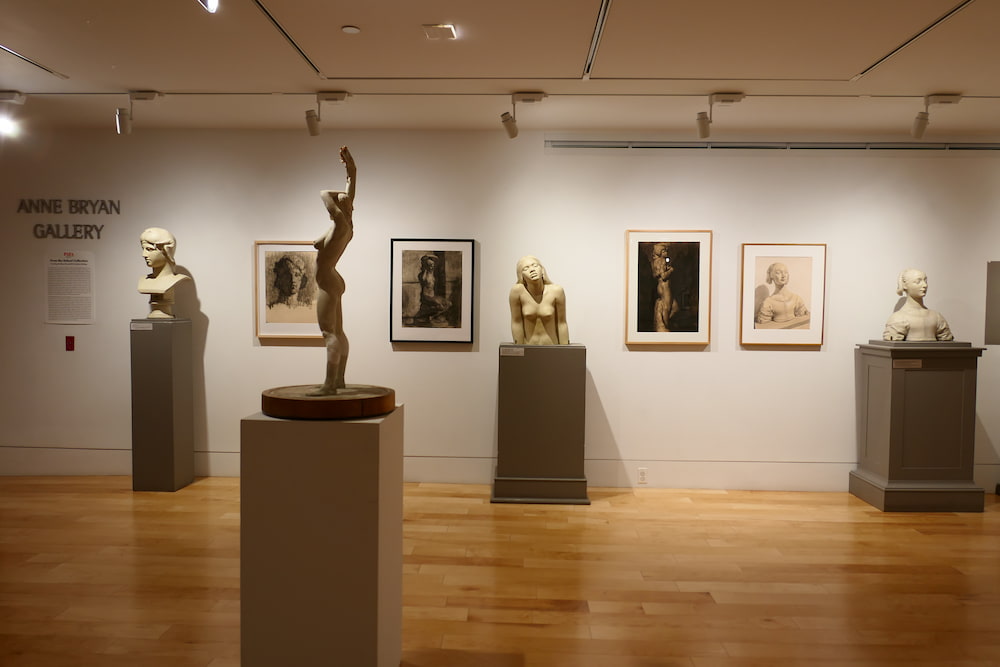
The establishment of the Pennsylvania Academy of the Fine Arts’ (PAFA) Cast Hall was a complex, multi-stage undertaking that combined international procurement, specialized artistry, and detailed academic oversight. The process began with procurement, as PAFA acquired plaster casts from renowned European studios in cities like Paris and Rome. These studios produced hollow plaster positives using molds taken directly from canonical originals housed in institutions such as the Vatican and the Louvre.
The technical execution relied on the medium of plaster of Paris, applied in piece-molds to capture the form of the original statue. Skilled artisans then assembled the resulting segments, meticulously filling and smoothing the seams to achieve a seamless likeness of the source work. The final phase involved the careful assembly and installation of these fragile, often monumental casts within the Furness building in 1876. This demanding process, which for a work like the Laocoön required significant engineering, was conducted under the direct supervision of PAFA’s faculty and curators to ensure the final arrangement fulfilled the space’s intended pedagogical and aesthetic objectives.
The “author” of the Cast Hall is a combination of the building’s architect and the institution’s founding educators. The Historic Landmark Building at 118 North Broad Street was designed by the American architects Frank Furness (1839-1912) and George Hewitt (1841-1916). Furness, a singular and bold designer, was trained in the Philadelphia office of Richard Morris Hunt and was deeply influenced by the High Victorian Gothic style. He was known for his aggressive, eclectic, and highly personal designs that combined Gothic, Ruskinian, and even emerging industrial motifs.
The acquisition and pedagogical use of the plaster casts, however, was driven by the Academy’s founders and early instructors, such as Charles Willson Peale and the painter Benjamin West. They championed the European academic model, where drawing from plaster casts of antiquities was the essential first step for any student before progressing to drawing from a live model. Thus, the Hall is a collaboration: Furness and Hewitt provided the architectural “shell,” while the Academy’s leadership provided the intellectual and pedagogical “core” in the form of the cast collection.
The Cast Hall is located on the second floor of the Furness-Hewitt-designed Historic Landmark Building at 118-128 North Broad Street(opened in 1876), Philadelphia, Pennsylvania. The Cast Hall is part of a unique urban campus that blends a historic museum with modern educational facilities in the adjacent Hamilton Building. It has been in this specific location since the building opened in 1876. The relationship with its environs is profound. The building is situated on the city’s grand cultural corridor, the Avenue of the Arts, placing it at the heart of Philadelphia’s artistic life. Within the building, the Cast Hall has a deliberate architectural relationship with the other spaces. It sits adjacent to the grand staircase and connects to other galleries and the famous Frank Furness-designed staircase. It was designed to be a central, inspiring feature of the student’s daily journey through the building.
The centerpiece of the Cast Hall collection is the exact replica of Michelangelo’s David, an approximately 17-foot-tall cast that serves as the centerpiece of its collection. The replica’s provenance is notable; it was originally commissioned by the John Wanamaker department store for an Italian exposition but was “never used because of its immense weight of over 3,000 lbs.” Subsequently stored in pieces, the cast was later gifted to PAFA in 1988.
The structural and material integrity of the cast has been professionally maintained. Recently conserved by the Giust Gallery, a firm with a long history (formerly Caproni) evidenced by the “Caproni cartouche” on many PAFA casts, the David is assembled in sections. These sections are secured with an interlocking system of roman pins and internal iron rods, which have provided excellent stability. The surface features an original patina of shellac and pigment. While many antique casts require the removal of later additions, “[a]ge has given pleasing warmth to the David’s patina,” commented PAFA faculty member Al Gury.2 Expert evaluation confirmed both the structural and surface conditions are stable, leaving the cast in an excellent state of preservation as it presides over the collection.
The Bust of Ariadne, another important sculpture in the Cast Hall, is work of significant artistic and cultural influence, a status derived from its “connection to Greek mythology and the enduring popularity of Ariadne’s story,”3 despite the anonymity of its sculptor and its precise date. The narrative, in which Ariadne aids Theseus in defeating the Minotaur only to be abandoned by him on Naxos, has been a potent source for artistic interpretation across centuries. The figure of Ariadne, depicted from ancient mosaics and frescoes to modern literature, theater, and dance, continues to be a vehicle for exploring profound and universal themes of “love, betrayal, and resilience.”4
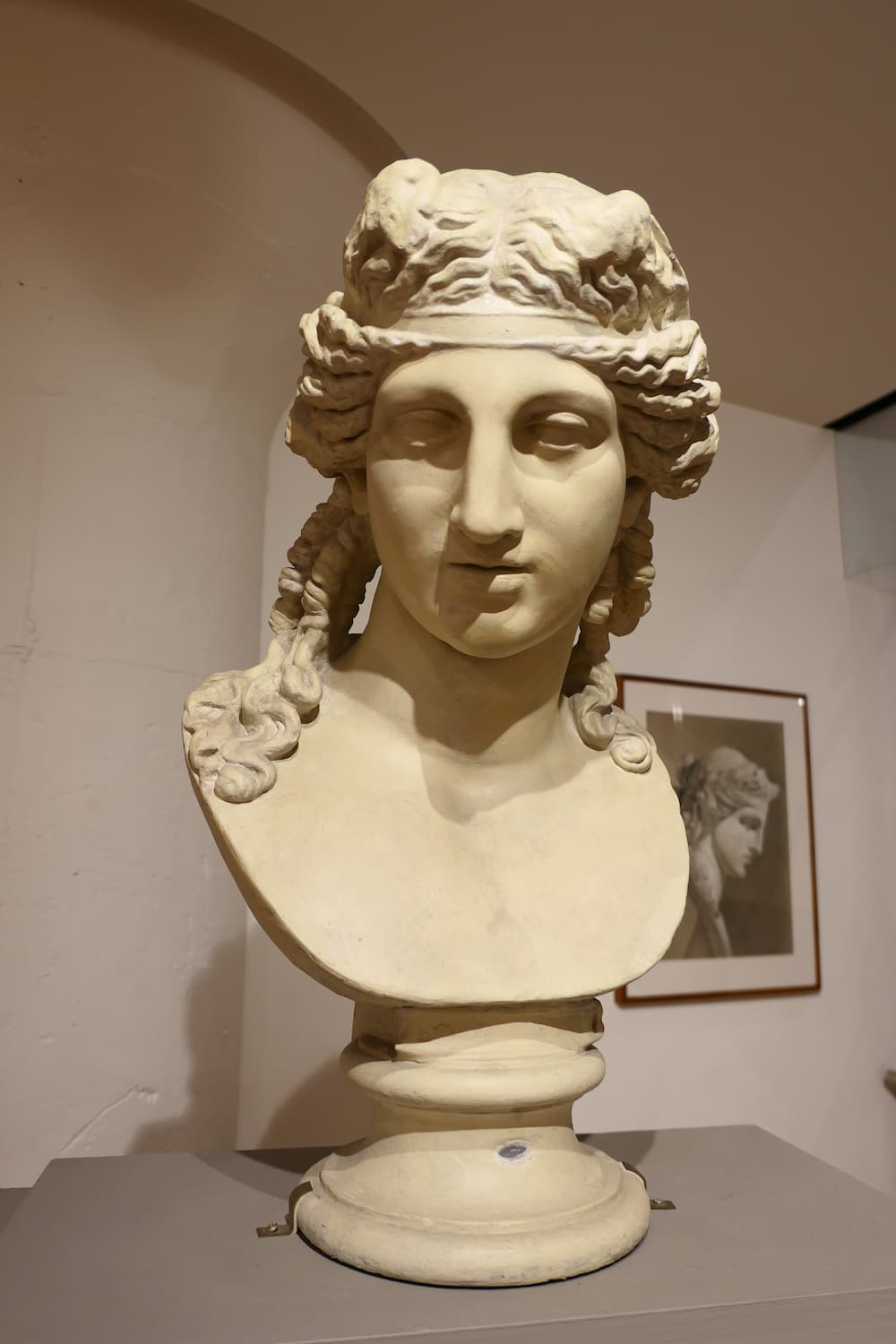
The practice of “Drawing from the Antique” remains a core foundation course, where students learn traditional techniques and conceptual thinking from these classical forms. The collection is a subject of ongoing research and collaboration with major institutions like the Philadelphia Museum of Art, the University of Pennsylvania, and the Royal Academy in London. The casts continue to inspire contemporary art, having been featured in modern exhibitions and groundbreaking performances by artists like Cassils.
Over time, the function of the Cast Hall changed dramatically. With the rise of Modernism in the early 20th century, direct observation and abstraction became more valued than the academic copying of classical ideals. By the mid-20th century, cast collections across the world fell out of favor and were often discarded. PAFA’s collection, however, survived. Its function today is no longer primarily pedagogical for practicing students (though it is still used), but rather historical, museological, and inspirational. It is a museum exhibit within a working art school—a preserved artifact of 19th-century art education that allows the public to experience the environment that trained artists.
In my opinion, the general idea and message of the Cast Hall is twofold. First, it is a physical manifestation of a belief in a universal artistic canon. It communicates the 19th-century idea that beauty and artistic excellence were objective, definable, and best exemplified by the classical and Renaissance traditions. By bringing these European masterpieces to Philadelphia in copy form, PAFA was asserting that American artists could and should participate in this grand tradition.
The academic practice of “Drawing from the Antique” was the first step in a rigorous pedagogical ladder. Students were not meant to merely replicate the lines and shadows of the Belvedere Torso or the Winged Victory; they were tasked with internalizing the principles that made these works canonical—the idealized proportions, the dynamic contrapposto, the masterful rendering of anatomy and drapery. This immersive, repetitive study provided a foundational vocabulary from which an artist could eventually develop a personal style. The experience of visiting these cast collections offered a profound personal verification of this idea. As I attempted to sketch the contours of the Bust of Ariadne in my personal notebook while visiting the academy, I became tangibly aware of the process as a form of a dialogue with the past. One learns by copying, with the ultimate aim of understanding the principles so thoroughly that one could later innovate and, ideally, surpass the contemporary to create new works worthy of joining that very canon. The worn bases of the statues, marked by generations of students, testify to this disciplined, repetitive labor, which was seen as the essential groundwork for all future originality.
Second, and more powerfully today, the Hall is a monument to the process of learning itself. The worn bases of the statues, marked by generations of students’ charcoal-dusted hands and moving stools, speak to the rigor and repetition of artistic training. The message to the modern viewer is not just “admire these masterpieces,” but “witness the room where American artists were forged.” It is a space that venerates the act of slow, careful, disciplined looking as the foundation of creation.
This pedagogical environment was the product of a remarkable transnational initiative that collapsed both geographical and temporal distance. On a geographical scale, the endeavor was fundamentally transnational. PAFA’s founders looked across the Atlantic, to the cultural capitals of Europe, to define an American artistic education. They procured first-generation casts from studios in Paris and Rome, with some commissioned directly from the plaster caster for the Louvre, creating a physical network that linked Philadelphia to the Vatican’s collections and other European institutions. This was an effort to transplant the heart of the European academy onto American soil to cultivate artistic tradition.
Furthermore, the temporal scale of this initiative is staggering. The collection consists of copies of items dating from 500 to 2,000 years earlier, bridging millennia. In one room, a 19th-century American art student could stand in direct, tactile engagement with a reproduction of a 5th-century BCE Greek sculpture, a 1st-century BCE Roman Hellenistic work, and a 16th-century Renaissance masterpiece. This created a compressed, synchronic art history where the “classical” was not a remote period but an active, present teacher. The cast hall effectively became a time machine, assembling a curated, linear progression of artistic excellence for pedagogical consumption. It asserted that the artistic achievements of Athens, Rome, and Florence were not confined to their original time and place but constituted a timeless and transportable legacy, directly relevant to the training of a modern artist in the New World. The Cast Hall stands as a monument to a bold, transnational and transhistorical project to build American cultural capital by systematically internalizing and emulating the most revered artistic models of the Western world.
Footnotes
-
A History of PAFA’s Cast Hall by Faculty Member Al Gury: PAFA - Pennsylvania Academy of the Fine Arts (2017) ↩
-
A History of PAFA’s Cast Hall by Faculty Member Al Gury: PAFA - Pennsylvania Academy of the Fine Arts (2017) ↩
-
Five influential figures in PAFA’s Cast Hall: PAFA - Pennsylvania Academy of the Fine Arts (2024) ↩
-
Five influential figures in PAFA’s Cast Hall: PAFA - Pennsylvania Academy of the Fine Arts (2024) ↩
Works Cited
A History of PAFA’s Cast Hall by Faculty Member Al Gury: PAFA - Pennsylvania Academy of the Fine Arts. PAFA. (2017,September 5). https://www.pafa.org/news/history-pafas-cast-hall-faculty-member-al-gury
Exclusive behind the Scenes Tour of the PAFA’s Cast Hall (in person). Harvard Club of Philadelphia. (n.d.). https://hrcphilly.clubs.harvard.edu/article.html?aid=640 Pennsylvania Academy of the Fine Arts (PAFA): Art School and Museum: Founded in 1805. PAFA. (n.d.). https://pafa.org/ Five influential figures in PAFA’ s Cast Hall: PAFA - Pennsylvania Academy of the Fine Arts. PAFA. (2024, October 1).
https://www.pafa.org/news/five-influential-figures-pafas-cast-hall-092424 Pennsylvania Academy of the Fine Arts. The Pennsylvania Academy of the Fine Arts: 200 Years of Excellence. (Philadelphia: University of Pennsylvania Press, 2005).