St. Paul Parish Item Info
- Title:
- St. Paul Parish
- Creator:
- Isabelle Wyatt
- Date Created:
- 10/24/2025
- Subjects:
- architecture
- Location:
- St. Paul Parish
- Latitude:
- 39.93932
- Longitude:
- -75.15886
- Rights:
- CC BY-NC
- Standardized Rights:
- https://creativecommons.org/licenses/by-nc/4.0/deed.en
St. Paul's Parish
What is the item and why did we choose it?
We chose St. Paul’s Church in part because of the long and complicated history between Irish Catholics and Italian Catholics in Philadelphia, particularly South Philly where this church is located. St. Pauls is in the heart of what is now known as the Italian Market, and its central location highlights how important religion was to the early immigrants in this area. It is the first Roman Catholic church in this area of Philadelphia, and was built on Christian Street because the street was wide, long, and busy, filled with shops and people.
This area originally was home to Irish Roman Catholic immigrants who worked in the surrounding factories and mills. This church is a fascinating example of the religious culture and tensions between immigrants in the area, as this was originally an Irish Catholic church and Italians weren’t welcome there. However, as the population in the area shifted, there started to be more Italian influence and more Italians joining the church. After researching the building, it is clear that it has a prominent Italian legacy: from the Italian artists that helped paint it to the Italian community that surrounds it. It is also worth noting that eventually it was the surrounding Italian community that was keeping the church going financially, and it probably would not be here today without them. The different phases of the church allow us to trace the aristocratic artistic influences of Italy and the role and rise of Italian immigrants in the area, providing a valuable historic lens on religion and immigration in Philadelphia.
Description
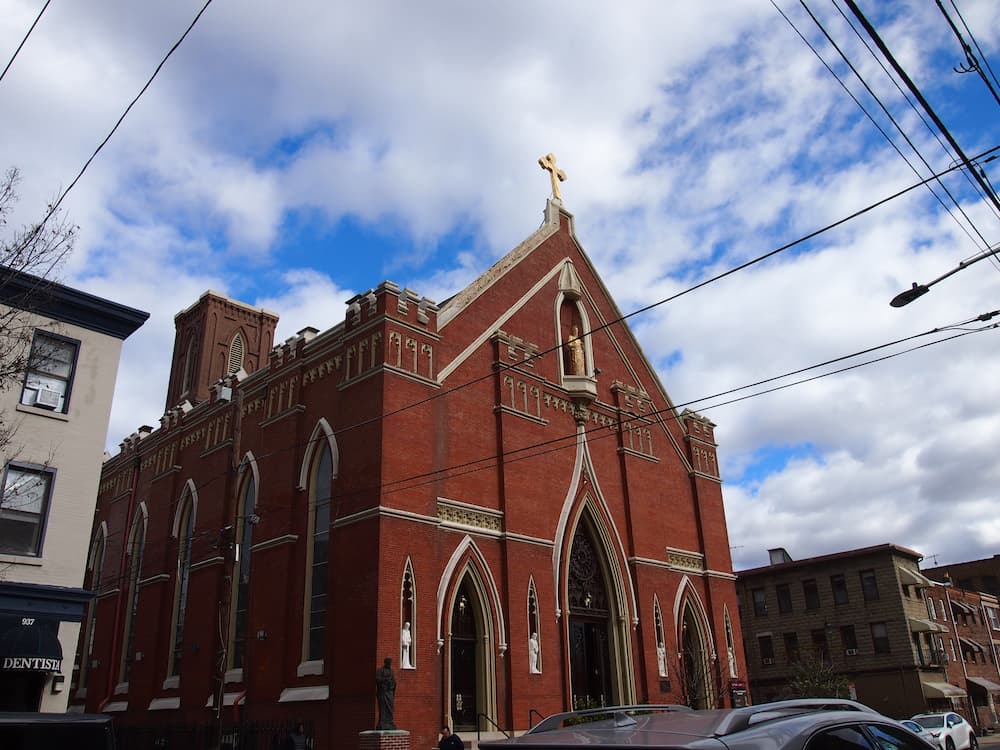
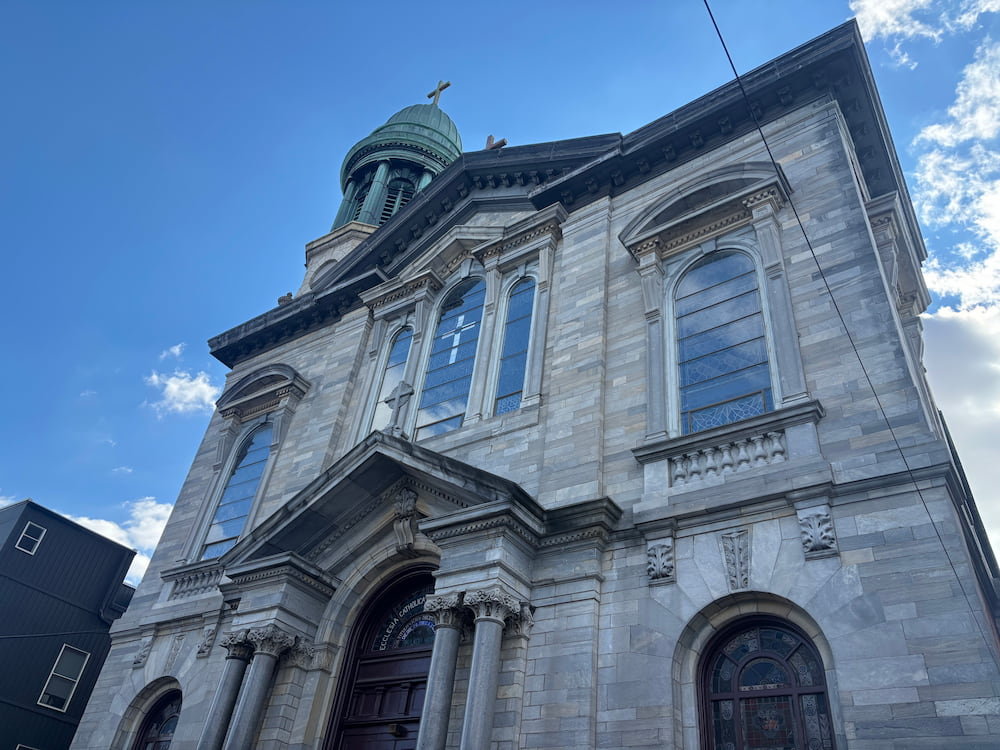
The exterior of St. Paul’s Church is composed almost entirely of red brick, in a gothic revival style. The front door is a pointed gothic style arch, with ornate woodwork including quatrefoil designs and a circle at the top mimicking the style of a rose window.
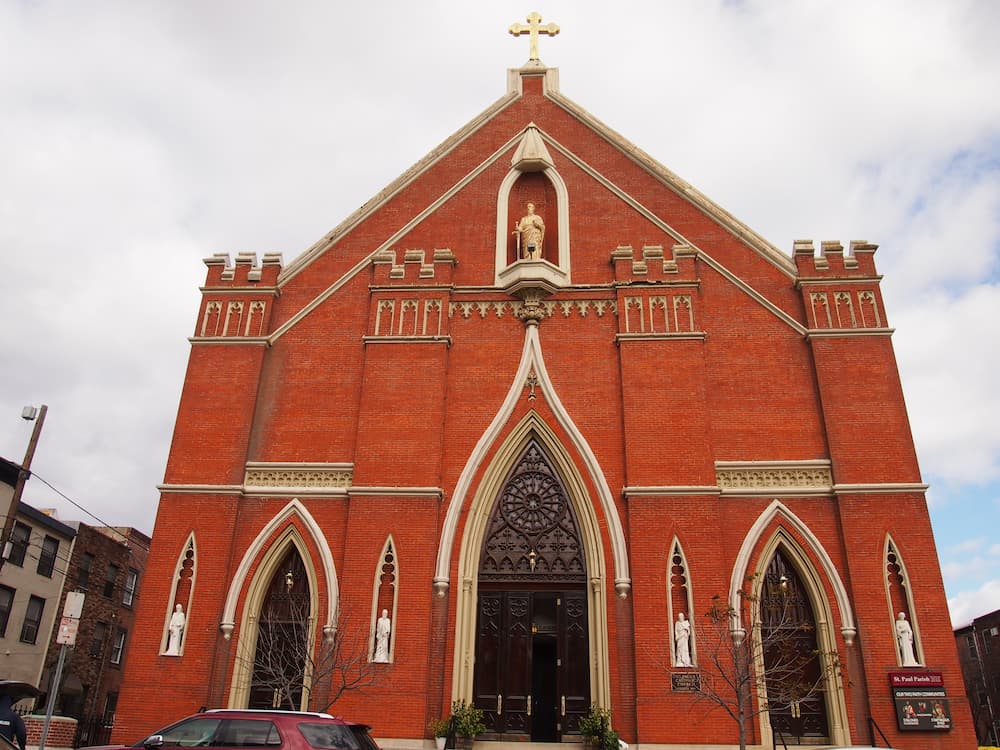
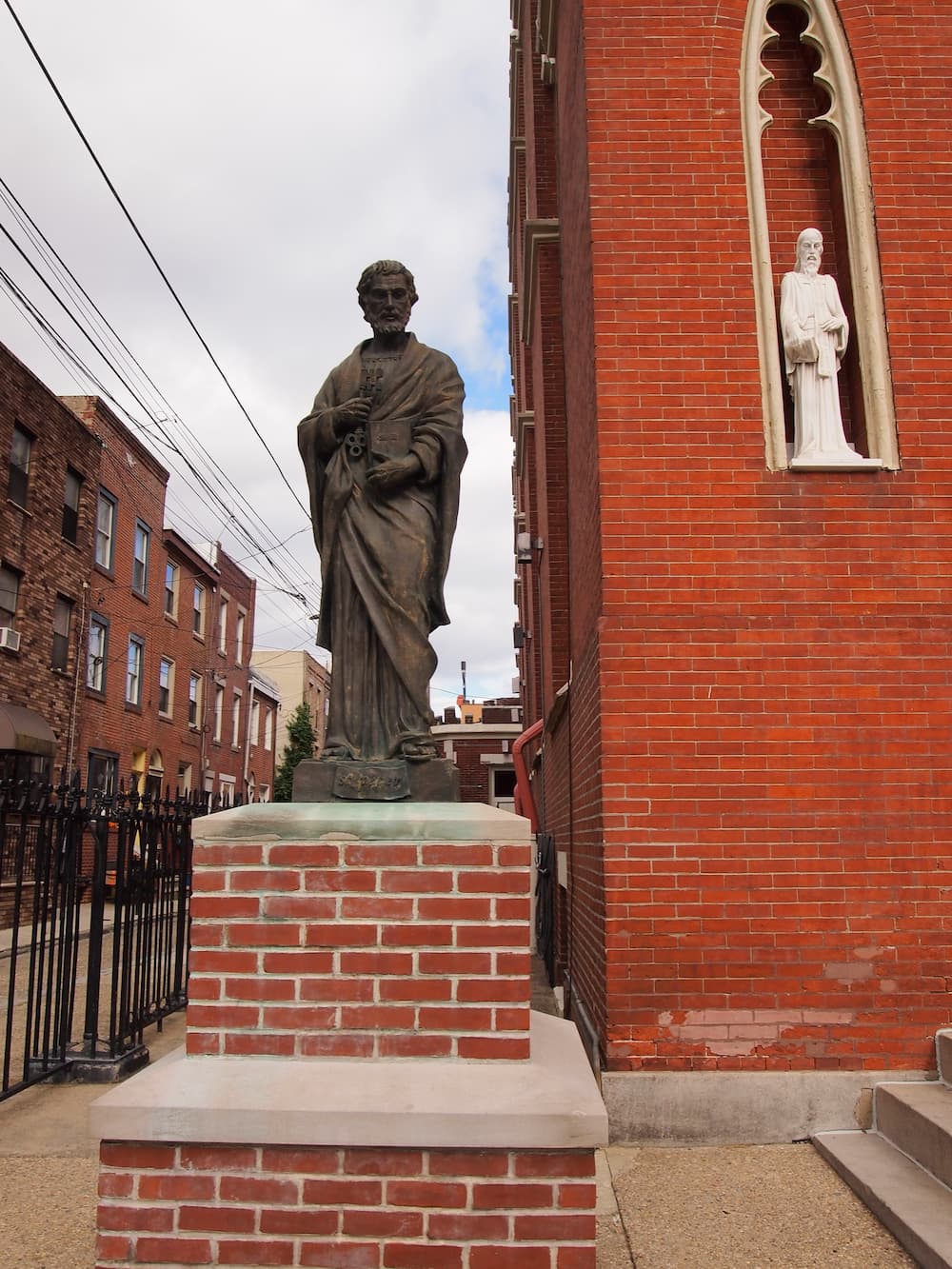
There are two smaller doors made out of the same dark wood on either side of the larger one, which gives it a similar structure to a “serliana” or Palladian window. Outside the church there are statues of two metal statues on either side, one of St. Peter and one of St. Paul. There is another gold statue of St. Paul in a niche above the large middle door.
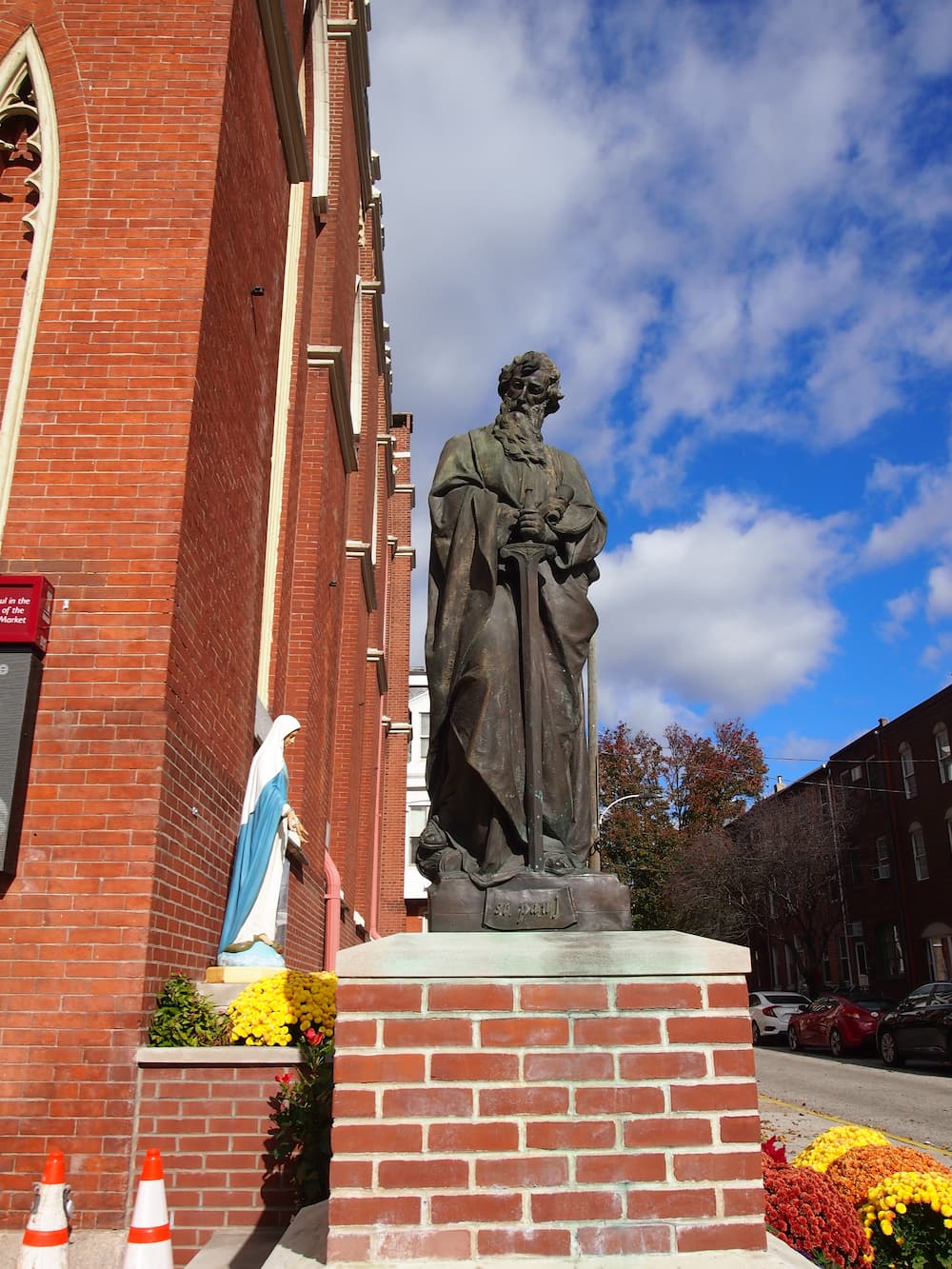
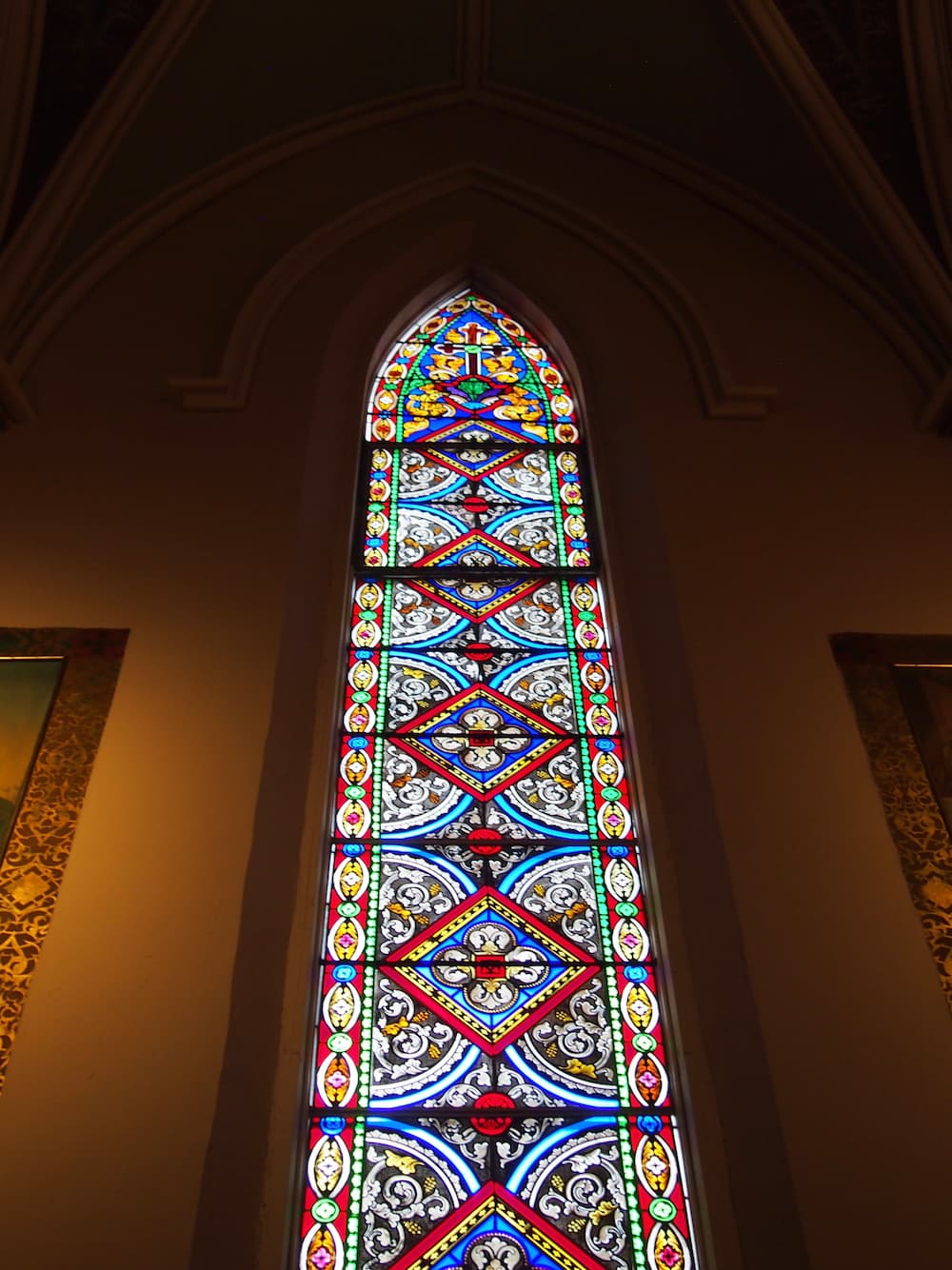
There is also a large gold cross on top of the building, but other than that all of the other decorative elements around the exterior are colored an off-white. On the inside there are six lancet stained glass windows on each wall. The windows on either side of the altar contain portraits, one of a Saint, perhaps Saint Paul, and one of Mary, but the rest are just decorated with quatrefoil designs.
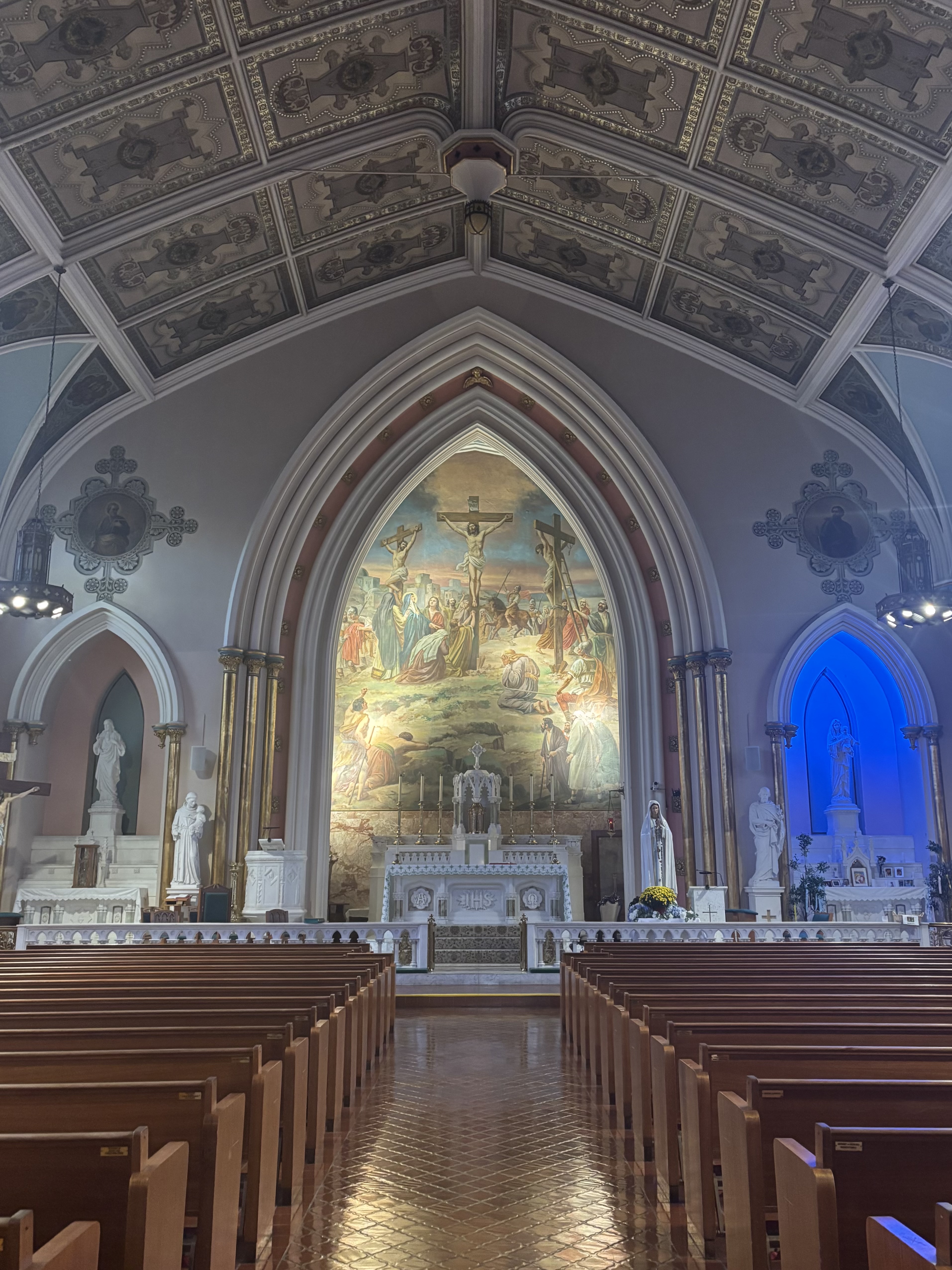
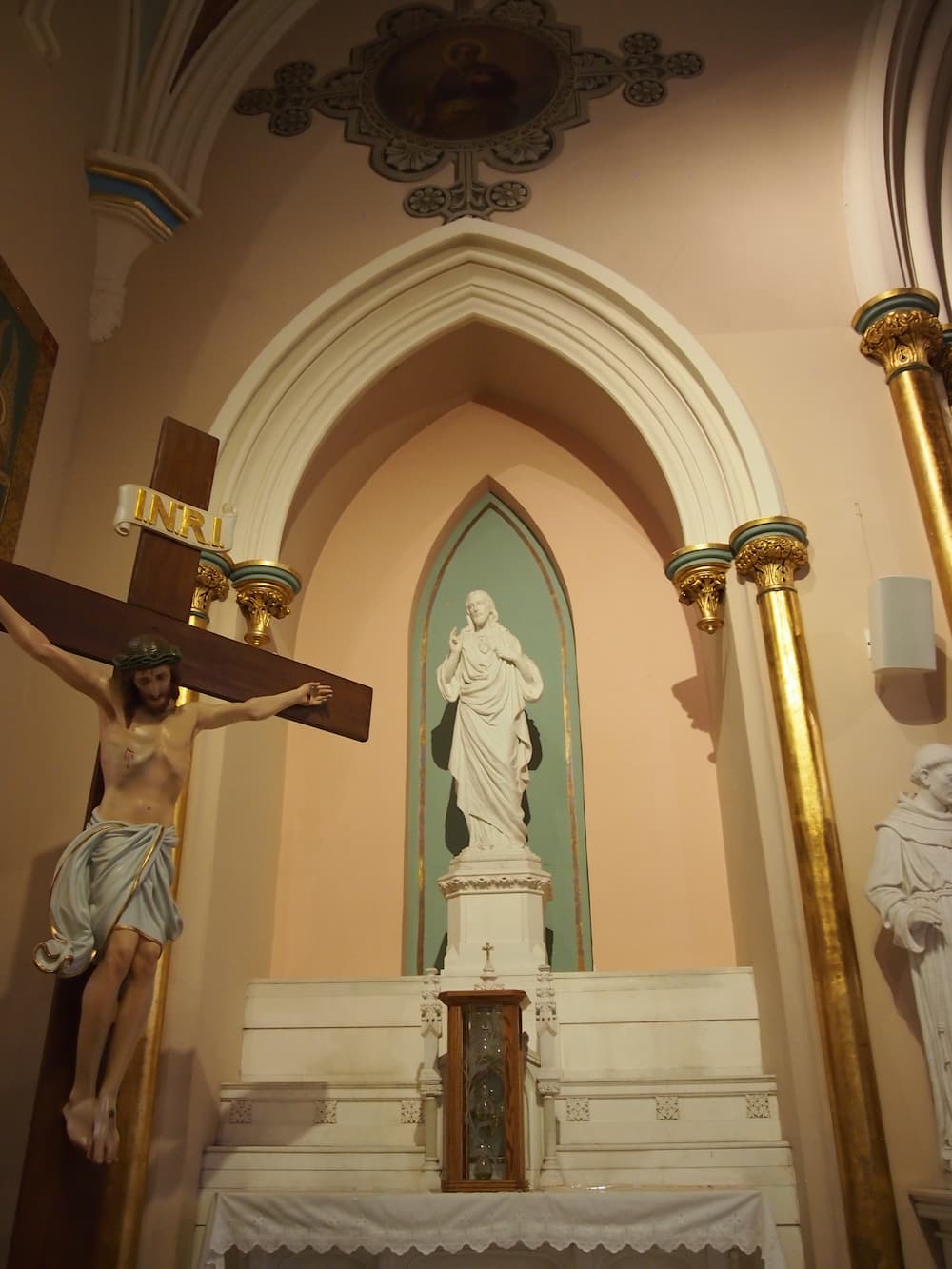
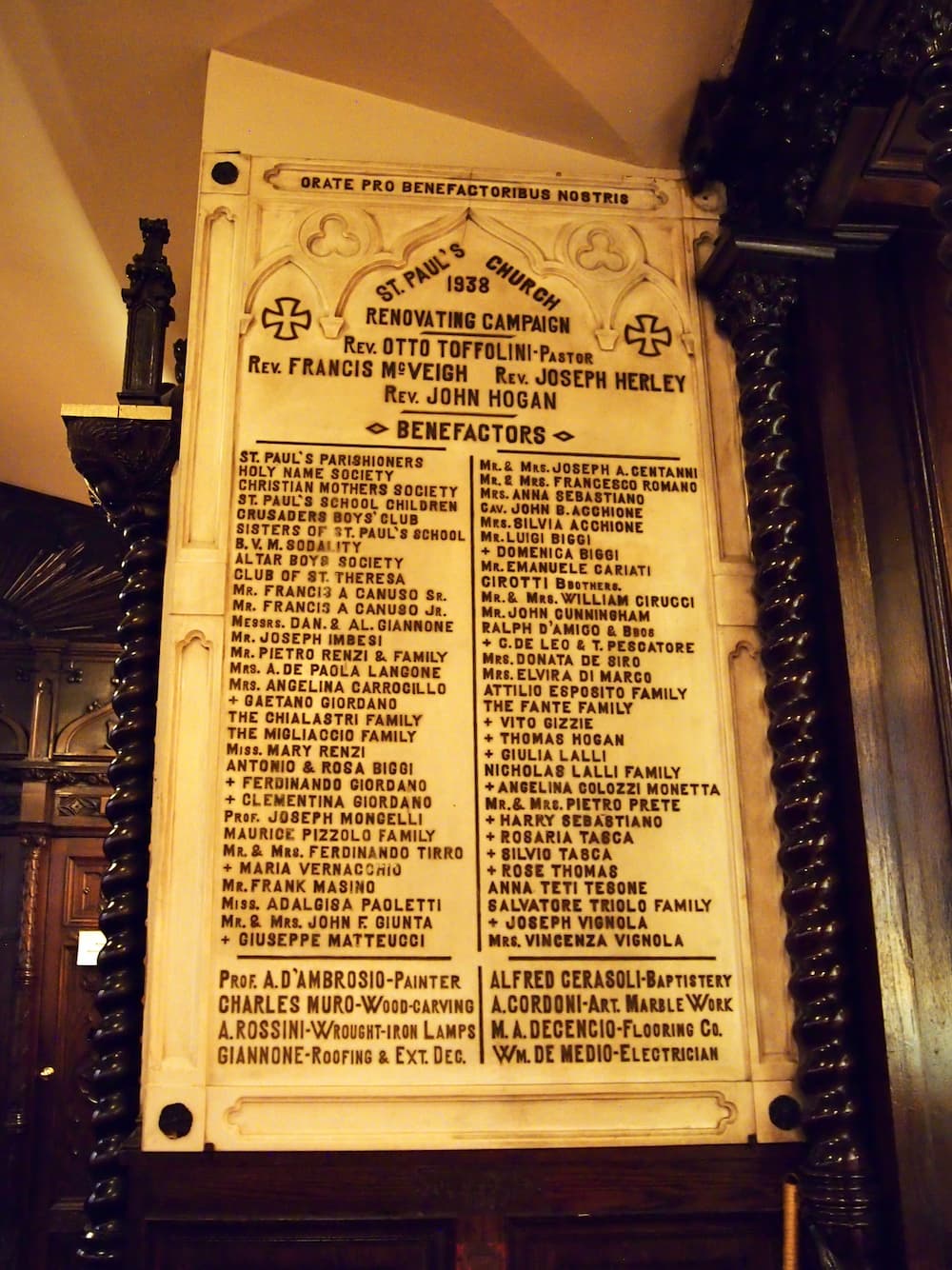
The interior was last renovated in 1938 by Reverend Otto Toffolini, and so most of what we see on the interior was part of that campaign. The most striking element of the church is the three arches up by the altar, framed by columns and set back into the wall. The middle one is larger, again bringing to mind the structure of a Palladian window, and contains a large painting of the crucifixion. The two smaller altars on either side contain statues, one of Jesus, and the other one of Mary holding Jesus as a baby.
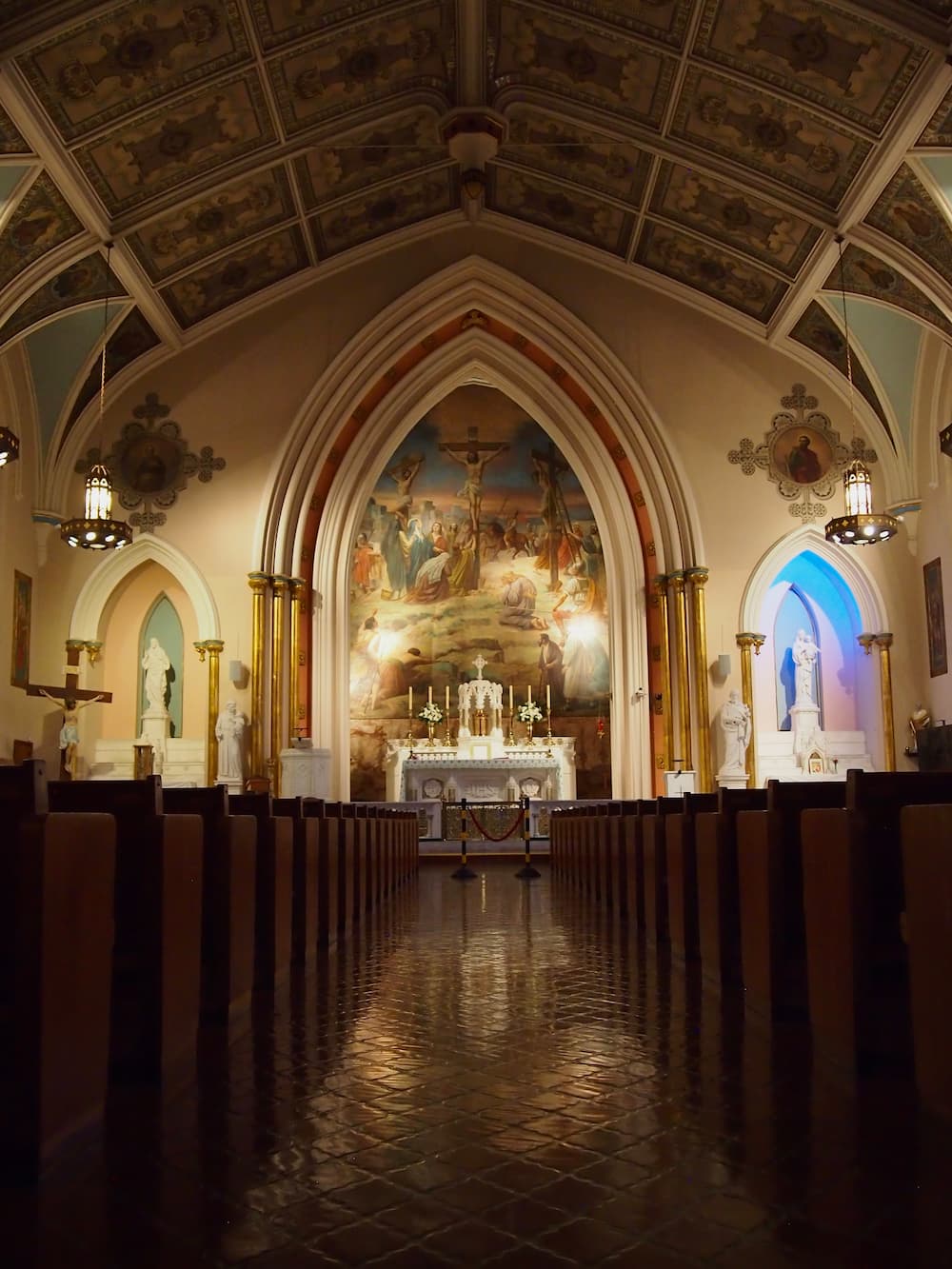
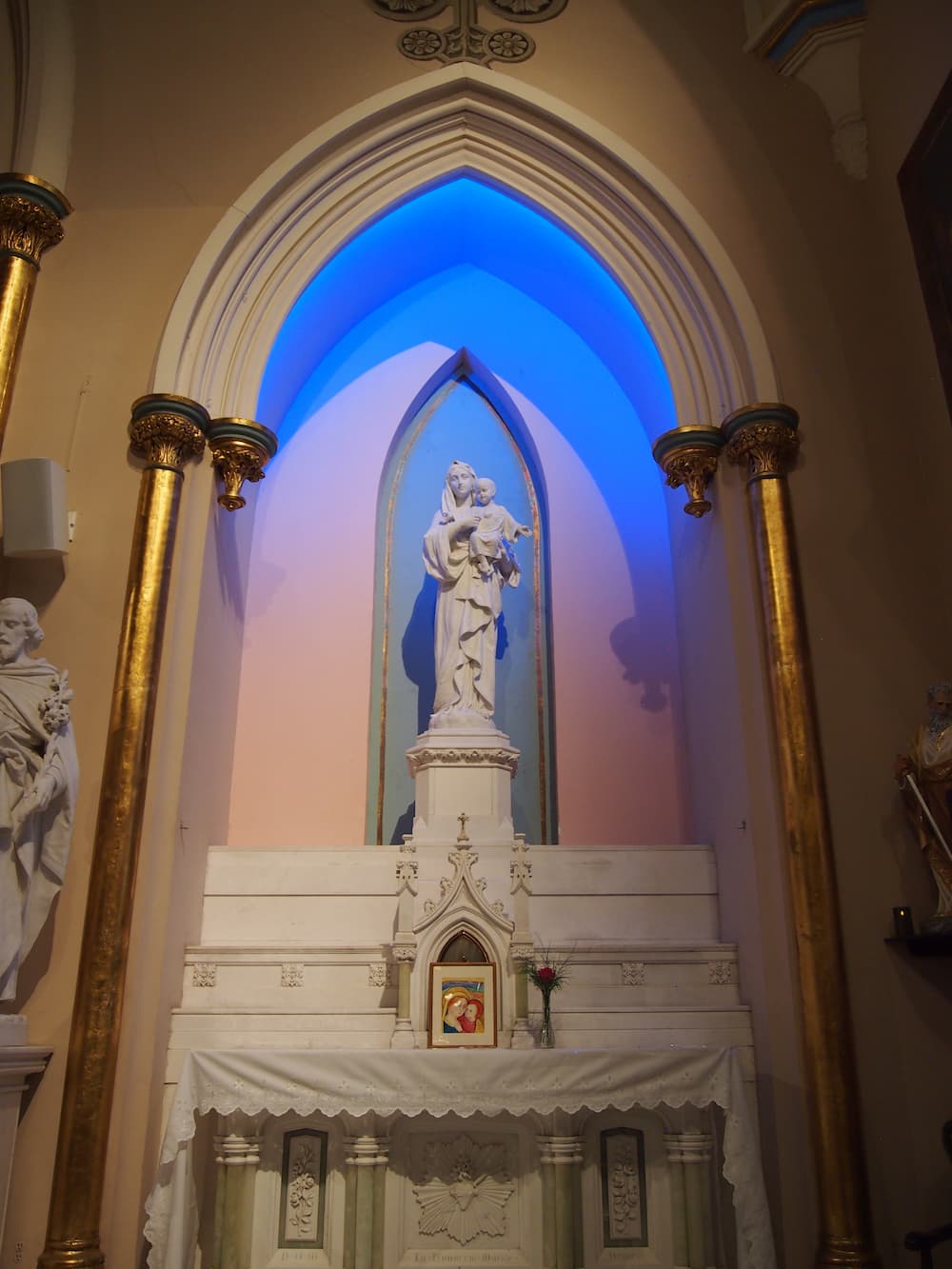
The floor of the altar area is made of marble, a prominent material in many Italian buildings. Along the walls there are eight paintings, four on each wall, done by Professor A. D’Ambrosio, who also painted the crucifixion scene on the altar. These murals detail the life of Jesus from birth, depicting some of the most famous biblical scenes, such as the birth of Jesus and the last supper.
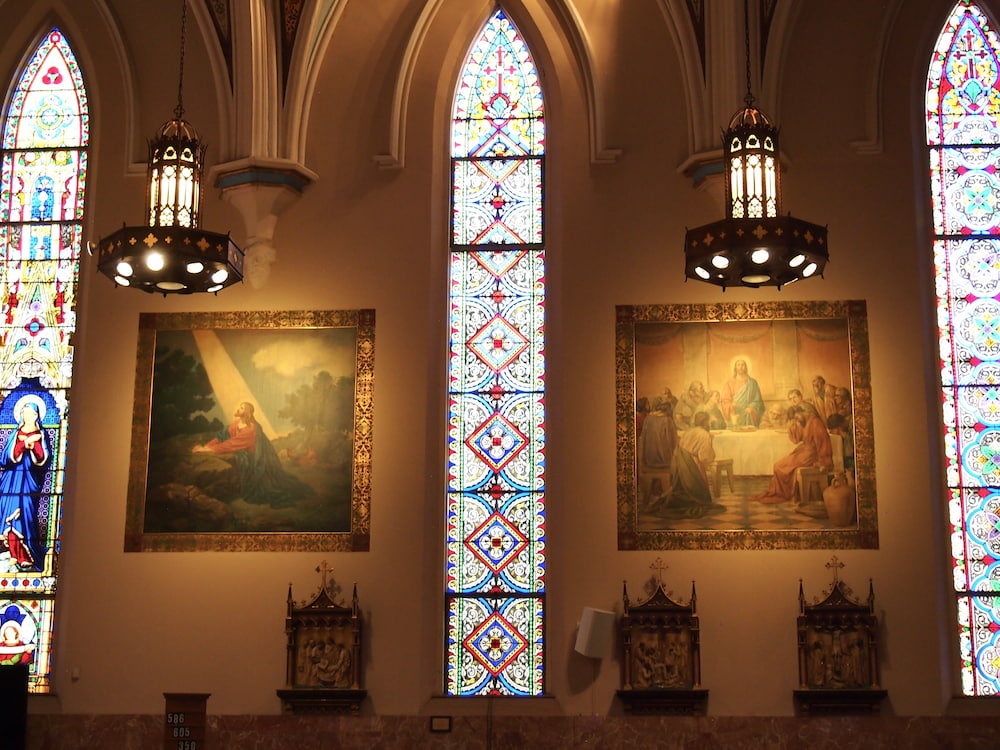
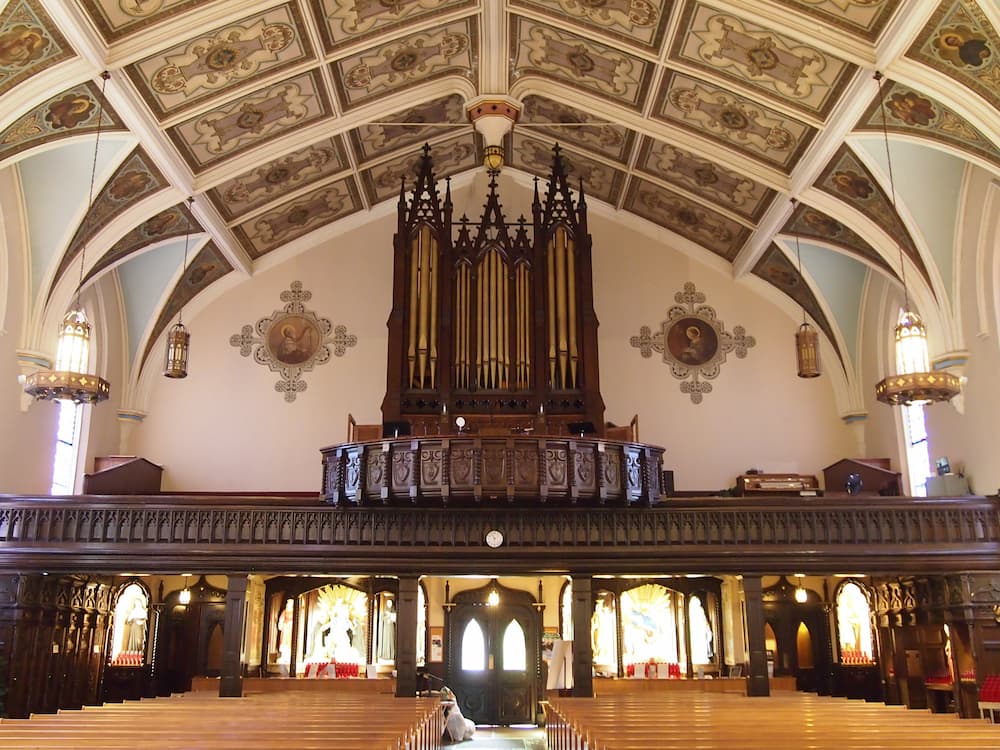
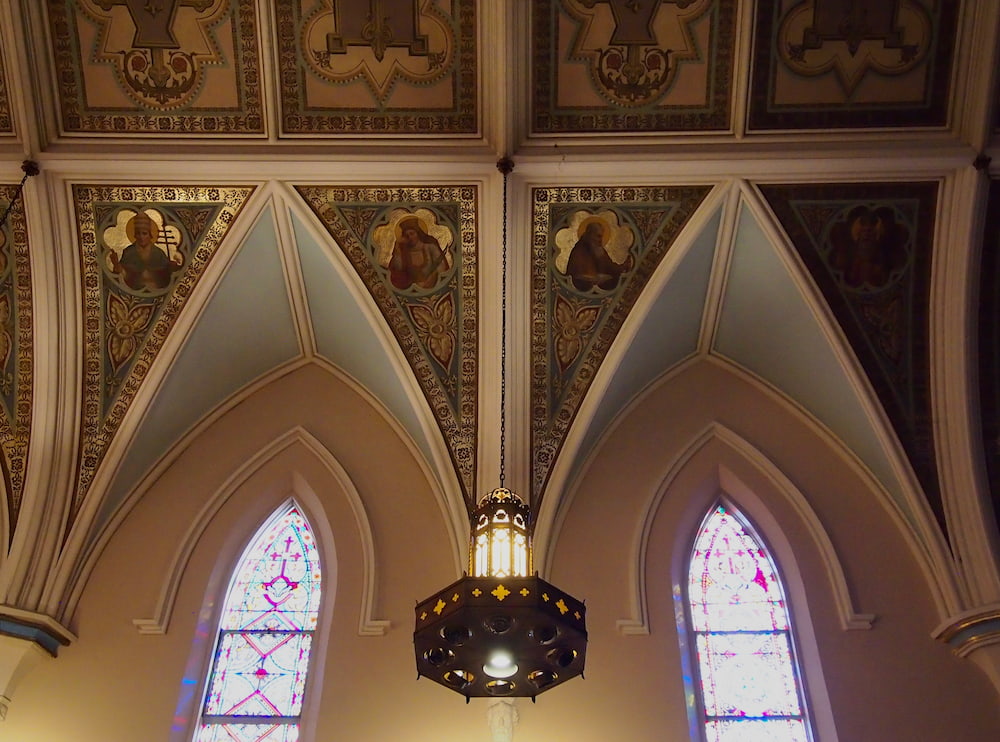
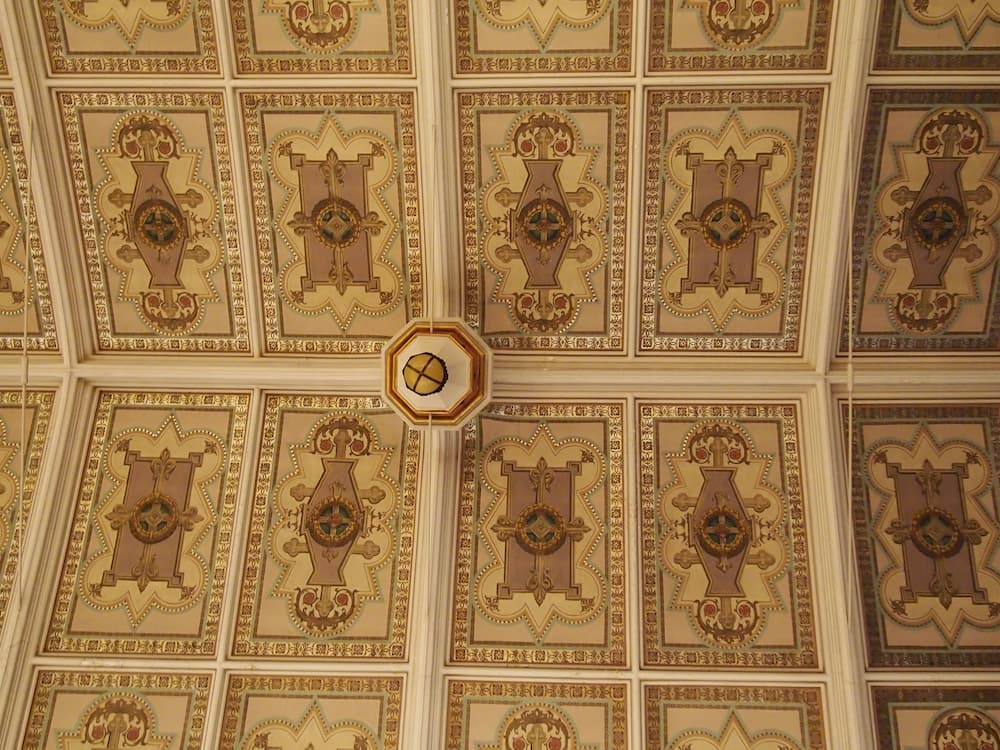
On the ceiling there is more decoration and painting, with portraits of saints on the lowest panels next to the stained glass window. In the back of the church there is a grand organ up above made out of the same dark wood as the doors and much of the other trim inside the church, and it reaches all the way up to the ceiling. In the back of the church are colored sculptures in shrines with votive candles in front of them. Some of these are sculptures of individual saints, and others are scenes, such as the birth and crucifixion of Jesus.
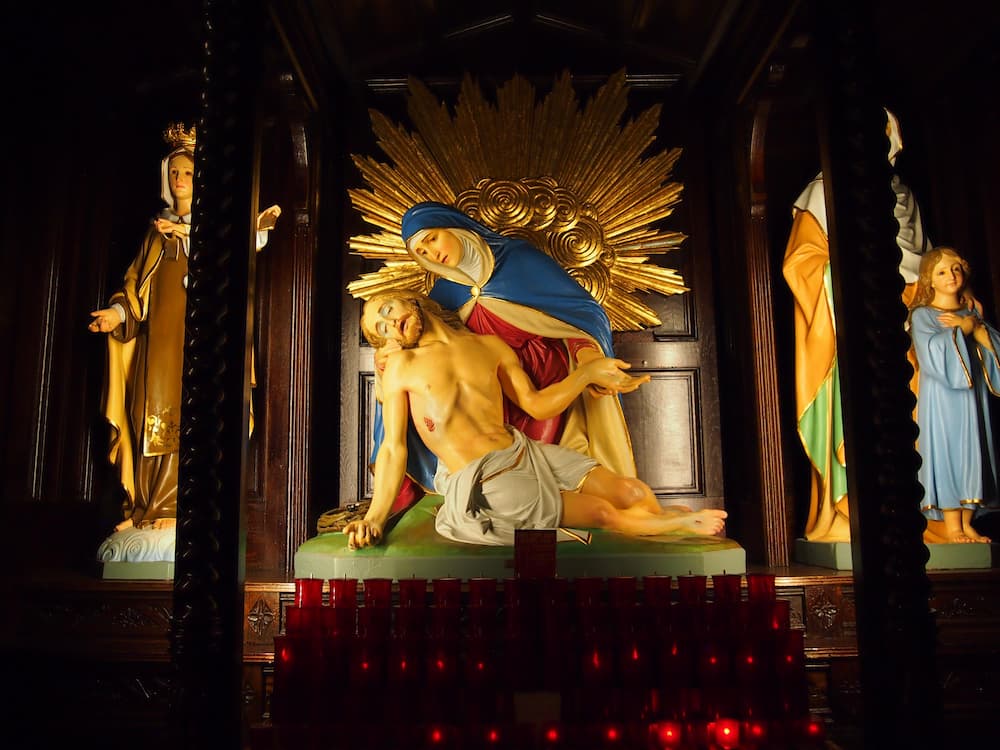
Around the room under the paintings are small sculptural relief scenes. While the architecture is in a Gothic style and not Italian, there is a similar emphasis on symmetry and beauty as seen in many Italian buildings. The arches and ceiling are ornate but still have a beautiful simplicity, making the space feel both grand and functional.
Founders and Artists
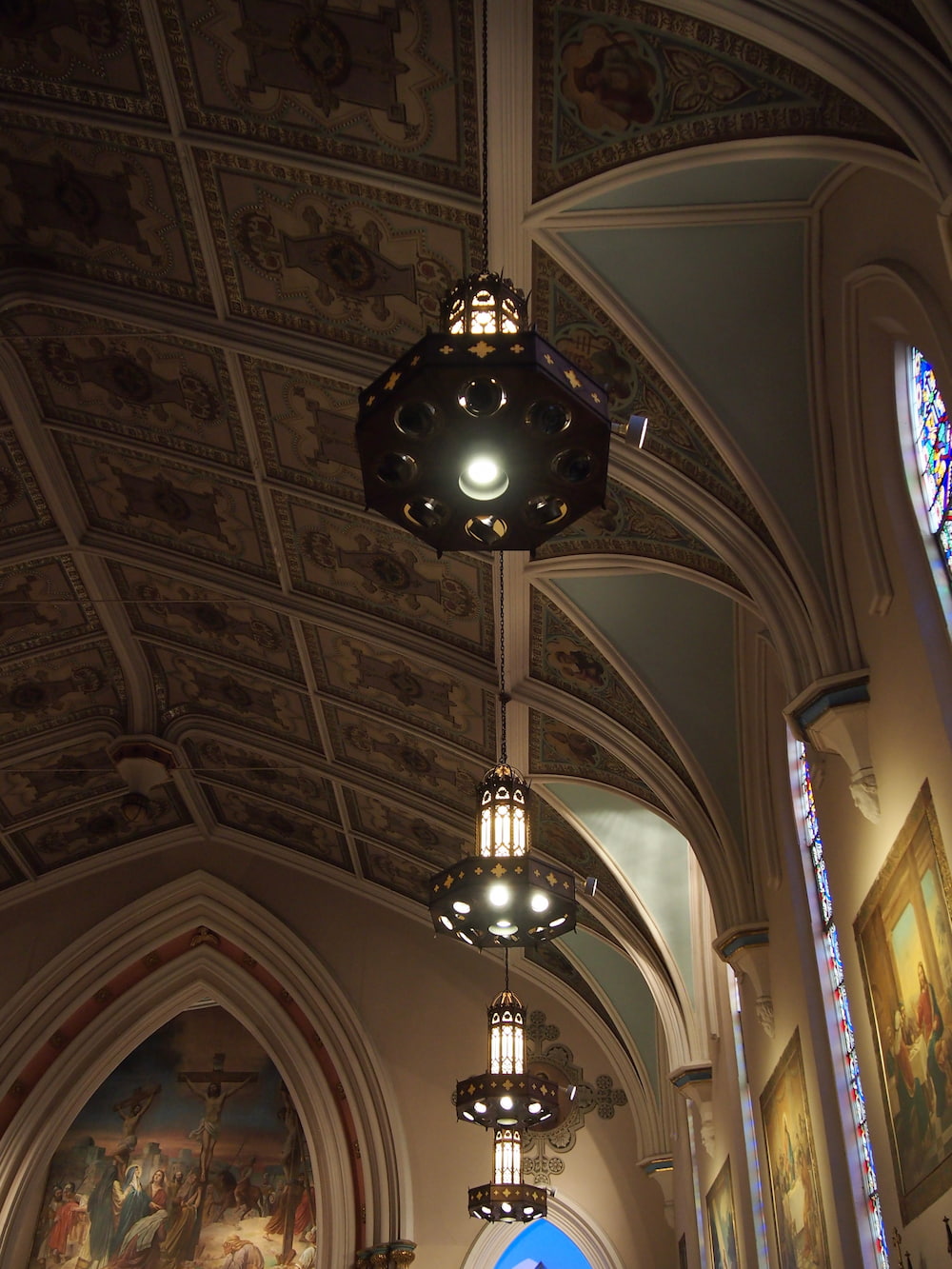
In 1847, St. Paul’s Parish was founded by the authority Bishop Francis Patrick Kenrick. Bishop Francis was born December 3rd 1796 in Dublin, and in 1814 went to Rome to study languages and scripture, receiving money for tuition from Pope Pius VII. He was then sent to Philadelphia to “restore discipline in the diocese of Philadelphia,”1 and was consecrated titular bishop of Arath on June 6th 1830. Bishop Francis was essentially overseeing all of the communities of the faithful in Philadelphia, and therefore had to approve the founding of St. Paul’s Parish, and was the person who conducted the dedication ceremony in 1847. However, the person who was in charge of organizing the construction of the church was Reverend Patrick F. Sheridan. Reverend Patrick was also the first pastor of the church, and was from Northern Ireland. The original architect of the building was John E. Carver, whose designs for the church date back to 1843. Carver was born in 1803 and lived in Philadelphia, and was known for being an advocate of Gothic style architecture. The original plans for the church were adapted during construction by William Kernan, about whom there isn’t a lot of information online. John McArthur Jr., best known as the architect of City Hall, designed the rectory of the church. The interior of the church is very elaborate, decorated with murals, marble, iron lanterns and woodwork. The baptistry was done by Alfred Cerasoli and the marble work by A. Cordoni, the iron lanterns were designed by A. Rossini and the woodwork was done by Charles Muro.
At one point, there were frescoes painted by Filippo Costaggini, a Roman artist who came to the U.S. to finish the frescos in the Capitol Building that Brumidi had started. In addition to painting the frescoes in St. Paul’s Catholic church, he also painted in Cathedral of Saints Peter and Paul, Old St Joseph’s, St Ann’s, and more. However the original Costaggini frescos were painted over by Professor Anthony D’Ambrosio.
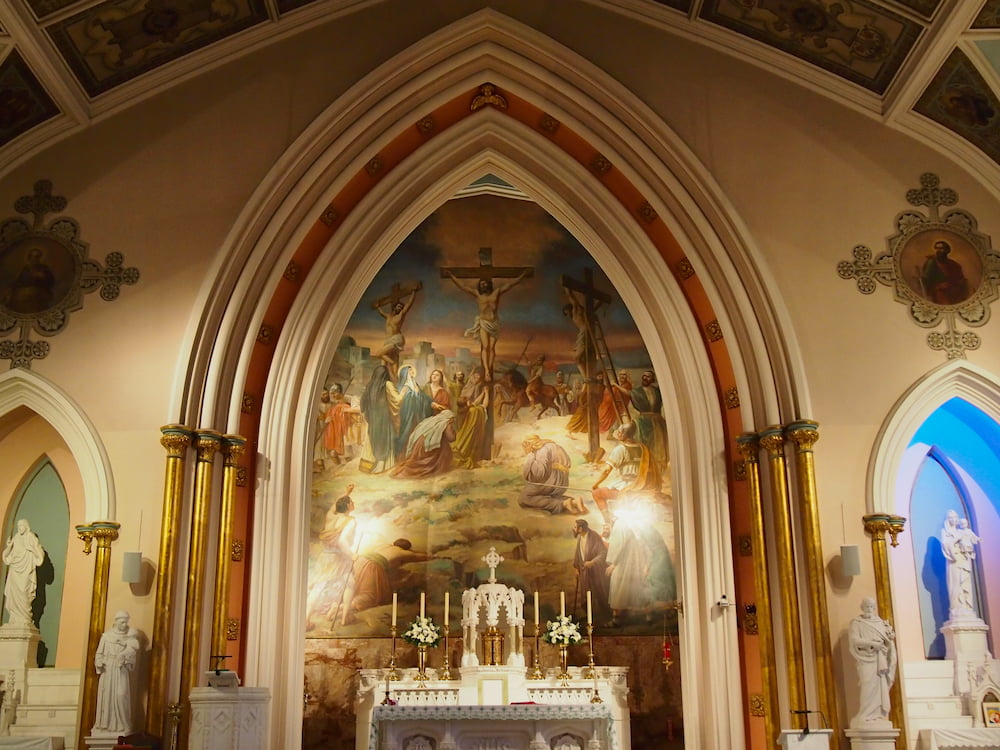
These elements discussed above were added by Father Otto Toffolini in 1938. Father Toffolini was the first pastor of Italian descent at St. Paul’s. He wanted to renovate for the 100th anniversary of the church, and raised the money to do so by having people commission their favorite saints to be painted on the ceilings.
In 1946 parishioners donated $20,000 for a new organ to replace the original organ from 1866. The most recent renovation was done for the 125th anniversary.
Location and Relationship with the Environment
St. Paul’s Catholic Church is located on 923 Christian St in Philadelphia, PA. Reverend Sheridan was in charge of picking the location, and he knew that he had to be strategic in picking this location. Christian street existed as early as 1787, and was a major street that is long, wide, and runs from the Schuylkill to the Delaware. More importantly the street is busy, and has many shops and businesses. Christian street is in Moyamensing, a township founded by the Swedish immigrants that came to the area, and the name is from the Native American word for “place of meeting.” Moyamensing Hall, a major governing office, was also on Christian street, and this was a major influence in Reverend Sheridan’s decision to buy the land near Christian street to build the church. St Paul’s Church had its first mass on Christmas in 1843, however due to some anti-religious riots, the church wasn’t completed until 1847. Over time the communities that lived in the Moyamensing area changed. Namely, there was a huge influx of Irish Catholic and Italian Catholic immigrants. There was a lot of separation and discrimination within the environment and community of South Philly in the 1880’s because of these two groups. This tension was reflected in the politics of the church; many Italians lived within the scope of the church however felt that they were not welcome to worship there. The church itself never moved; however it has undergone significant renovations. It also burned most of the way down at least once; in 1861 while Father Sheridan was away visiting Ireland an altar accidentally started a fire which left only the walls. Today, the area around the church is thought of as the “Italian Market,” a rich community with many businesses founded by primarily Italian, Hispanic, and Asian immigrants.
Materials, Construction, and Supervisors
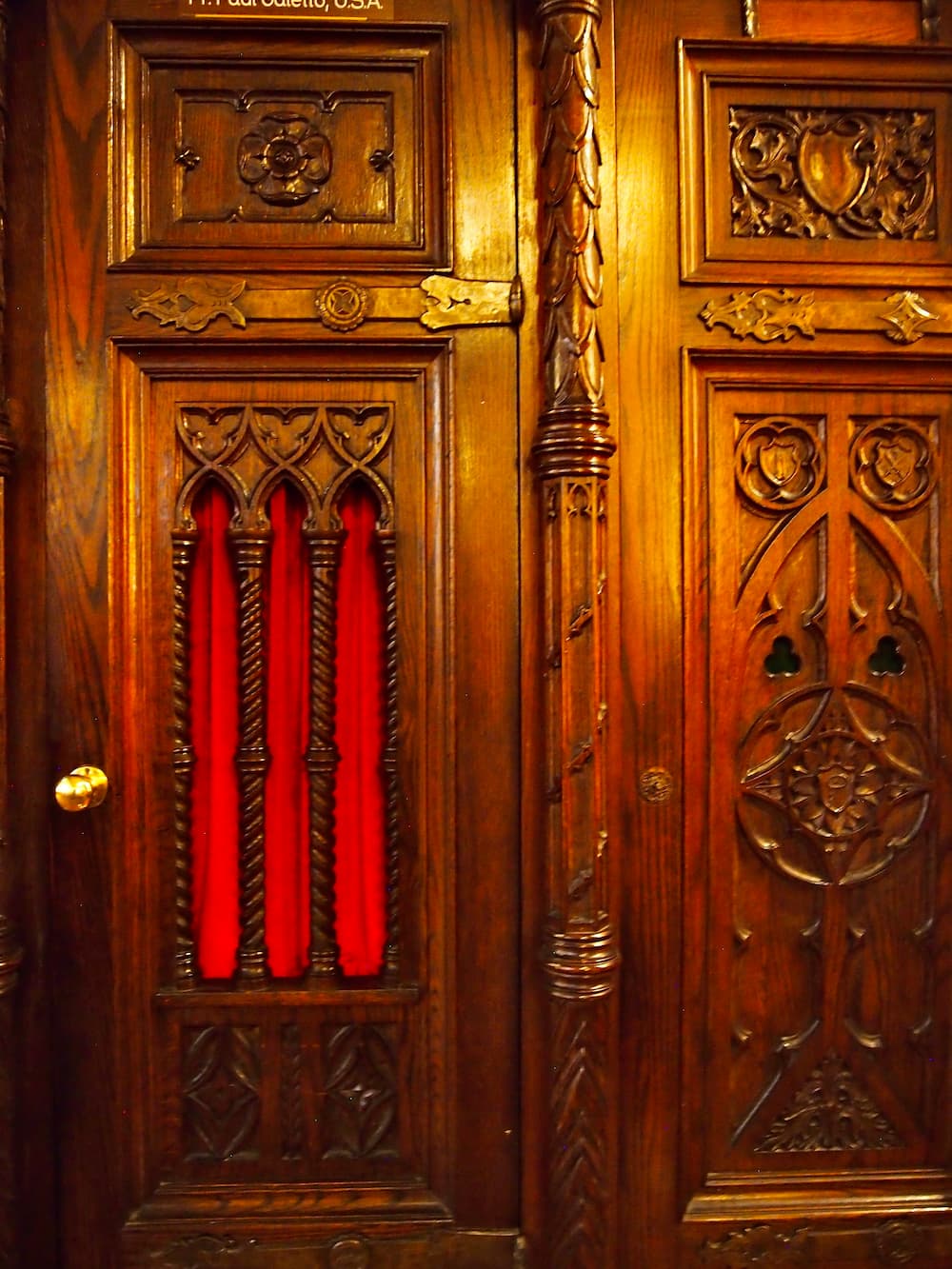
St. Paul’s Church has been through a few different renovations, and so the items and materials inside have not remained consistent. Work on the church was started after Bishop Kenrick blessed the cornerstone on May 7, 1843, although the building of the church was mainly supervised by Father Sheridan. The church, as discussed in the description section, is made mostly of red brick which is very striking against the white and gold of the decorative elements on the outside. Although the building and assembly started in 1843 it went quite slowly, in part as a result of the community it served being immigrants without excessive amounts of money to donate. The main recent renovation was supervised by Father Otto Toffolini. Included in the materials and techniques visible in the church today is marble work on the altar, stained glass windows, wrought iron lamps, statues on the interior and exterior, marble on the floor of the altar, paintings, small sculptural relief scenes, and wood carving for some of the statues, confessional booths, trim, and base of the pipe organ.
The history of the building and renovations of this church are extensive, with many people involved in all different aspects. It is difficult to untangle all the techniques and elements used in this building, as it is a culmination of many different renovations and many eras of history.
Evolving Function
St. Paul’s church was created because Bishop Francis Patrick Kenrick felt that there was a need for a new parish in the newly improved and quickly growing district of Moyamensing. It is the 12th oldest church in Philadelphia, and was named after St. Paul who became an Apostle after the Christian religion had been established and was important in spreading the religion. The missionary life of St. Paul is highly symbolic for the church, as its mission was to ensure that the religion of the immigrants can be maintained in the Americas. It is also interesting to note that Saint Paul has been criticized within Christianity for associating with and being influenced by Pagans, and Italian Catholics have also been criticized for their religious practices being too Pagan.2 Before the 1890’s, many parishes in Philadelphia were dominated by Irish Catholics. As a consequence other ethnic groups were often not welcome in the established churches, leading to the creation of “national parishes.” These were churches designated for immigrants of a particular nationality, and by 1900 it is documented that there were German, Polish, Slovakian, Lithuanian, and Italian national parishes. In the case of St. Paul’s church, the surrounding area was populated predominantly by Italians. The Irish Catholics did not welcome the Italians who lived there into the church, and their relationship is discussed on page 94 of “Beyond history : the times and peoples of St. Paul’s Roman Catholic Church, 1843 to 1993,” a book written by Celeste A. Morello in 1992. She describes “…the stabbings around the church … the Irish were stabbing the Italians so they’d keep away … The Italians would complain to the Bishop, but he didn’t do anything until the Italians fought back with those stilettos, then the Bishop listened…”3 The discrimination also took more forms than just violence. During the 50th anniversary renovation, no one acknowledged that the paintings were done by a well known Italian artist, and instead gave Father McGlinn all the credit.
The dynamics between the Italians and other immigrants within religious Philadelphia institutions has also been studied by Richard N. Juliani, a sociology professor at Villanova. In chapter 1 of his 2007 book, “Priest, Parish, and People: Saving the Faith in Philadelphia’s ‘Little Italy,’” he talks about the founding of St. Mary Magdalene de Pazzi in 1852 by Bishop John Neumann. St Mary Magdalene de Pazzi, named after a sixteenth-century Florentine Carmelite nun, was the first Italian national Parish in the United States. The original site was “a small chapel and adjacent cemetery, previously owned by African American Methodists,” and was originally described plainly as “Church for the Italians.”4 The modern building of St. Mary Magdalen de Pazzi was built in 1891 and designed by distinguished architect Edwin Forrest Durang.
Edwin was an extremely dedicated church architect in Philadelphia who specialized in eclectic design. There is also Italian architectural influence in Edwin’s designs; for example, there is a faux Palladian window at the top of the front of the church. The interior of the church also has a lot of Italian influence. There are several replicas of preserved Italian artworks from the Renaissance. On the main apse there is a replica of “The Crucifixion of Jesus,” the original of which was painted by Guido Reni for the high altar of the Basilica of St. Lawrence in Lucina in Rome in 1639-40. Within the main altar, there is a ceramic tile rendition of the fresco “The Last Supper”, originally painted by Leonardo Da Vinci in 1495–98 for the refectory of the Convent of Santa Maria delle Grazie in Milan, Italy. On the ceiling there is a replica of “The Assunta, or Assumption of the Virgin”, the original of which was designed for the high altar of the Basilica Santa Maria Gloriosa dei Frari in Venice and painted by Titian in 1516-18.
However, St. Mary Magdalene de Pazzi church wasn’t adequate for the community. Many Italians lived within the bounds of St. Paul’s; and felt that they should be able to worship there instead of traveling further to St. Mary Magdalene’s. The shift in attitude towards the Italian community is reflected in the records, Anna Petronelli was the first Italian to be baptized at St. Paul’s and Father Otto Toffolini, who came to St Paul’s in 1932, was the first pastor of Italian descent. St. Mary Magdalene de Pazzi was closed as an official parish in 2000, and is used as a worship site once a week for St. Paul’s. Our course is divided into 3 conceptual phases; how the pioneers of America took inspiration from Italian arts and culture, the mass migrations of Italians to Philadelphia in the late 1800’s, and how their culture blended with that of the Americans to turn Philadelphia into the ‘Global City’ it is today. The evolution of St. Paul’s Parish aligns perfectly with these ideas. The original art and architecture of St. Paul’s had Italian aristocratic influence, yet the poor immigrants from the 1880s were not allowed in the church. Today, the parish encompasses both St. Mary Madalene de Pazzi and St. Paul’s churches, and serves all of the diverse immigrant populations of the Italian market.
Interpretation of Idea and Message
This church has always been an important part of the community around South Philadelphia, although its message has shifted over time. In the early days of the church, its outreach and association extended beyond just mass services. Father Sheridan built a school near the church, which later developed into the Church of Our Lady of Good Counsel. St. Paul’s was also across the street from Commissioners Hall, which had been used as a hospital for wounded soldiers during the civil war and for people with smallpox during the epidemic, and St. Paul’s eventually ended up purchasing it and turning it into a convent for the Sisters who taught at the school. The church was incredibly central to the community, although as we have discussed it was mostly for the Irish immigrants when it was formed and it did not send the message of being open and welcoming to the entire community. This started to shift as more Italians started arriving in South Philadelphia. In 1898 a new school was built adjoining the convent in Commissioners Hall, which served around 800 children of Italian ancestry and nativity. This started building more connections between the churches and schools in the area, joining the originally Irish Catholic St. Paul’s to the Italian Catholic community. The Madonna House was also created nearby, which was an organization aiding new Italian immigrants, giving them support and access to education and vocational training. St. Paul’s was used for Sunday Mass for the Italian children. Eventually the director of Madonna House, Father Edward J. Lyng, was made pastor of St. Paul’s Church in recognition of his great work for the community, further tying the church to the new Italian immigrant community. 5
In 1932 Our Lady of Good Counsel Church and St. Paul’s Church were consolidated, and both St. Paul’s church and St. Mary Magdalene de Pazzi absorbed the parishioners of Our Lady of Good Counsel and “thus it was that the two churches which had such mutual boundaries and mingling of personalities merged into the thriving St. Paul’s Parish of today. 6 The same year as the consolidation, Father Otto Toffolini was made pastor of St. Paul’s Church, as well as overseer of the Madonna House, ushering in another wave of change and shift in the message of the church. According to the current website of St. Paul’s Parish, Father Toffolini “set about healing many broken hearts and soothing the hurt feelings of others.”7 He spent twenty two years as pastor there, not only integrating the Italian immigrants into the religious community, but making physical changes and renovations reflecting the new Italian American population. Many of the artists in this renovated campaign that we have discussed were Italians or Italian Americans, as were many of the benefactors listed on the renovation plaque still in the church today. The message of the church became more open and welcoming, reflecting the community that it served.
Today the message of the church continues to be welcoming towards the entire community. They are still open every day, with Mass once a day on weekdays, and three times a day on Sundays, and are generous to anyone who may want to wander in. We visited twice, and were invited to take part in an activity they were doing to honor dead loved ones, and encouraged to take as many pictures as we wanted. The church does the Procession of the Saints, which is now a classic tradition in the Italian Market and has origins in the traditions of Italian immigrants. Both St. Paul’s and St. Mary Magdalen de Pazzi Church are now part of the same Parish, which sends the message of the churches being more united, instead of existing only to serve separate sections of the community as was the case when these churches were founded. St. Paul’s Church holds many religious events which can be found on the bulletins in the church and online, and are very focused on building community. They have programs for homeless people and people with limited mobility, and also emphasize that they welcome anyone, including and especially people who might not traditionally be welcomed in a Catholic church.
We have discussed Philadelphia as a palimpsest. Celeste Morello, author of Beyond history : the times and peoples of St. Paul’s Roman Catholic Church, 1843 to 1993 said in the introduction to her book, “When Father Michael Gambone asked me to write St. Paul’s history, I never expected to have to communicate with six states, Washington, D.C. and Northern Ireland as well as have to translate information from Latin, French and Italian. Few, if any parishes would have such history requiring this.”8 (xi) In St. Paul’s Church, from the architecture to the art to the ideas, there are traces of many different cultures that immigrants to Philadelphia brought with them. It is as remarkable an example of a palimpsest as any other in Philadelphia. While the original architecture is in a Gothic style, not Italianate, and while the architectural and artistic foundation was constructed by the Irish Catholic immigrants, the Italian immigrants have clearly made their mark and have been integral to the church as we know it today. We see this in the art on the walls, the marble on the floor of the altar, the parishioners that have donated money, but most of all in the strong community-based legacy that the church continues to hold today.
Footnotes
-
Morello, Celeste A. Beyond History: The Times and Peoples of St. Paul’s Roman Catholic Church, 1843 to 1993, 1992. ↩
-
Hartog, Paul. 2000. Review of Paul and the Pagans. Faith Baptist Theological Seminary. March 2, 2000. https://faith.edu/faith-pulpit/posts/paul-and-the-pagans/. ↩
-
Morello, Celeste A. Beyond History: The Times and Peoples of St. Paul’s Roman Catholic Church, 1843 to 1993, 1992. ↩
-
Juliani, Richard N. Priest, Parish, and People: Saving the Faith in Philadelphia’s “Little Italy,” 2007. ↩
-
“History – St. Paul Parish,” n.d. https://stpaulphilly.org/history/. ↩
-
“History – St. Paul Parish,” n.d. https://stpaulphilly.org/history/. ↩
-
“History – St. Paul Parish,” n.d. https://stpaulphilly.org/history/. ↩
-
Morello, Celeste A. Beyond History: The Times and Peoples of St. Paul’s Roman Catholic Church, 1843 to 1993, 1992. ↩
Works Cited
“Durang, Edwin Forrest (1829-1911) – Philadelphia Architects and Buildings,” n.d. https://www.philadelphiabuildings.org/pab/app/ar_display.cfm/23154.
Geoghegan, Patrick. “Kenrick, Francis Patrick.” Dictionary of Irish Biography, October 2009. Accessed November 24, 2025. https://www.dib.ie/biography/kenrick-francis-patrick-a4507.
Haas, Kimberly. “History May Lie Deeper Under a Church Rectory in South Philly.” Hidden City Philadelphia, April 24, 2025. https://hiddencityphila.org/2019/07/history-may-lie-deeper-under-a-church-rectory-in-south-philly/.
Hartog, Paul. “Paul and the Pagans - Faith Pulpit.” Faith Pulpit, March 2, 2000. https://faith.edu/faith-pulpit/posts/paul-and-the-pagans/. “History – St. Paul Parish,” n.d. https://stpaulphilly.org/history/.
Juliani, Richard N. Priest, Parish, and People: Saving the Faith in Philadelphia’s “Little Italy,” 2007. https://research.ebsco.com/c/ti7mx7/ebook-viewer/pdf/gjo5i23obr/page/pp_9.
Maiorano, Grace. “St. Paul Parish Celebrates 175th Anniversary.” Medium, October 18, 2018. Accessed November 24, 2025. https://medium.com/south-philly-review/st-paul-parish-celebrates-175th-anniversary-a513107397c5.
Morello, Celeste A. Beyond History: The Times and Peoples of St. Paul’s Roman Catholic Church, 1843 to 1993, 1992. https://digital.library.villanova.edu/Item/vudl:423420#?xywh=-2630%2C1425%2C6901%2C3363&cv=18.
“Procession of Saints – South 9th Street Italian Market,” n.d. https://italianmarketphilly.org/italian-market-festival/procession-of-saints/.