South Philly Musicians Remix (reenvisioning) Item Info
- Title:
- South Philly Musicians Remix (reenvisioning)
- Creator:
- Eric Okdeh
- Subjects:
- mural
- Location:
- South Philly Musicians Remix (reenvisioning)
- Latitude:
- 39.93085
- Longitude:
- -75.16856
- Source:
- https://publicartarchive.org/art/South-Philly-Musicians-Remix-reenvisioning-/d8db4899
- Rights:
- South Philly Musicians Remix copyright 2016 City of Philadelphia Mural Arts Program / Eric Okdeh, Broad & Tasker Streets. Photo by Steve Weinik. This image, which is under copyright, is displayed on this website for educational and scholarly purposes.
South Philly Musician Remix
A New Mural Unveiled
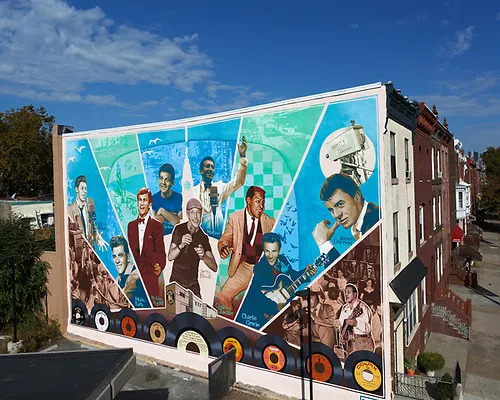
“South Philly Musicians Remix (reenvisioning)” is a brightly colored mural created by artist Eric Okdeh. It sits on the South facing side of the building located at 1532 S. Broad Street . It depicts eight musicians of South Philly origins who gained popularity during the 50s and 60s: Frankie Avalon, Chubby Checker, Fabian Forte, Al Martino, Bobby Rydell, Jerry Blavat, Charlie Gracie, and James Darren. The background of the mural is bright blue and teal, and it is overlaid with depictions of these musicians. The musicians are colored in faded brown and grey colors, giving it a vintage tone, which is nostalgic to the era they are from. The primary material used for this mural was acrylic paint. Mural Arts Philadelphia, the public art program behind this mural, reports that the average amount of paint needed for one mural of this size is about 30 gallons. The wall was restored prior to the creation of the mural, which improved the quality and durability of the mural. The eye-catching colors of the mural reflect the liveliness of the depictions and instill a sense of excitement and celebration in the viewer. The bottom rim of the mural is lined with records, which explicitly adds to the appreciation for music, especially music from mid-century America.
The artist of this mural is a man named Eric Okdeh. He is a Philadelphia-based muralist who graduated from Tyler School of Art with a BFA in painting. He focuses on public art, and has mentioned the importance of community and inclusion in art. Besides taking on public mural projects, he also teaches mural workshops for children, teens, adults, and even incarcerated individuals. He has achieved over 100 public art installments globally. He is very focused on the empowering aspect of art, specifically mural making. This is reflected in his large scale works that depict a variety of topics. This mural specifically celebrates a sense of local community and cultural pride. Beyond his artistry, he has been featured in many publications and exhibitions about public art.
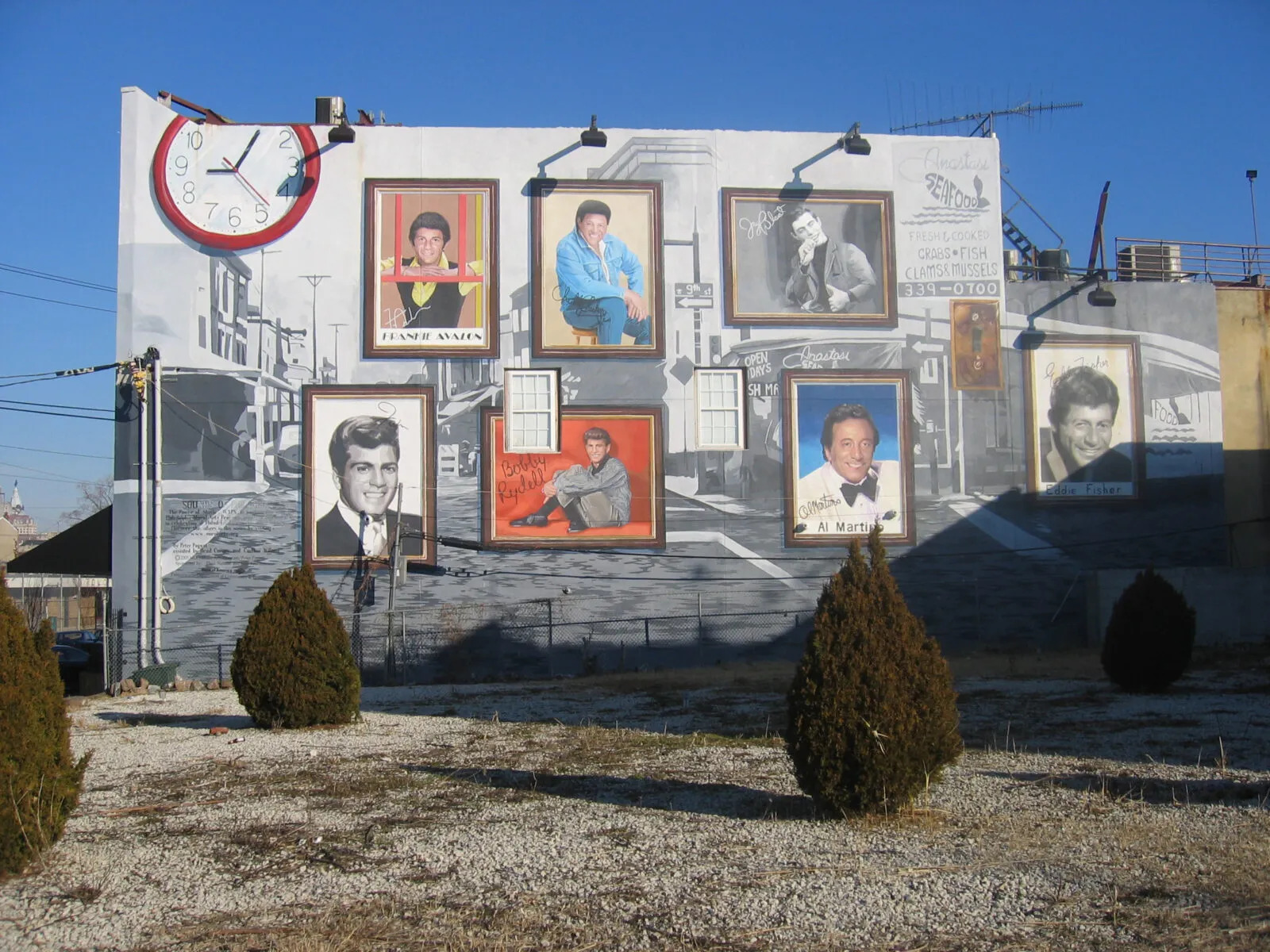
This mural is located at 1532 S. Broad Street. This project was a replacement for a previous mural called South Philly Musicians which was located at 1231 E. Passyunk Avenue. These locations are approximately a 15 minute walk from each other. The original mural was in very close proximity to the Italian markets, while the new mural is off of broad street. Broad street is very highly traveled, so buses, cars and pedestrians pass by this mural constantly. The original mural fell into disrepair due to a lack of maintenance and frequent building repairs nearby. The Mural Arts Program (MAP) decided that the mural could not be restored, so a new mural went into commission. The project was funded and organized by Mural Arts Philadelphia, a local public art program which is responsible for many murals around the city. The The mural was formally announced on June 9, 2016, and received a formal dedication on October 15. The mural was in the process of being created during the summer and fall of that year. According to an article from June of 2016, MAP had raised 65,000 dollars for this project, but the projected budget was close to 75,000 (Johns, 2016). A huge amount of this budget went towards restoration work on the wall itself prior to the installment of the mural. The mural was received very positively by the public. According to a report from the Philadelphia Inquirer, the dedication turnout was around 300, including Frankie Avalon, Jerry Blavat, and Charlie Gracie (Bender, 2016). The dedication showed not just the importance of this mural, but the importance of murals as a part of the culture of Philadelphia in general. At the dedication, Jane Slusser, the chief of staff under the mayor at the time, notably said “Venice has canals and Paris has the Eiffel Tower, but Philadelphia has murals” (Bender, 2016). Philadelphia’s history is very visible in its streets, and murals show important pieces of the city’s autobiography. This specific mural was created as an homage to celebrated musicians with South Philly origins. Specifically musicians who became popular during the Bandstand era, which was an explosion of American youth culture. This specific mural was created as a replacement (or reenvisioning) of the original South Philly Musicians mural, but these two murals shared much of the same purpose.
Why South Philly Musicians?
Beginning in the late 19th and early 20th centuries, waves of Italian immigrants, mainly from southern Italy, settled in the area, drawn by affordable housing and job opportunities in nearby factories and docks. A lot of the Italian cultural presence in the neighborhood is heavily food based. The attraction of the Italian Market, as well as the Italian influence on Philadelphia’s food culture through various sandwiches and dishes defines the Italian legacy in Philadelphia for many, but music is a crucial part of the cultural presence of Italians in Philadelphia as well. Even today, many residents of the neighborhood value this mural because of its appreciation for the history of South Philadelphia and the successful individuals who emerged from the neighborhood.
The connection between these musicians’ careers and their Italian heritage also comes into play here. In a brief excerpt about the mural, Jeremy Goode writes that while “seeing his childhood friend Mario Lanza’s success as an opera singer, [Al] Martino began singing in local night clubs, leading to his leaving for New York City” (Goode, 2021). This is very reminiscent of all the history about Italian opera in America. Italian opera was something that came with the flood of immigrants to America. This is interesting, especially because of the status that opera holds now as an elite, ‘high class or ‘sophisticated’ form of art. Karen Ahlquist also observes that opera itself was like an immigrant in America—sometimes celebrated as a mark of refinement, and sometimes viewed as foreign or even fragile in a society still shaping its identity. The connection to opera that some of the figures in the mural have is interesting in the synthesis of Italian culture into American culture in terms of music. Something that had such ‘foreign’ roots became a quintessential part of this country’s popular culture in a similar way to how the Bandstand era of music is considered so fundamental to American music culture.
As noted previously, the mural depicts Frankie Avalon, Chubby Checker, Fabian Forte, Al Martino, Bobby Rydell, Jerry Blavat, Charlie Gracie, and James Darren in scenes in Philadelphia and the Jersey Shore. These musicians were all born around the same time in the early 1940s and were all born in Philadelphia, with the exception of Chubby Checker. Most of them were born to Italian immigrant parents in South Philadelphia. South Philadelphia was a huge participant in a rising youth movement and the search for “teen idols” which is how many of these singer/actors got their start. Frankie Avalon, Fabian Forte, and Bobby Rydell all made their television debuts in their early teenage years. Forte was among these talents who were scouted by record labels and talent scouts (Goode, 2021). While many of these men were born into working class families, their rise to stardom was rapid and successful and their South Philly roots helped them all achieve their intertwined careers.
A Lasting Legacy
The function of the mural is deeply connected to the strong sense of community and cultural identity that exists in South Philly. This sense of community allowed these musicians to thrive, and the celebration of them perpetuates the ties that this neighborhood has to music and Italian culture. This era of musicians who popularized youth culture and made many appearances on shows like American Bandstand all had roots in South Philly, and this is something that current residents clearly value as their local history. Therefore, remaking this mural that had fallen into disrepair was an important effort in revitalizing and carrying on the celebration of Italian musical culture in the neighborhood.
One quote from an article about the mural really resonated with me in particular. Okdeh is quoted saying that “for an older generation, it gets to tell a lot of their story and the things that they hold dear” (Hood 2016). The author of the article goes on to say that despite the mural’s blatant tribute to the older generation of South Philadelphia, the “mural has also been recognized as a potential bridge between young and old crowds alike.” This really stood out to me while shaping my own understanding of the mural based on when I went to see it as well as the research I had done on it. The figures depicted in the mural are from a time when the celebration of youth culture was growing quickly. Many of these individuals gained fame and popularity from talent scouting shows and variety shows that focused on teens and youth culture. One essay about American Bandstand, a popular music television program in the 50s and 60s notes that “Philadelphia youth culture became American culture” as a result of shows like Bandstand and the growing influence of youth culture in American popular culture in general (McClain). To me, it’s very interesting that the mural has so much connection to youth culture, yet is isolated from contemporary youth culture in many ways. Many of the names and faces on the mural are unknown to young people of today, and I think part of the intention of the mural is to draw attention to figures who might not be known by younger generations. The glorified depiction of these musicians definitely inspired me to research them, so part of the idea of the mural seems to be forging a connection between younger and older generations. Forging this intergenerational connection is also what the musicians were doing at the time–bringing youth culture onto the radar of American culture was very monumental.
There is also a message about the exchange and blending of cultures since most of the men depicted are of Italian descent. Not only the introduction of Italian culture to American culture, but the influence Italian culture had on the formation of American popular culture is very relevant here. The Italian roots of these men directly influenced American pop culture as a whole. This is interesting when we think about American cities like Philadelphia as not only melting pots, but palimpsests. New layers of people and cultures settle into different geographic locations and rewrite the identity of said place. It’s also interesting to think about the idea of a palimpsest literally when it comes to an analysis of a mural. The disrepair, abandonment, re-repair, and layered art projects reflect changes in the city itself. The recreation of this mural shows that projects like this are not permanent, and are subject to renovation, erasure, and revival as the city evolves. This memorial to Philly musicians taking the form of a mural is important as well. Philadelphia is known for its murals, as they have many different functions. The original mural program started as an anti-graffiti project and became a way to revitalize communities and provide jobs and activities to youth and adults. It also became a way to capture different parts of Philadelphia’s history and identities and strengthen community ties. This mural is just one example of a public art project memorializing localized history as well as providing community engagement.
One final note about the interpretation of this mural is that the appreciation for Italian-American history is more subtle, but very present. Upon first glance one might not understand why this mural would be included in this course, but the discussions and excursions related to South Philly have been enlightening. I noticed a section of the Italian Cultural Center of the Delaware Valley was devoted to Charlie Gracie, which immediately caught my attention because of this project. The exhibit highlighted not only his career, but how proud he was of his Italian heritage. This shows how integrated different ethnic groups become in a society that is made up of immigrants. The overall influence of Italian-Americans from South Philly on the American music scene during the mid 19th century is made clear by this mural.
Works Cited
About - Eric Okdeh. (2019). EricOkdeh.com. https://www.ericokdeh.com/about
About - Mural Arts. (2025, March 26). Mural Arts. https://muralarts.org/about/
Ahlquist, K. (2023). “Opera as an Immigrant in Lorenzo Da Ponte’s New York,” In Italian Opera in the United States, 1800-1850: At the Origins of a Cultural Migration. Libreria Musicale Italiana
Bender, W. (2016). “Mural honors musical legends Frankie Avalon attended the dedication celebrating artists from the ‘Bandstand’ era..” Philadelphia Inquirer, The (PA), CITY-D ed., sec. LOCAL NEWS, 16 Oct. 2016, p. B02. NewsBank: Access World News Research Collection
Canepari, A., & Goode, J. (2021). The Italian legacy in Philadelphia : history, culture, people, and ideas. Temple University Press.
Eric Okdeh - Mural Arts. (2025, April 23). Mural Arts. https://muralarts.org/artists/eric-okdeh/
Goode, J. (2021). SOUTH PHILLY MUSICIANS REMIX MURAL, In A. Canepari & J. Goode (Eds.), The Italian Legacy in Philadelphia: History, Culture, People, and Ideas. Temple University Press.
Johns, A. (2016, June 13). A new mural brings South Philly’s own American music icons to Broad Street. Broad Street Review; Philadelphia Cultural Fund. https://www.broadstreetreview.com/previews/a-new-mural-brings-south-phillys-own-american-music-icons-to-broad-street
McClain, J., & McClain, A. (2012). American Bandstands. Encyclopedia of Greater Philadelphia. https://philadelphiaencyclopedia.org/essays/american-bandstand/#:~:text=Essay-,Essay,advertisers%20the%20show’s%20local%20orientation.
Miller, J. (2025). Mural Arts Philadelphia honors South Philly musicians in new mural. WXPN Vinyl at Heart. https://xpn.org/2016/10/09/south-philly-bandstand-mural/ New Mural in South Philly Musicians is Dedicated for Mural Arts Month. (2016, October 20). Temple Update. https://templeupdate.com/new-mural-in-south-philly-musicians-is-dedicated-for-mural-arts-month/
Sanchirico, C. (2021). Jazz in the Neighborhood and the World, In A. Canepari & J. Goode (Eds.), The Italian Legacy in Philadelphia: History, Culture, People, and Ideas. Temple University Press.
South Philly Musicians - Mural Arts. (2025, October 26). Mural Arts. https://muralarts.org/artworks/south-philly-musicians/
South Philly Musicians Remix in Philadelphia, PA. (2025). Public Art Archive. https://www.publicartarchive.org/art/South-Philly-Musicians-Remix-reenvisioning-/d8db4899
South Philly Musicians Remix (reenvisioning) - Mural Arts. (2025, April 17). Mural Arts. https://muralarts.org/artworks/south-philly-musicians-remix-reenvisioning/