Philadelphia Art Museum Item Info
- Title:
- Philadelphia Art Museum
- Creator:
- Kailey Mitsuoka
- Subjects:
- architecture
- Location:
- Philadelphia Art Museum
- Latitude:
- 39.9656
- Longitude:
- -75.18
- Rights:
- CC BY-NC-ND
- Standardized Rights:
- https://creativecommons.org/licenses/by-nc-nd/4.0/deed.en
Philadelphia Art Museum
Introduction
The Philadelphia Art Museum, a monumental structure known for its classical architecture, is one of the most important landmarks in Philadelphia. It is a modern rendition of temples from the Classical period, incorporating Roman and Greek architectural elements. The museum is one of the most obvious examples of how classicism has influenced architecture in the United States. Its placement at the end of Benjamin Franklin Parkway, a major street that houses numerous museums, public buildings, and key landmarks, gives the museum a feeling of importance. The museum is symbolic of the past, connecting itself to ancient civilizations and their accomplishments while simultaneously using their history to show the future legacy and relevancy of Philadelphia as a global city.
The Architects
The Philadelphia Art Museum commissioned both the Trumbauer firm and the Zantzinger, Borie & Medary firm to design the building’s architecture (Johnson), though they often fought against one another for artistic power. The firms had different visions of classism, which led to disagreements and tension. Trumbauer was inspired by “archeological classism” and Palladianism, whereas the Zatzinger firm was influenced by Beaux-Arts architecture (Building the City Beautiful 5). One of Trumbauer’s first designs of the museum “resemble(d) an enormous Palladian country house, with characteristic central portico” (Making a Modern Classic 64).1 Palladianism aimed to recreate classic ideals of symmetry and proportion. His work played a central role in American architecture dating back to colonial times. For example, Thomas Jefferson admired Palladio and modeled his home, Monticello, after the Palladianism style. While Trumbauer drew from historical styles, which had been around for centuries, the Zatzinger firm was interested in more modern renditions of classism. Zatzinger and his colleagues were trained in Paris and so drew inspiration from Beaux-arts (Building the City Beautiful 3). The Beaux-arts style was taught at the École des Beaux-Arts beginning in the late nineteenth century. This style emphasized a combination of classic forms with “highly decorative surfaces” (“Beaux-Arts”). Early designs from the Zatzinger firm depict ornamentation and an interpretation of classic architecture which strays away from the historic accuracy idealized by the Trumbauer firm.
Julian Abele, who worked for the Trumbauer firm, was one of the main design architects that designed the Philadelphia Art Museum. He studied architecture at the University of Pennsylvania in 1902 (Burell). Abele challenged norms by being “the first African American to graduate from the University of Pennsylvania’s School of Architecture” (Burell). Abele was a top student at the School of Architecture and won numerous awards while there (Johnson). He was offered a job at Horace Trumbauer’s architecture firm after graduating (Tifft) and went on to design numerous buildings in the city such as Eisenlohr Hall and the Free Library of Philadelphia. His talents were not constrained to Philadelphia. He was commissioned to design buildings for Duke, Harvard, and Monmouth University (Johnson). Despite his success as an architect, Abele was never publicly recognized for his work. He rarely signed his name, and all work was attributed to the Trumbauer firm.2 Unfortunately, it was only recently that he was given recognition for the buildings he designed.
Howell Lewis Shay was another architect who worked for the Trumbauer firm and helped design the museum. Like Julian Abele, Shay attended the University of Pennsylvania’s architecture program, which is now known as the Weitzman School of Design (“Shay, Howell Lewis”). Shay is recognized for creating a compromise that incorporated different design aspects of the two firms (Building the City Beautiful 56). According to Shay, the Zatzinger firm’s original design was inspired by the Acropolis, which has multiple temples. This may explain why the museum has a total of eight temple inspired porticos. The museum also shows geographic similarities with the ancient Greek tradition of placing sacred buildings on top of an acropolis.
Inspiration
In ancient Greek cities and Roman cities, important monuments were put on top of hills, and these hills are referred to as acropolises. The Parthenon, which is situated on an acropolis in Athens, is one of the best examples of Classic architecture.3 In Rome, the ancient Roman Capitolium stands above the city with three temples: Temple of Jupiter Capitoline, Temple of Juno Moneta, Temple of Minerva (“Capitoline Hill”).4 When deciding where to place the museum, the architects were not directly emulating these ancient cities. However, like ancient Greece and ancient Rome, they wanted the museum to be seen from great distances. The Philadelphia Art Museum overlooks Philadelphia and continues that ancient tradition of height to symbolize power and importance.
Physical Description
The Philadelphia Art Museum is a massive building that dwarfs surrounding structures and is heavily inspired by Greek and Roman classicism. The interior of the building is 78,000 square feet. Situated on top of a hill, it faces Banjamin Franklin Parkway and is made of dolomite stone from Minnesota (Making a Modern Classic 29). The two central temple fronts stand higher than the rest of the building. The museum has two main entrances: the east entrance and the west entrance.
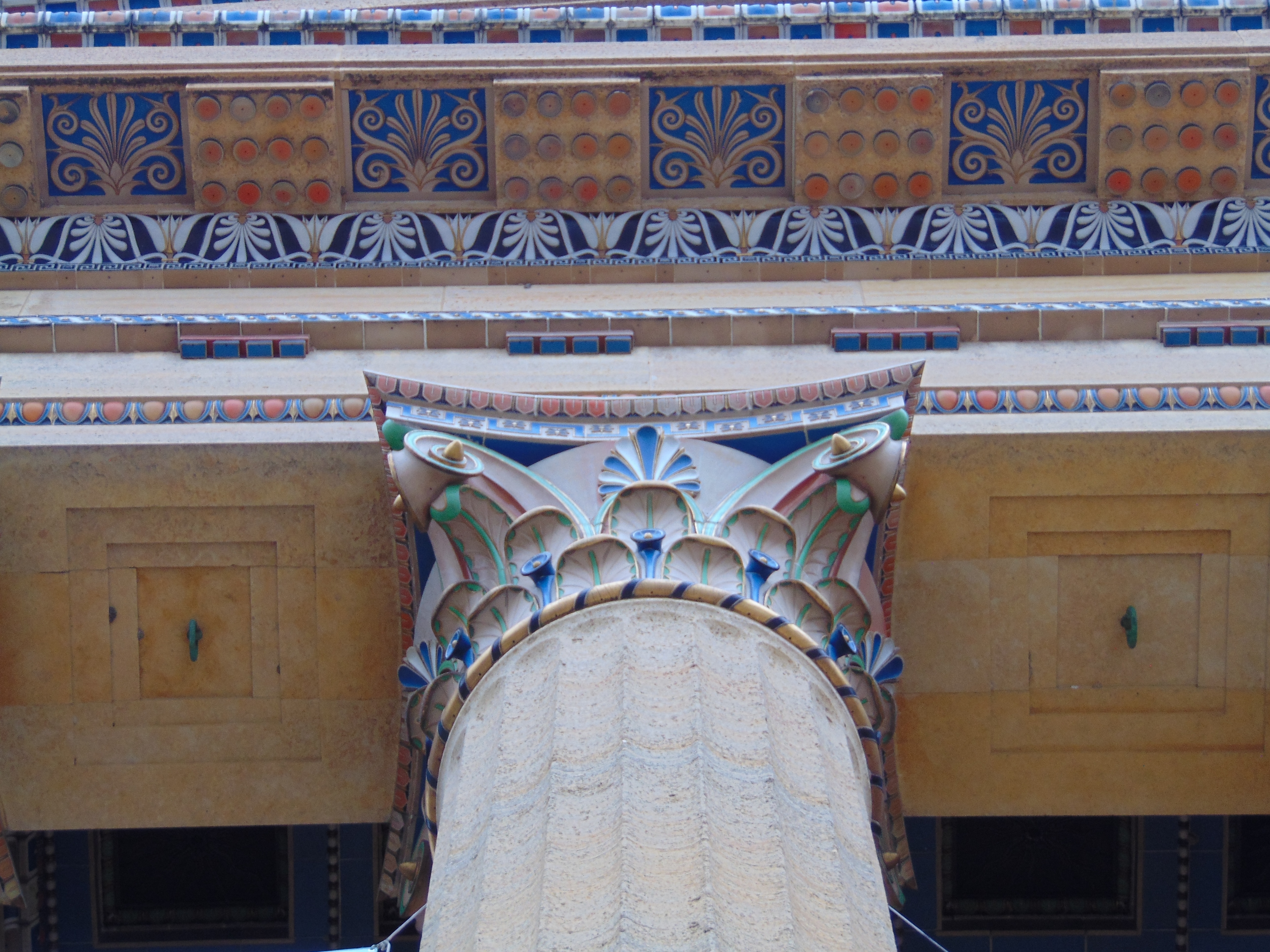
The west entrance is supported by six Corinthian columns, with a small staircase leading to the entrance. The columns are made of the same yellow stone as the rest of the building. They are raised from the ground and rest on top of the doorway. At the tops of the columns, ornate scrolls and leaves are adorned with colorful shades of red, blue, green, and white (Picture 1). Above the columns, tiles are placed on the edges and the underside of the pediment. The tiles match details on the columns and repeat similar shapes and curves. Borie, who worked on various plans for the museum, is responsible for adding these colored details, making the museums design a more “modernistic temple” (Making a Modern Classic 83). At the time, the use of ancient polychromy was relatively rare. This detailing on the entablature adds character to the building and shows an extraordinary attention to detail. From the center, the building expands outward and eventually creates a 90-degree angle with the building’s wings. Rectangular windows line the wings of the buildings with smaller windows on the top level and longer windows on the bottom level. Between the windows, pilasters with colorful ornamentation at the tops stand vertically.
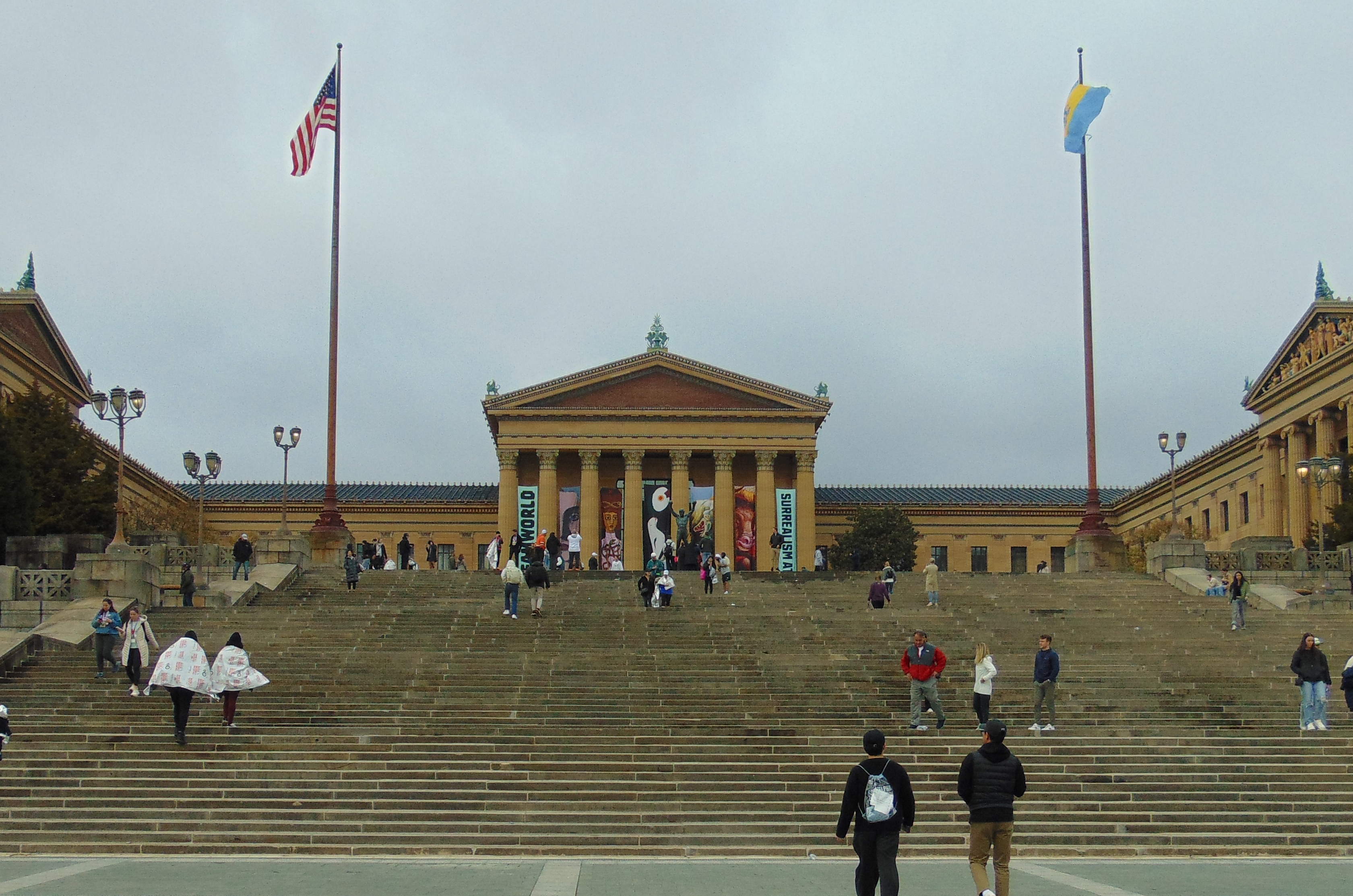
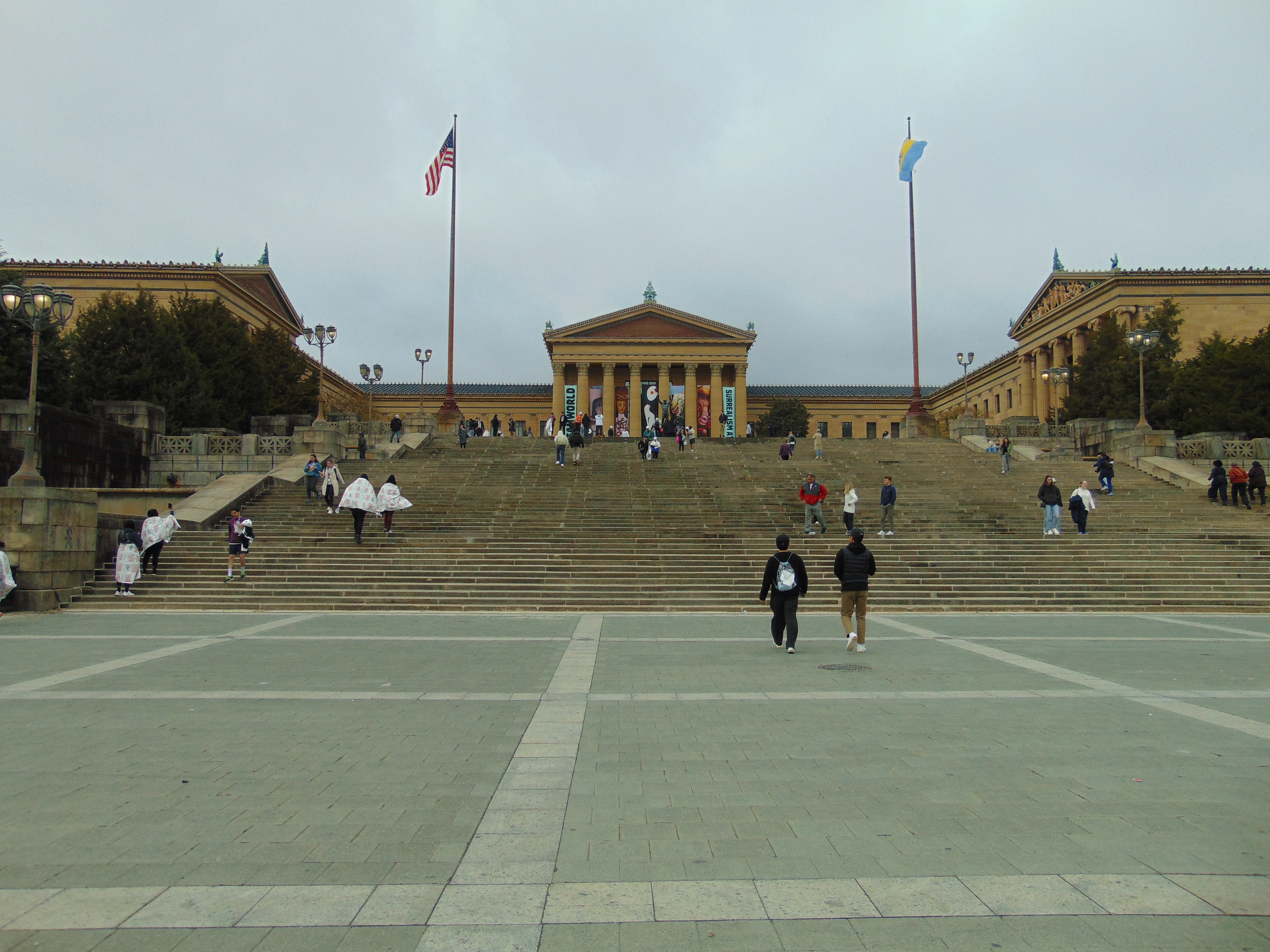
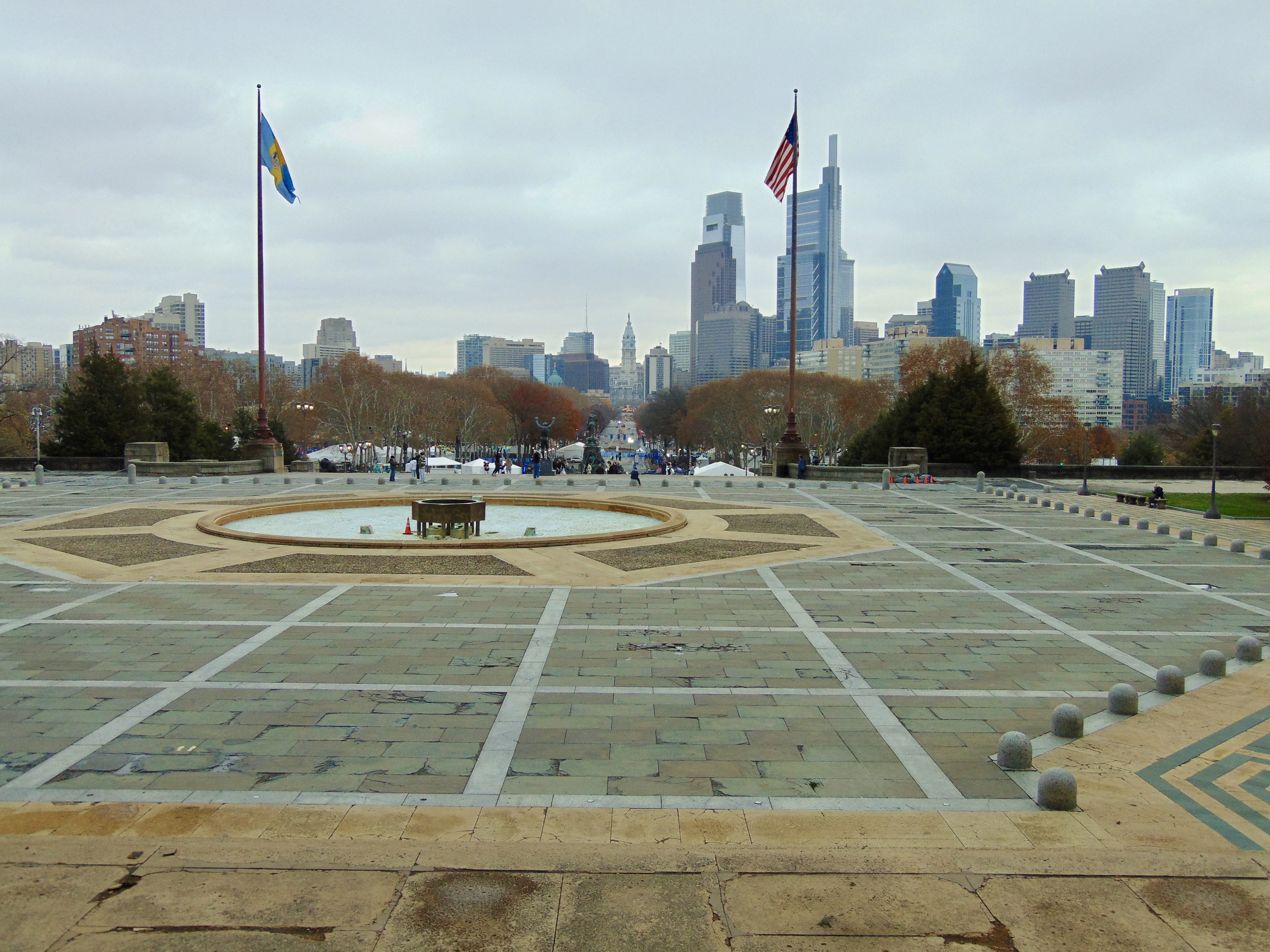
The east entrance contains a courtyard with a fountain, leading to the museum’s iconic Rocky steps. These steps create a sense of grandeur (Picture 2). The museum towers over visitors, forcing onlookers to tilt their heads upwards to see the entirety of the façade. Like the west entrance, the east entrance is supported by Corinthian columns with a pediment at the top. Underneath the pediment there is terra cotta detailing and tiling. Red bricks fill the main triangular part of the pediment. Unlike the west entrance, however, the columns reach ground level, allowing visitors to stand between them. A huge glass window in the center of the portico reaches from the bottom to the top, stopping at the level of the Corinthian capitals. It serves as an entryway with multiple doors at the very bottom.
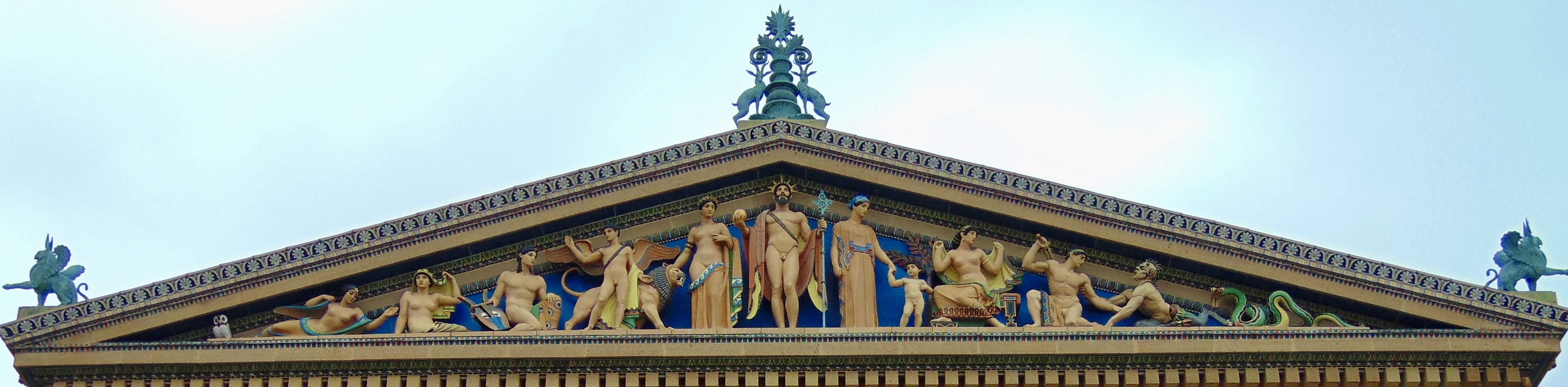
The wings of the building stand perpendicular to the center Portico. Each wing contains a portico that faces the courtyard. An additional portico is located on the reverse side of each wing. These porticos are raised, making them decorative and inaccessible for public use. Each portico has six ionic columns and between the center four columns, three windows are placed between the visual gaps. One of the porticos on the north side is famous for the sculptures placed within its pediment. Paul Jennewein and John Gregory were commissioned to design the pedimental sculptures and took inspiration from the Temple of Zeus and the Temple of Aphaia (Making a Modern Classic 92). The sculptures depict complicated tales from classical mythology. The Greek gods and Goddesses are made of terra cotta and decorated with colorful paint. The colors make the figures eye catching, even from below. Jennewein was deliberate in choosing which figures to include and the order in which they appear. Brownlee states that “the pediment depicts the influences that have shaped Western art” and symbolize(s) the two great defining themes of human art and civilization, sacred and profane love” (Making a Modern Classic 93). Zeus is the central figure in this depiction. He is surrounded by numerous Greek gods and mythological creatures (Picture 3). Standing to the right of Zeus is Ceres, who holds the hand of the child Triptolemus. The tree behind the child symbolizes Daphne and is followed by the god Ariadne. Next to him stands Thesus and a brightly colored green python. To the left, Aphrodite stands with cupid, and behind him is a lion. The final three gods depicted in the pediment are Eros, Adonis, and Eos (Making a Modern Classic 95).5 This frieze serves as a reminder that the building not only holds art but is itself a piece of art.
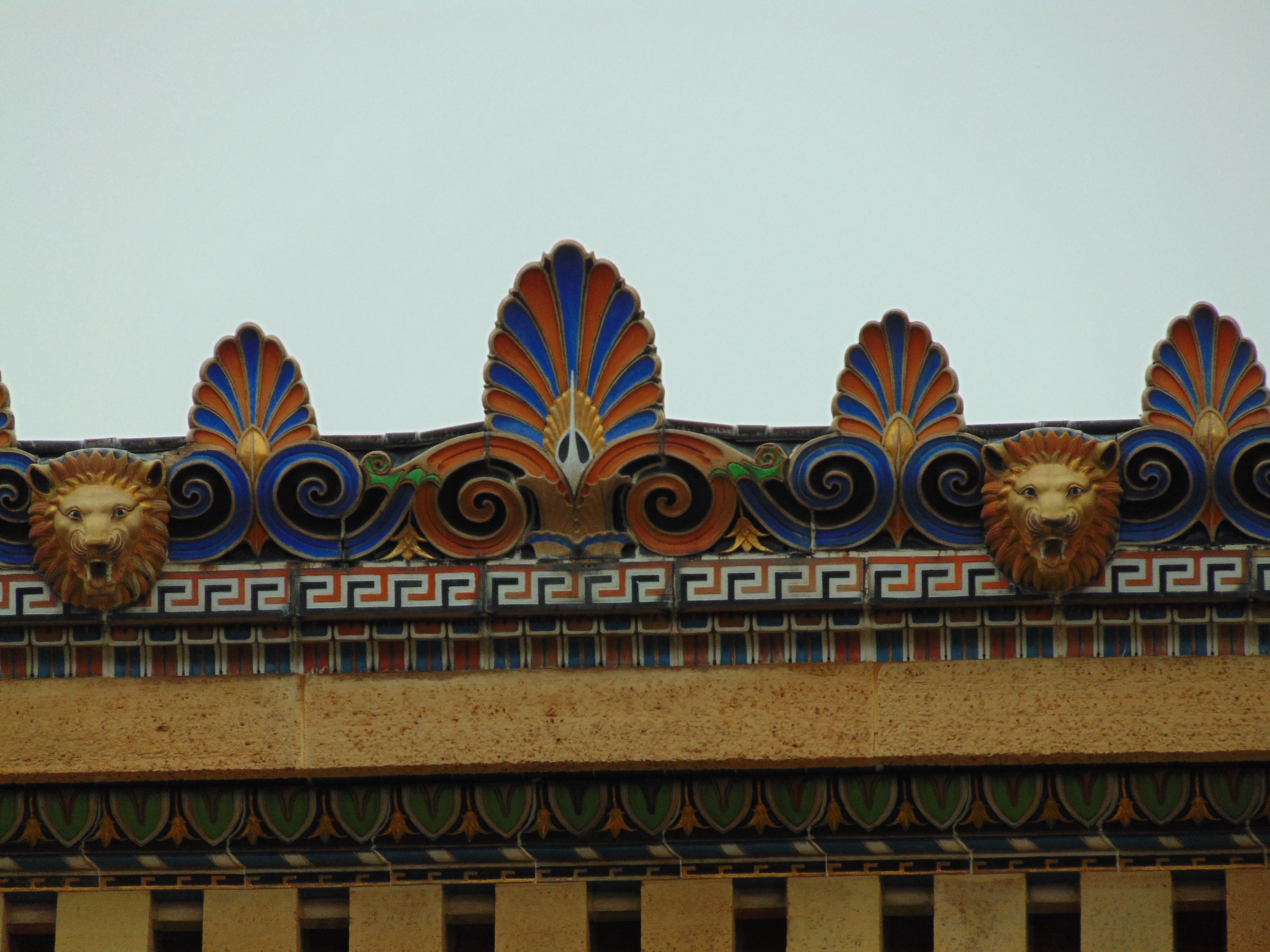
The museum is also decorated with bronze ornaments that represent mythological animals. These figurines are placed on the tops of porticos. Ibexes and seated griffins sit on the side wings of the museum (Making a Modern Classic 42). Additionally, the museum’s rooftop is lined with bronze ornaments that resemble leaves and lion heads (Picture 4). The swirling elements and geometric patterns add to the visual engagement. The patterns and ornaments create an eclectic style.
Past and Present Location
In 1876, the world’s fair, which celebrated the founding of the United States, saw the beginnings of the Philadelphia Art Museum (Blumberg). A gallery of around 4,000 artworks was placed on display for those who attended the fair. When the fair concluded, the gallery became a permanent museum open to the public. The gallery was located in a building called Memorial Hall. As the museum gained popularity, a new, bigger building was needed to accommodate the large number of visitors (Blumberg). However, it took over 20 years for the new, expanded Philadelphia Art Museum to be built. Memorial Hall still exists and now houses the Please Touch Me Museum.
The architect who built Memorial Hall, Hermann J. Schwarzmann, was inspired by the beaux-arts architectural style (“Memorial Hall”). Memorial Hall was far less impressive in size and design than the Philadelphia Art Museum (Picture 5). In comparison to Memorial Hall, the Philadelphia Art Museum looks far more stoic and angular. Memorial Hall is located far from the city center in Fairmount Park and across the Schuylkill. It was constructed on a flat area that could not be seen from afar and was geographically separated from the busiest parts of the city. The architects and city planners wanted the new museum to be seen from afar, much like the Greek idea of an acropolis.

Today, the Philadelphia Art Museum is located at the end of Benjamin Franklin Parkway on a hill next to the Schuylkill River. The Benjamin Franklin Parkway is a massive street with wide boulevards spanning from City Hall to the Philadelphia Art Museum. 6 The Parkway connects Fairmount Park to Center City. From City Hall, one can see the art museum and from the art museum, one can see City Hall (Picture 6). These two landmarks reflect each other’s significance, as one is the center of local governance, and the other is a center of art.
The east entrance of the museum faces the parkway and overlooks other educational institutions such as the Franklin Institute, the Benjamin Franklin Museum, the Barnes Foundation, and the Rodin Museum. Past the Rocky Steps of the east entrance lies the Oval, a greenspace for public use, and past the Oval, the parkway leads straight down to Logan circle. Continuing down the boulevard, one will find JFK plaza, better known as Love Park. At this point, the Benjamin Franklin Parkway ends and converges into two streets. However, the linear continuity continues straight and directly behind Love Park stands City Hall. The placement of the Philadelphia Art Museum at the end of the parkway was deliberate, as city planners aimed to connect old parts of the city to new parts of the city.
Fairmount Park Commission
The building of the museum was initiated by Peter A. B. Widener, a wealthy Philadelphian who made his fortune by selling streetcars (Building the City Beautiful 55). He was part of the Fairmount Park Commission which oversaw the development of the city. Widener successfully convinced fellow members of the Fairmount Park Commission that a new building for the art museum was needed. (Building the City Beautiful 55). The Fairmount Park Association was given authority to create a committee that would decide on a design for the museum. Unsurprisingly, Widner became commission president. However, after the creation of the committee, a new figure took the lead in overseeing the development of the museum. This new leader was Eli Kirk Price who was elected as chairman. Eli Kirk Price took the lead in pushing to create a new building for the art museum. Prior to his appointment as chairman, he had already been elected as vice-president of the Fairmount Park Commission. In his role, Price dealt with local government and allocation of funds. (Building the City Beautiful 45). Price was involved in every step of building the museum and he maintained this role until its completion.
Building the Philadelphia Art Museum
As explained above, years after Shay’s initial design was approved, Charles Borie made adjustments to incorporate terra cotta detailing, tiles, and yellow colored dolomite. After Eli Kirk Price approved these changes, Borie continued working towards his vison. Stone masons who cut the dolomite followed incredibly detailed and precise outlines given by Borie and his team (Making a Modern Classic 85). Throughout the process, a variety of mayors were elected to office, which ultimately affected funding negatively. As construction began, the World War I also caused a roadblock to the museum’s completion, as supplies and materials were diverted elsewhere. The museum finally opened it doors in 1928.

A Century Later
Almost 100 years later, the museum still exists, and its function as an art museum open to the public has remained the same. From the beginning, the museum was meant to represent Philadelphia’s connection to classical beauty and intellect. It was commissioned after the museum had outgrown its original building, Memorial Hall. When construction was finally completed in 1928, skyscrapers started appearing on the Philadelphia skyline. However, these skyscrapers could not stop the Philadelphia Art Museum from garnering praise for its design. The museum’s interpretation of classical architecture has become intertwined with the image of Philadelphia. Its presence symbolizes the wisdom of powerful ancient cities and serves as inspiration for what Philadelphia can achieve.
Footnotes
-
See chapter 3 of Making a Modern Classic to learn more about various designs proposed for the museum ↩
-
Johnson explains that Abele was a “chief administrator in Trumbauer’s office.” ↩
-
See Mathias to learn more about the acropolis in Athens. ↩
-
See “Capitoline Hill” to learn about the use of hills as defense against attacks. ↩
-
See 93-95 to learn more about the mythology of these figures ↩
-
The Benjamin Franklin Parkway was inspired by the City Beautiful Movement. Aimed to model an “orderly, classical metropolis” and was characterized by boulevards and public buildings lining the streets (Building the City Beautiful 13). ↩
Works Cited
“Beaux-Arts.” Chicago Architecture Center, www.architecture.org/online-resources/architecture-encyclopedia/beaux-arts.
Blumberg, Naomi. 2025. “Philadelphia Museum of Art - Museum, Philadelphia, Pennsylvania, United States.” Encyclopedia Britannica. October 13, 2025. https://www.britannica.com/topic/Philadelphia-Museum-of-Art.
Brownlee, David Bruce. 1997. Making a Modern Classic: The Architecture of the Philadelphia Museum of Art. Philadelphia Museum of Art.
Burrell, Janelle. 2024. “Julian Abele, the Black Architect behind Philadelphia’s Art Museum and over 400 Buildings.” Cbsnews. CBS Broadcasting Inc. February 14, 2024. https://www.cbsnews.com/philadelphia/news/julian-francis-abele-philadelphia-art-museum-black-architect-harvard-duke/.
“Capitoline Hill.” ArcheoRoma, www.archeoroma.org/sites/capitoline-hill.
“Frequently Asked Questions.” n.d. Philadelphia Museum of Art. Accessed October 27, 2025. https://press.philamuseum.org/faqs/#How%20many%20buildings%20comprise%20the%20Philadelphia%20Museum%20of%20Art.
Johnson, Greg. 2021. “The Unbridled Brilliance of Julian Abele, Penn Today.” Penn Today. University of Pennsylvania. February 22, 2021. https://penntoday.upenn.edu/news/unbridled-brilliance-julian-abele.
Matthius, Meg. “Acropolis of Athens.” Encyclopedia Britannica, 2 Oct. 2025, www.britannica.com/place/acropolis-of-Athens.
“Memorial Hall.” Global Philadelphia, 17 Mar. 2025, globalphiladelphia.org/memorial-hall#:~:text=When%20the%20competition%20failed%20to,the%20building%20permanent%20and%20fireproof.
“Our History.” n.d. Philadelphia Museum of Art. Accessed October 27, 2025. https://www.visitpham.org/our-history.
Rosenheck, Mabel. n.d. “Philadelphia Museum of Art.” Encyclopedia of Greater Philadelphia. Accessed October 26, 2025. https://philadelphiaencyclopedia.org/essays/philadelphia-museum-of-art/.
“Shay, Howell Lewis.” n.d. Weitzman School of Design. Trustees of the University of Pennsylvania. Accessed October 26, 2025. https://www.design.upenn.edu/architectural-archives/collections/shay-howell-lewis.
Tifft, Susan E. 2005. “Out of the Shadows.” Smithsonian Magazine. February 2005. https://www.smithsonianmag.com/history/out-of-the-shadows-85569503/.