Washington Ave Green (Historical Pier 53) Item Info
- Title:
- Washington Ave Green (Historical Pier 53)
- Creator:
- Ruthanna Kern
- Date Created:
- 10/24/2025
- Location:
- Washington Ave Green (Historical Pier 53)
- Latitude:
- 39.932277
- Longitude:
- -75.140607
- Rights:
- CC BY-NC
- Standardized Rights:
- https://creativecommons.org/licenses/by-nc/4.0/deed.en
Washington Ave Green (Historical Pier 53)
Introduction
I was first introduced to the Washington Ave Pier Immigration Station as Philadelphia’s Ellis Island. Immigration stations were the sites of significant transitions in the lives of millions who chased after the American Dream. However, an immigration station was only the beginning of the American reality. The stories of immigrants are built into every block, town, and region in the United States. As a notable and memorialized site in American immigration history, the Washington Avenue Pier Immigration Station was not only a site of transformation, but also of continuity. The people who passed through this station carried on the traditions, languages, and values of their homes. These immigrants influenced the United States as much as it influenced them, and the influences of many of the Italian immigrants who passed through this station are undoubtedly visible at other locations highlighted on this map.
Description
The immigration station at the Washington Ave Pier, also known as Pier 53, was built by the Pennsylvania Railroad in the 1870s. The station was connected to several railroad lines that could quickly transport newly arrived immigrants to destinations across the Eastern United States. The railroad owned the wharves surrounding the station, and the area was made up of warehouses, factories, and depots. Originally, the facility for receiving immigrants was two stories. There, immigrants passed through customs inspections and then could buy train tickets downstairs. All arrivals had previously passed through the Lazaretto for their mandatory quarantine and health screening. In 1896, the railroad spent $10,000 to expand the capacity of the building from 300 people to 1,500. The building was modernized with electric lights and steam heat. Passengers disembarked on the second story of the building, where up to eight inspectors greeted each ship. As to the wait times, “it was estimated that 300 English-speaking or 150 non-English-speaking passengers could be processed each hour.”1 The first floor had a “ticket office, money exchange, women’s dressing room, waiting room, and travel information bureau.”2 There was also a section of the examination room that was called the “altar,” as immigration restrictions on single women resulted in hurried weddings during processing.3

The original building was torn down in 1915, due to a combination of the frozen Delaware often impeding travel and the beginning of WWI slowing the waves of immigrants from Europe. Other processing stations appeared at other wharves, but the Immigration Act of 1924 placed quotas on immigrants of certain national origins and essentially ended major direct immigration from Europe to Philadelphia. In total, “between 1815 and 1985 more than 1,300,000 immigrants entered America through Philadelphia.”4 Operational between 1873 and 1915, Pier 53 is estimated to have processed more than a million people and almost two hundred thousand Italians.5 Few first hand accounts of the experience of passing through this immigration station exist today. This is perhaps due to the speed at which immigrants were processed through the station, leaving little time to reflect on their experience within the building itself. Another possibility is that these new immigrants might not have had the language skills or physical tools to write down their thoughts immediately. Therefore, most tales of this pier were passed down orally, as many Italian-Americans recount stories of their grandparents arriving at Pier 53 and walking nine blocks to what is now called the Italian Market.
Washington Ave Pier vs. Ellis Island vs. Angel Island
Ellis Island in New York Harbor and Angel Island in San Francisco Bay are the most commonly discussed immigration stations that were operational during the era of mass immigration in the late 19th and early 20th centuries. By a landslide, Ellis Island processed the most immigrants, approximately 12 million between 1892 and 1924.6 Angel Island processed about one million immigrants between 1910 and 1940.7 Numerically, Washington Ave Pier is closer to Angel Island. But there is a significant distinction that separates Philadelphia’s main immigration station from Ellis and Angel Islands. While Ellis and Angel Islands served as both quarantine and processing centers, Washington Ave Pier did not function as a quarantine facility. The major quarantine facility for the city of Philadelphia was the Lazaretto, which sent the immigrants it cleared for entry into the country to Pier 53. I believe that the trauma associated with quarantine and possible rejection from the country has imprinted Ellis Island in the national consciousness. Meanwhile, Angel Island reckons with the legacy of racialized violence and the imprisonment of Chinese immigrants. As the Philadelphia processing system was split into two steps at two historical sites, I believe both negative and positive associations are somewhat decentralized in comparison to those of Ellis and Angel Islands.
Land Buoy
Description
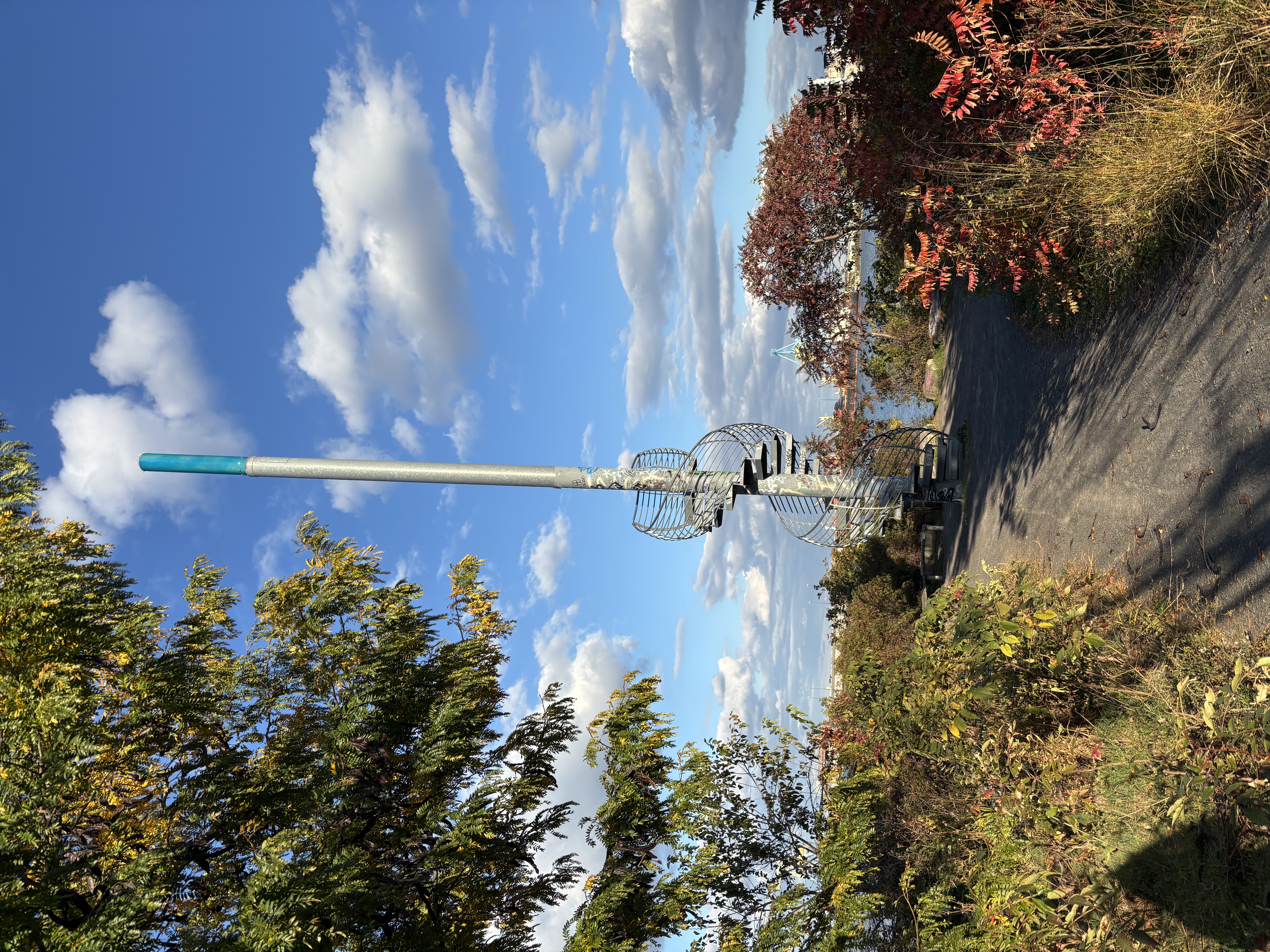
Dedicated in 2014, the Land Buoy is a sculptural piece that honors the memory of those who passed through the Washington Ave Pier Immigration Station. The Land Buoy has a spire that is 55 feet tall and a spiral staircase around the spire that reaches its peak at 16 feet. The top of the staircase offers views of the waterfront up and down the Delaware River. The main material for the piece is galvanized steel, and it appears gray or silver in daylight. It is protected against lightning through a system that runs through the central column of the sculpture. The “Land Buoy” also emits a soft blue light, which is “a beacon and an invitation in memory of those who came through the Pier.”8 That light is powered by solar panels. The ecological design of the Washington Street Pier was done by Applied Ecological Services. It features native plants, educational components, and a boardwalk. Visitors are able to reach into the water and walk on a path over a wetland habitat. The Land Buoy is surrounded by what is now called the “Washington Avenue Green,” an eco-friendly public space maintained by the Delaware River Waterfront Corporation. It partners with the William Penn Foundation, the Pennsylvania Department of Conservation and Natural Resources, the Pennsylvania Department of Environmental Protection, and the City of Philadelphia in preserving the pier.
Artist
The artist behind the Land Buoy is Jody Pinto, who was born in 1942. Pinto is known for her “incorporation of functional public art and architecture into the natural environment.”9 Pinto’s career was based in New York City, but she studied at the Pennsylvania Academy of the Fine Arts and then taught there for forty years. Her major works include “beautifying the corridors and stations of St. Louis’ Metrolink light rail, marking the boundary of Phoenix and Scottsdale in a desert park, and bridging a crevasse to carry the trail hiker forward through Philadelphia’s Wissahickon Valley Park.”10 That last piece is called the Fingerspan, and it was commissioned by the Association for Public Art in 1987. Over the past fifty years, Pinto has created projects in the United States, Japan, and Israel. Her drawings are housed in the Guggenheim Museum, the Museum of Modern Art in New York City, the National Gallery of Art in Washington, D.C, and the Philadelphia Museum of Art, along with other private and public collections. Pinto also founded Women Organized Against Rape (WOAR) in Philly in the early seventies, and this organization opened the first rape crisis center at Philadelphia General Hospital in 1973.11
The Land Buoy was a personal piece for Pinto as her paternal grandparents, Luigi and Josephine Pinto, were processed at Pier 53 when they immigrated from Italy to Philadelphia. They arrived in 1909 from Casal Velino in the province of Salerno. Her family lived in South Philly near South Ninth Street, and Luigi sold fruit and produce from a cart.12 Jody’s father and uncles were artists, and they were mentored and sponsored by Albert Barnes of the Barnes Foundation. Following in the family tradition, Jody and her siblings also became artists. Reflecting on her grandparents, artistic family legacy and the Land Buoy, Pinto wrote, “My gift to them, and to the over one million immigrants who made the great journey to this country, began when I first learned during a public art project that I was standing on the same pier on which my grandparents, Luigi and Josephine (for whom I am named), had touched land after their long journey.”13
Purpose
The Land Buoy was created to honor all those who passed through Pier 53 when it was an immigration station. Its blue beacon symbolizes and literalizes the hope the immigrants felt when reaching their new lives in the United States. As the stairs are climbable, the Land Buoy functions as a 360-degree viewpoint for visitors to gaze upon the river and the city. Pinto described her goal for this interactive element, “I want people to climb the spiral into a crows nest and take the place of what it meant to sight land for the first time.”14 Its natural surroundings represent the restoration of this ecosystem following its decades as an industrial hub. The city spent $2.15-million renovating this one-acre space because it wanted this historic space to be returned to the public as a place of peace and natural beauty.15
Conclusion
The Land Buoy keeps alive the stories of all the immigrants who passed through Pier 53. There were over a million people and millions of stories of adversity, determination, and hope. These stories live on, first and foremost, in the descendants of these immigrants. But there is a power to memorializing people in the physical space where they experienced a significant change. That is what the preservation of Pier 53 as the Washington Ave Green has done. I think that the Land Buoy would be even more impactful if there were a sign explaining its meaning to visitors to the pier, who might just think it is a natural spot without its historical significance.
When I visited the Washington Ave Green, I was surprised by the amount of graffiti on the Land Buoy. At first, I wondered if the public understood the gravity of this art and why people would choose to write explicit messages or draw inappropriate images. Even though this takes away from the simplicity of Pinto’s plain steel design, I eventually took the graffiti as a sign that people have spent time in this space. There were other man-made paths in the woods leading up to the buoy that suggest the same thing. I also saw several joggers run along the boardwalk. I think that the incorporation of this historical site into the everyday lives of Philadelphians is a fitting tribute to all those who came through the station, even if the monument itself does look different from how the artist intended.
Footnotes
-
Frederic Miller, “Philadelphia: Immigrant City,” Balch Online Resources, n.d., www2.hsp.org/exhibits/Balch%20resources/philaellisisland.html. ↩
-
Miller, “Philadelphia: Immigrant City.” ↩
-
“History,” Washington Avenue Green, 2018, https://washingtonavenuegreen.com/02history/02history2.html. ↩
-
Miller, “Philadelphia: Immigrant City.” ↩
-
Paolo Valentino, “From Rocky to Botticelli, Italian Philadelphia: Concerts, Shows, Exhibits, and Conferences in a City in Pennsylvania Where the ‘American Dream’ Speaks Our Language, ” in The Italian Legacy in Philadelphia: History, Culture, People, and Ideas (Temple University Press, 2021). ↩
-
“History and Culture - Ellis Island,” National Parks Service, February 3, 2025, https://www.nps.gov/elis/learn/historyculture/index.htm. ↩
-
“U.S. Immigration Station, Angel Island,” National Parks Service, April 20, 2021, https://www.nps.gov/places/u-s-immigration-station-angel-island.htm. ↩
-
“Washington Avenue Pier,” Delaware River Waterfront, n.d., www.delawareriverwaterfront.com/where-to-go/washington-avenue-pier. ↩
-
“Land Buoy,” Association for Public Art, October 6, 2025, www.associationforpublicart.org/artwork/land-buoy/. ↩
-
Bradley Maule, “The Pintos: A Philadelphia Immigration Story, Told through Art at Washington Avenue Pier,” Hidden City Philadelphia, February 26, 2023, hiddencityphila.org/2014/08/the-pintos-a-philadelphia-immigration-story-told-through-art-at-pier-53/. ↩
-
“Artist,” Jody Pinto, n.d., www.jodypinto.com/artist. ↩
-
Jody Pinto, “A Family of Italian American Artists, ”in The Italian Legacy in Philadelphia: History, Culture, People, and Ideas (Temple University Press, 2021). ↩
-
Pinto, “A Family of Italian American Artists.” ↩
-
“Land Buoy.” ↩
-
“Visit Washington Avenue Pier,” Visit Philadelphia, May 12, 2025, https://www.visitphilly.com/things-to-do/attractions/washington-avenue-pier/. ↩
Works Cited
“Artist.” Jody Pinto, n.d. www.jodypinto.com/artist.
“History.” Washington Avenue Green, 2018. https://washingtonavenuegreen.com/02history/02history2.html.
“History and Culture - Ellis Island.” National Parks Service, February 3, 2025. https://www.nps.gov/elis/learn/historyculture/index.htm.
“Land Buoy.” Association for Public Art, October 6, 2025. www.associationforpublicart.org/artwork/land-buoy/.
Maule, Bradley. “The Pintos: A Philadelphia Immigration Story, Told through Art at Washington Avenue Pier.” Hidden City Philadelphia, February 26, 2023. hiddencityphila.org/2014/08/the-pintos-a-philadelphia-immigration-story-told-through-art-at-pier- 53/.
Miller, Frederic. “Philadelphia: Immigrant City.” Balch Online Resources, n.d. www2.hsp.org/exhibits/Balch%20resources/phila_ellis_island.html.
Pinto, Jody. “A Family of Italian American Artists.” In The Italian Legacy in Philadelphia: History, Culture, People, and Ideas. Temple University Press, 2021.
“U.S. Immigration Station, Angel Island.” National Parks Service, April 20, 2021. https://www.nps.gov/places/u-s-immigration-station-angel-island.htm.
Valentino, Paolo. “From Rocky to Botticelli, Italian Philadelphia: Concerts, Shows, Exhibits, and Conferences in a City in Pennsylvania Where the ‘American Dream’ Speaks Our Language. In The Italian Legacy in Philadelphia: History, Culture, People, and Ideas. Temple University Press, 2021. - “Visit Washington Avenue Pier.” Visit Philadelphia, May 12, 2025. https://www.visitphilly.com/things-to-do/attractions/washington-avenue-pier/.
“Washington Avenue Pier.” Delaware River Waterfront, n.d. www.delawareriverwaterfront.com/where-to-go/washington-avenue-pier.