"Our Market Ancestors: Carl Samuel Redel" Mural Item Info
- Title:
- "Our Market Ancestors: Carl Samuel Redel" Mural
- Creator:
- Willa Bywater
- Date Created:
- 10/24/2025
- Subjects:
- mural
- Location:
- "Our Market Ancestors: Carl Samuel Redel" Mural
- Latitude:
- 39.9368411366421
- Longitude:
- -75.158212445428
- Rights:
- CC BY-NC-SA
- Standardized Rights:
- https://creativecommons.org/licenses/by-nc-sa/4.0/deed.en
Our Market Ancestors Carl Samuel Redel
Philadelphia is, unofficially, the Mural Capital of America. Therefore, it is no surprise that part of the Our Market project, a project meant to revitalize the Ninth Street Italian Market’s stores and buildings and bring the community together, was the creation of a series of murals honoring important figures in the Market’s history. One of these murals is “Our Market Ancestors: Carl Samuel Redel,” honoring the life and work of Carl Samuel Redel, a Polish Jewish immigrant and Holocaust survivor who started the business Carl’s Farm Eggs, which is still on Ninth Street today.
Carl Samuel Redel
Carl was born on October 4, 1926, in the community of Wielopole in Poland, a very small village with a large Jewish population. He was 16 when his family died in the concentration camps, and 19 when Poland was liberated from Nazi occupation at the end of World War II. At some point after this, he immigrated to America, and founded Carl’s Farm Eggs in 1956.1 He married Helen Redel, who was also Polish and Jewish. They are interred together in the Alliance Cemetery in New Jersey.2
This is the basic information of Carl’s life—the rest of it, unfortunately, is not easily found, and so the details must be sketched in with information derived from context. The text accompanying the mural makes reference to Carl combating anti-Semitism to build a life for himself in the market. While there are no further details given, it is unfortunately not surprising that he would have faced anti-Semitism in the market. While there was often a solidarity between immigrant groups that existed in proximity to each other, such as was the case with Philadelphia’s Irish, Italian, Jewish, and Eastern European communities, there was also interethnic hostility which is well recorded. Jewish culture promoted prioritizing higher education, and as such they were more often able to find advanced positions, which meant that they were sometimes even in the position of supervisors to Italians in factories.3 The Second World War had considerable effects on both the Italian and Jewish populations, for different reasons and to different ends. According to the article “World War II and American Jewish Identity,” by Edward Shapiro, “Wartime public opinion polls revealed that Americans distrusted Jews more than any other European group with the exception of the Italians.”4 At the same time, during the wartime period, there was increased tension between the Italian and Jewish communities due to the aforementioned preexisting resentment and concern in the Jewish community over what the rise of fascism in Italy meant for Italian-Jewish relations in the diaspora. However, thanks to the efforts of community leaders on both sides at mitigating conflicts, these tensions never reached a boiling point, and once the United States joined the war, Italians and Jews in America both felt themselves on the same side again, as Italians wanted to prove themselves loyal to their adoptive country and Jews wanted to join the fight against Hitler and the Nazis.5
In Philadelphia specifically, The South Philadelphia Shtiebel, which has a map of historic synagogues and other markers of Jewish presence, shows the highest concentration of historic presence slightly north of the South Ninth Street Market, clustered more along South 6th Street.6 However, even if the Jewish community was not a large presence in the Italian Market, the two communities were directly adjoining, and there was likely at least some Jewish presence in the Market. Additionally, the fact that it has historically been an immigrant community means that Jewish immigrants like Carl might have been drawn to the area for the atmosphere and community it offered. That said, in Philadelphia much of the Jewish population showed a trend in movement towards the suburbs in the post-war period. By the time Carl would have arrived in the US, the Jewish population in the 9th Street Market area would have been declining, but the ethnic tensions that might have existed there previously would be decreasing as well.
The Our Market Project
While there is less of a Jewish population in the market now, Carl’s mural’s presence in the market speaks to the historic presence, and more generally helps tell the story of resilience and community that Our Market aims to present. The Our Market project is led by Michelle Angela Ortiz, who grew up in the 9th Street Market area and aims to revitalize the market and help its community bridge divides and stay together during chaotic times. The project is trying to center community voices and preserve cultural memory, and the murals are an important part of that. Ortiz said that the goal of the ancestor murals was to remind “present day people in the Market that we come from ancestors that have also faced struggles but have survived. We can we learn from them, especially in this current climate that we are in which has seen the presence of ICE in the Market several times already.”7
In addition to leading the project, Ortiz is also the painter of the portraits in the Our Market Ancestors murals, including that of Redel. She is a professional muralist and visual artist who has done murals in multiple different states and internationally and works in community building projects through art. The framework of the mural was painted by Emily Busch, who is a “Philly based musician and artist,” according to her Instagram page,8 and comes from a lineage of Polish immigrants who have lived in Camden, NJ for several generations 9 The murals also had “artistic support” from Valentín Sánchez-Stoddard and Briana Dawkins.10
The Mural
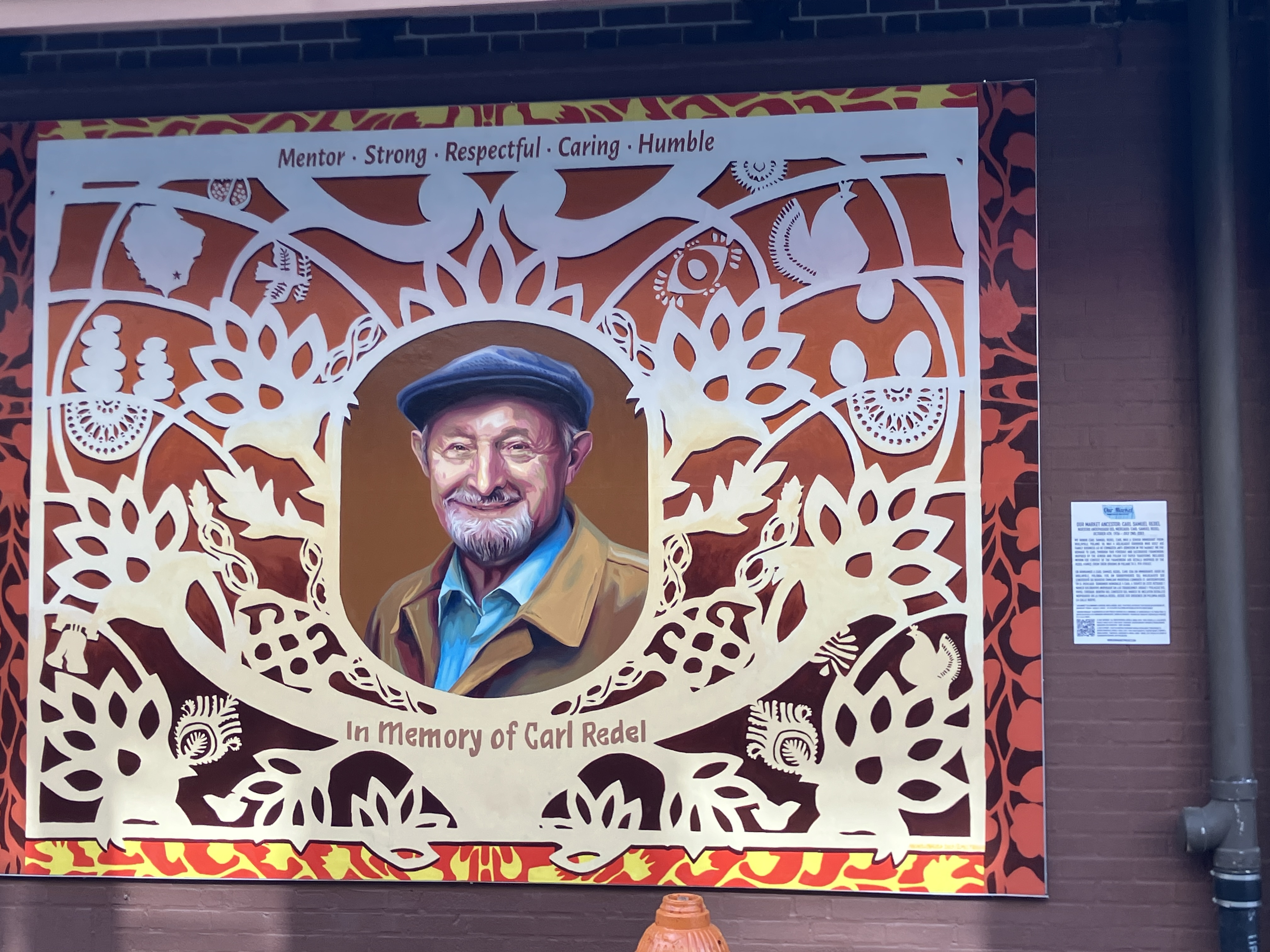
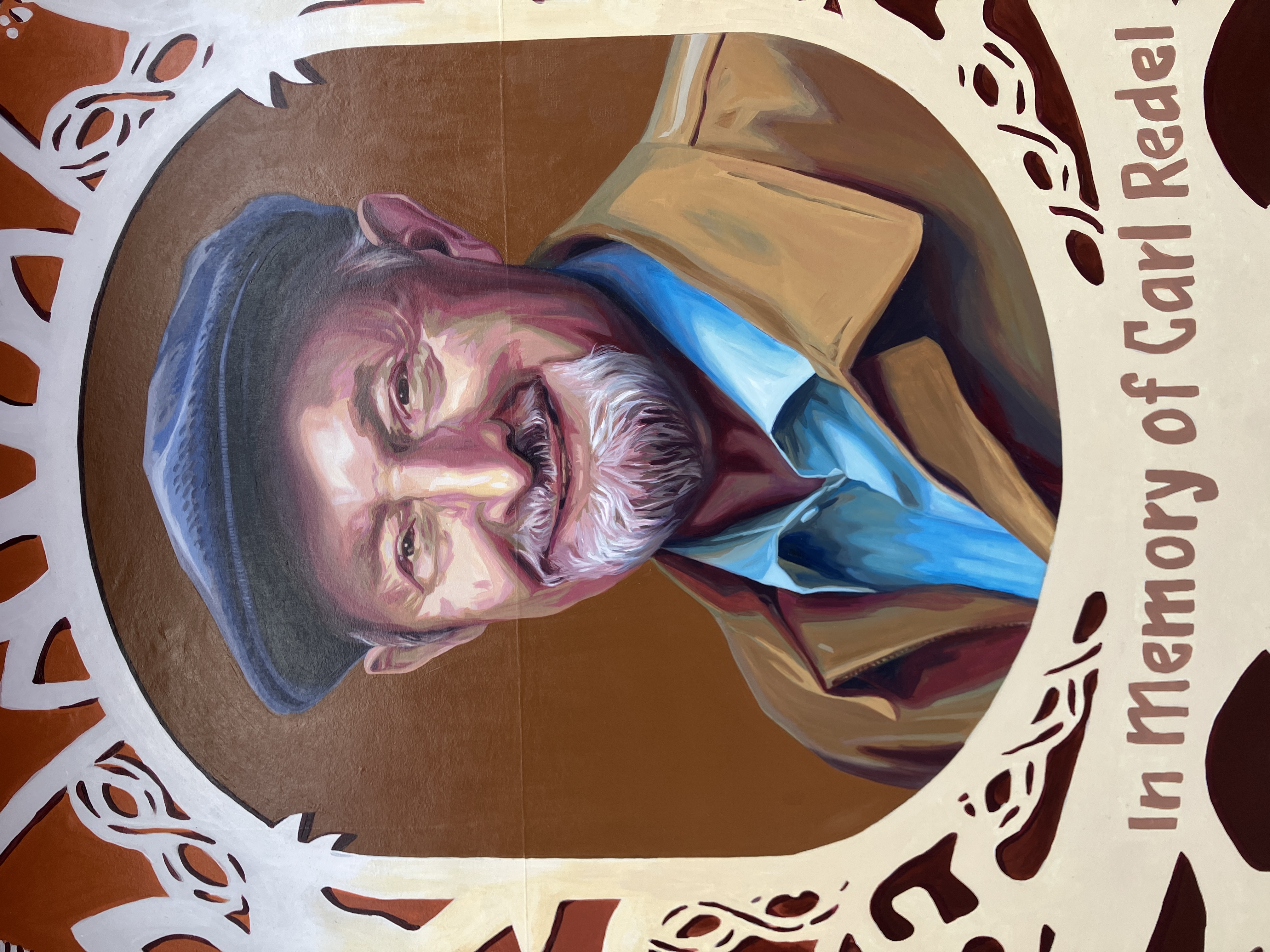
The mural is painted onto a canvas suspended on backing that is movable, and currently placed on a brick wall. It is about the height of a grown person, and placed slightly off the ground so it reaches higher than most people, but not by much. It is hand painted. The primary colors one notices upon viewing it are red and white, which are the colors of the Polish flag. The border has leaflike red shapes against a black background. In a frame in the center of the mural is a rendition of Carl Samuel Redel’s face. He is an older man with a gray beard, wearing a blue cap, a bright blue shirt, and a brown jacket. He is smiling warmly. The frame around him resembles a papercut, white on a red background, and the papercut shapes form many different symbols, including chickens, eggs, the shape of the country of Poland with a star marking where Carl was born, stacked stones, a cracked liberty bell, a dove with a branch in its mouth, and an eye. Below Carl text reads “In memory of Carl Samuel Redel,” and at the top of the mural text reads “Mentor – Strong – Respectful – Caring – Humble”. The mural is located on 9th Street Market, on the side of a building facing the side of the building that houses Carl’s Eggs, which now also sells meat.11
The mural shows both Carl’s country of origin, Poland, and his city of adoption, Philadelphia (through the Liberty Bell). It also shows what he brought to the market (through the chickens and eggs). The papercut style and the red and white colors of the frame are also a reference to Poland, since the papercut style is a part of Polish culture and the colors are reminiscent of the flag. The dove carrying the branch is a classic symbol of peace, as well as reminiscent of the story of Noah and the Ark and the hope that the dove represented in that story. The meaning of the stacked stones is uncertain. The meaning of the eye is also uncertain, but it could be a reference to Jewish mysticism. Interestingly, there are no direct references to Judaism on the mural—perhaps this is because it was difficult to find a way to visually represent it without potentially bringing in negative associations. The portrait of Carl shows him looking directly at the viewer and smiling gently. There is a warmth and humor in his face, and the colors are vibrant and cool, with the bright blue of his shirt serving as a pop of color that draws your eyes to it. The words chosen to represent him showcase his virtues as an individual, but also his significance in relation to the community as a mentor. Finally, the positioning of the mural directly across from Carl’s Eggs makes it seem as if Carl is watching over his old store.
Carl’s mural stands as a testament to human ability to survive and be kind even after horrific events. His status as a Holocaust survivor also functions as a reminder, with the increasing presence of ICE in the Market community, to not let such events happen again. In the Ashkenazi Jewish community, the traditional thing to say when someone dies is “May their memory be for a blessing.” With the mural, Carl’s memory is made into a blessing for all time, that all visitors to the Market may be inspired to emulate him in being consistently caring and respectful despite the cruelty in the world, and that the market community may be protected from harm.
Footnotes
-
“Carl’s Farm Eggs,” Carl’s Farm Eggs, accessed Nov. 23 2025, https://carlsfarmeggs.com/. ↩
-
Helen Redel,”Find a Grave, accessed Nov. 23, 2025, https://www.findagrave.com/memorial/190799433/helen-redel. ↩
-
Ronald H. Bayor, “Italians, Jews and Ethnic Conflict,” The International Migration Review 6, no. 4 (1972): 380-1, accessed November 23, 2025, https://doi.org/10.2307/3002823.\ ↩
-
Edward S. Shapiro, “World War II and American Jewish Identity,” Modern Judaism 10, no. 1 (1990): 69, http://www.jstor.org/stable/1396050. ↩
-
Bayor, “Italians, Jews and Ethnic Conflict,” 384-91. ↩
-
“South Philly History.” South Philadelphia Shtiebel. Accessed November 23, 2025. https://www.southphiladelphiashtiebel.org/south-philly-history. ↩
-
Cristian Salazar, “It’s Our Market,” The Philadelphia Citizen, photos by Sabina Louise Pierce, Mar. 12, 2025, https://web.archive.org/web/20251026160357/https://thephiladelphiacitizen.org/its-our-market/. ↩
-
Busch, Emily. “Posts.” Instagram. 2025. https://www.instagram.com/birdiebusch/ ↩
-
Busch, Emily. “About.” emilybirdiebusch.com. 2025. https://www.emilybirdiebusch.com/about-1. ↩
-
Our Market Project [@ourmarketproject]. Instagram, May 2 2025, https://www.instagram.com/reel/DJKoskFyJhe ↩
-
“Carl’s Farm Eggs.” Carl’s Farm Eggs. 2025. https://carlsfarmeggs.com/ ↩
Works Cited
Bayor, Ronald H. “Italians, Jews and Ethnic Conflict.” The International Migration Review 6, no. 4 (1972): 377–91. https://doi.org/10.2307/3002823.
Busch, Emily. “About.” emilybirdiebusch.com. 2025. https://www.emilybirdiebusch.com/about-1.
Busch, Emily. “Posts.” Instagram. 2025. https://www.instagram.com/birdiebusch/
“Carl’s Farm Eggs.” Carl’s Farm Eggs. 2025. https://carlsfarmeggs.com/.
Given, Molly. “Our Market Project illuminates immigrant spirit of Philly’s Italian Market.” Metro Philadelphia, Aug. 18, 2025, https://metrophiladelphia.com/stories/our-market-project-illuminates-immigrant-spirit-of-phillys-italian-market,103714.
“Helen Redel.” Find a Grave. Accessed November 23, 2025. https://www.findagrave.com/memorial/190799433/helen-redel.
“Our Market Ancestor: Carl Samuel Redel.” Mural Arts, 2025, https://muralarts.org/artworks/our-market-ancestor-carl-samuel-redel/.
Our Market Project [@ourmarketproject]. Instagram, May 2 2025, https://www.instagram.com/reel/DJKoskFyJhe/
Salazar, Cristian. “It’s Our Market.” The Philadelphia Citizen, photos by Sabina Louise Pierce, Mar. 12, 2025, https://web.archive.org/web/20251026160357/https://thephiladelphiacitizen.org/its-our-market/.
Shapiro, Edward S. “World War II and American Jewish Identity.” Modern Judaism 10, no. 1 (1990): 65–84. http://www.jstor.org/stable/1396050.
“South Philly History.” South Philadelphia Shtiebel. Accessed November 23, 2025. https://www.southphiladelphiashtiebel.org/south-philly-history.’