Sarah Drexel Van Rensselaer House Item Info

- Title:
- Sarah Drexel Van Rensselaer House
- Subjects:
- architecture
- Location:
- Sarah Drexel Van Rensselaer House
- Latitude:
- 39.950317000511
- Longitude:
- -75.1708419253725
- Source:
- https://www.loc.gov/pictures/item/pa0843.photos.139375p/resource/
- Rights:
- No known restrictions
Sarah Drexel Fell Van Rensselaer Mansion
- Location
- The First Owners:
- The Van Rensselaer’s Square:
- The Mansion and Beaux Arts Style:
- Facade and Entrance:
- The Grandeur Continues:
- Popes or Doges?:
- A Family House:
- An Athletic Afterlife:
- A Rental Haven
- An Anthropological Anthropologie:
- Why Did This Mansion Remain Standing?:
- What Does it represent and how does it reflect the Global City
Location
The Sarah Drexel Fell Van Rensselaer mansion is located at 1801 Walnut St, Philadelphia, PA 19103 or at 39°57’01.2”N 75°10’14.4”W and was built in 1889. This historic house sits at the intersection of Walnut and 18th streets, and stands watch on the northeast corner of the bustling Rittenhouse Square. A lush public park, Rittenhouse Square is one of the five green spaces in the heart of Philadelphia imagined by William Penn in the early 1680s (Heinzen 2). Pennsylvania was meant to be a refuge, a “peaceful oasis of brotherly love”, and with this grand experiment came the creation of the first modern planned community (Heinzen 1). The city plan was developed by Thomas Holme, who designated the swath of land that would become Rittenhouse Square to the enjoyment of the public and for a while a hunting grounds nicknamed “The Governor’s Woods” (Rivinus 9). Holmes and Penn were likely inspired by the public squares of London, and wanted to bring the finest city designs from across the world to Philadelphia (Heinzen 3).
The First Owners:
While the owner of the majority of the land surrounding the square changed hands over the years, it was considered underdeveloped until the beginning of the 19th century (Rivinus 10). The first noted owner of 1801 Walnut St was James Harper who bought it circa 1828 (Cohen 241). Harper was the first in a long line of notable people who occupied the square. An Irish immigrant, he set up a successful brick factory before being elected to Congress and eventually returning back to Rittenhouse Square (BioGuide). He bought up the plots because he saw the possibilities for the square which was still underdevloped–although he never seemed to build on 1801 Walnut St.
The first residence at the site was built by William R. Lejee, a banker and broker from Lake Geneva (Cohen 241). He purchased lots 1801-3 and erected a three story stone mansion on the property (Image 1). The simple facade was accented by carved window casings Much of this residence can be seen in successor, the symmetry in the windows, three on each floor of the side facing the main street, with the main entrance utilizing the corner lot and placing it on the side street (19th), away from the hustle and bustle of the square. This was eventually torn down to make way for the next house to take up residence on the lot.
The Van Rensselaer’s Square:
By the time the Van Rensselaers came to call Rittenhouse Square, the neighborhood had transformed into something that was likely unrecognizable by William Penn. Rittenhouse Square at this time was likened to the famous Washington Square in New York by the Gilded Age author Henry James, but noted that it had kept its simplicity and residential nature when Washington Square had eventually yielded to commercialization. After the death of the Drexel patriarch Anthony Drexel, Sr. in 1893, the various Drexel heirs and their families convened upon the square, with at least five different families taking up residence (Heinzen 84). Sociologist Digby Baltzel stated that “at no other time in the city’s history, before or since, have so many wealthy and fashionable families lived so near one another”. Dinner party seats were filled by Cassatts, Devereuxs, Cadwaladers, Mills, Van Rensselaers, Munns, Fells, Drexels, and Biddles, a charmed set of Gilded Age new money families (Heinzen 86). At the center of it was the Van Rensselaer Mansion, a “marble monument to the luxurious life of inherited wealth and high fashion” built by Sarah Drexel Fell Van Rensselaer.
The Mansion and Beaux Arts Style:
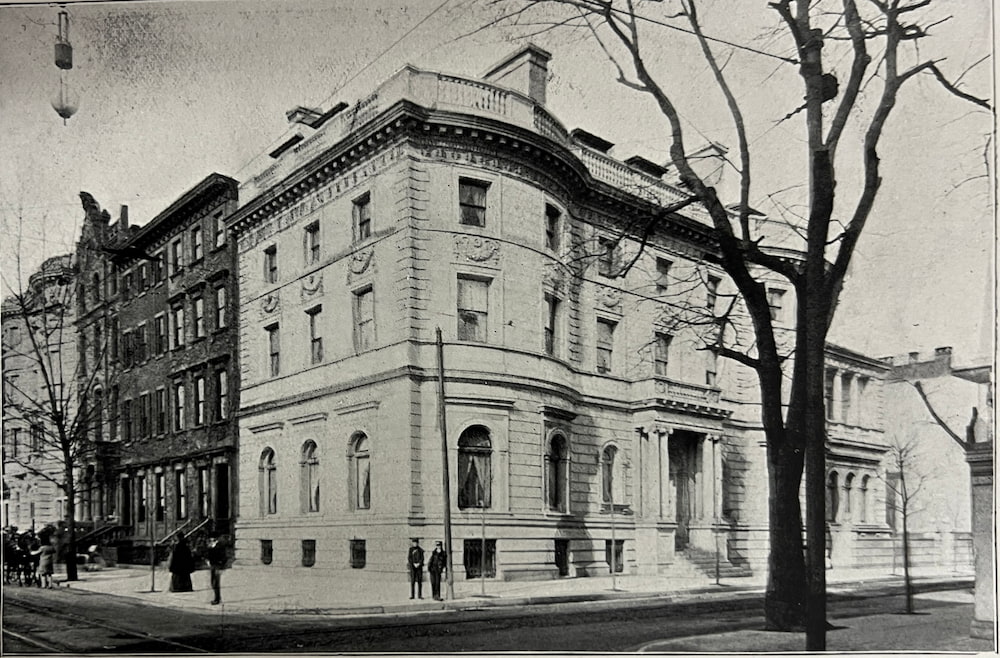
The Van Rensselaer Mansion is a three story Beaux Arts house designed by Peabody and Sterns and described as “the finest [Beaux Arts residence] in the city” by its contemporaries (King 62). The stone and marble house stood out from the brick townhouses that surrounded it and the Italianate villa located across the street (Heinzen 85). The style, originating in Paris in the mid to late 19th century , combined elements of ancient Greek and Roman structures and the flourishes of French, Italian Renaissance and Baroque styles. Beaux Arts became a symbol of the Gilded Age as it made its way to America, inspiring designs for public works such as the New York Central Library to private mansions such as this one (Kliest). It can be identified by its use of symmetry, intricate carvings that draw from the Greek and Roman cannon, theatrical staircases, and rich ornamentation that is inspired by cultures and periods across history.
Facade and Entrance:
The facade and entrance of the residence combine many elements of the style to provoke a stately and grand house. The scale is expanded with high ceilings and a raised first floor, making the building rise up above you as you stand on the ground below. On the exterior carving abound, with quoins deck the corners and deep-set stone casings surround the arched windows. Under each of the windows on the third floor, a festoon reaches across each end. Near the roofline, an entablature full of carved medallions sits below the dentils sitting along the edge. Combined with the undulating exterior, the design begins to feel Baroque, with its associations to grandeur and opulence. Despite this, the ornament does not overpower the facade, likely due to the precise symmetry that brings balance and classical inspiration to the facade.
Moving towards the entrance, you can’t help but stop and notice the intricately carved portico, with the unique capitals of the columns supporting it. While not quite from any particular order, the four volutes that surround the capital bring their own flavor, while egg and dart moulding and carved lions heads symbolize taste and strength. The floral margents that flank the double arched doors draw you deeper into the house.
The Grandeur Continues:
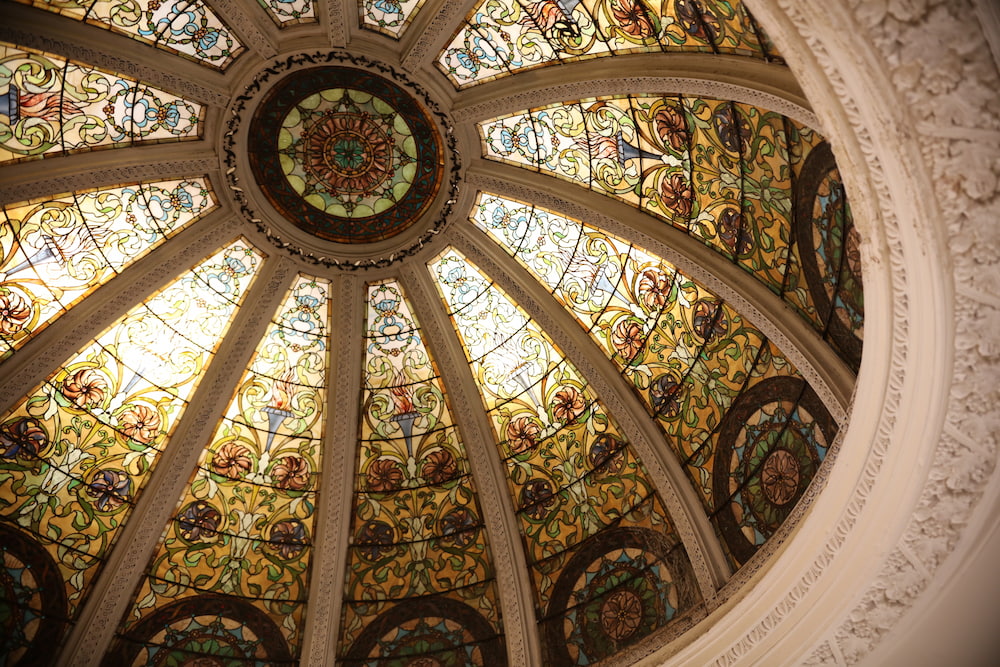
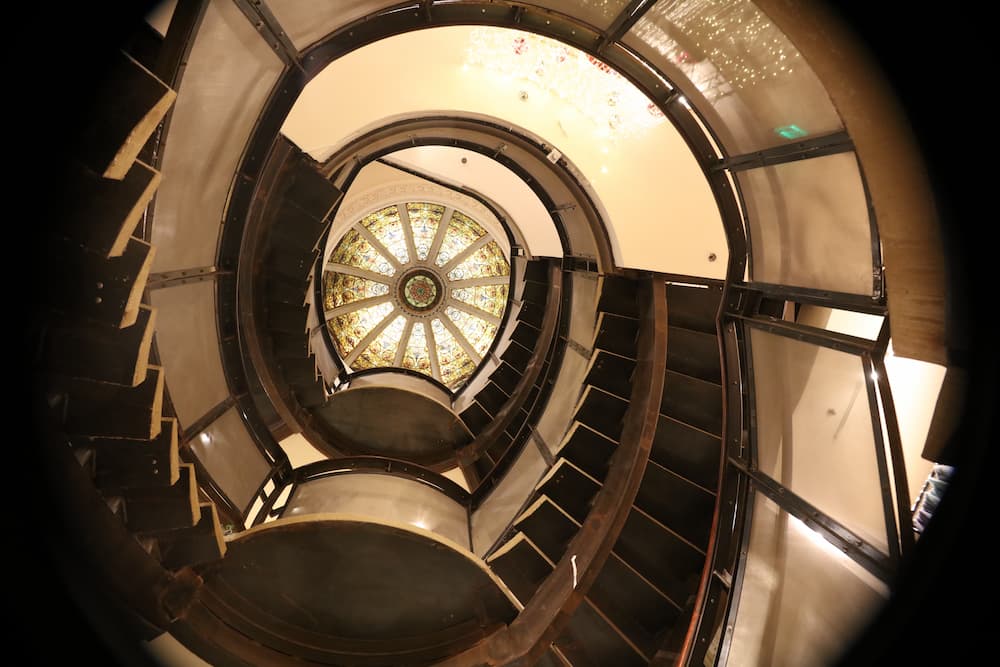
Once inside the dramatic spiral staircase draws your eye up to the intricate glass dome made by Tiffany. The stained glass depicts a distinctly Art Nouveau arabesque, the chrysanthemums combining with leaves and scrolls as they wind around each of the twelve mirrored, identical panels. Below this a colorful mandela contains simplified floral motifs while at the very top, a lit torch feels truly aflame because of the light streaming in.
If you don’t get lost staring at the dome for too long, Mrs. Van Rensselaer’s drawing room to the right of the entrance begs for your attention. Perhaps what remains the most elaborate room today, what stands out most are the fireplace and ceiling.
Popes or Doges?:
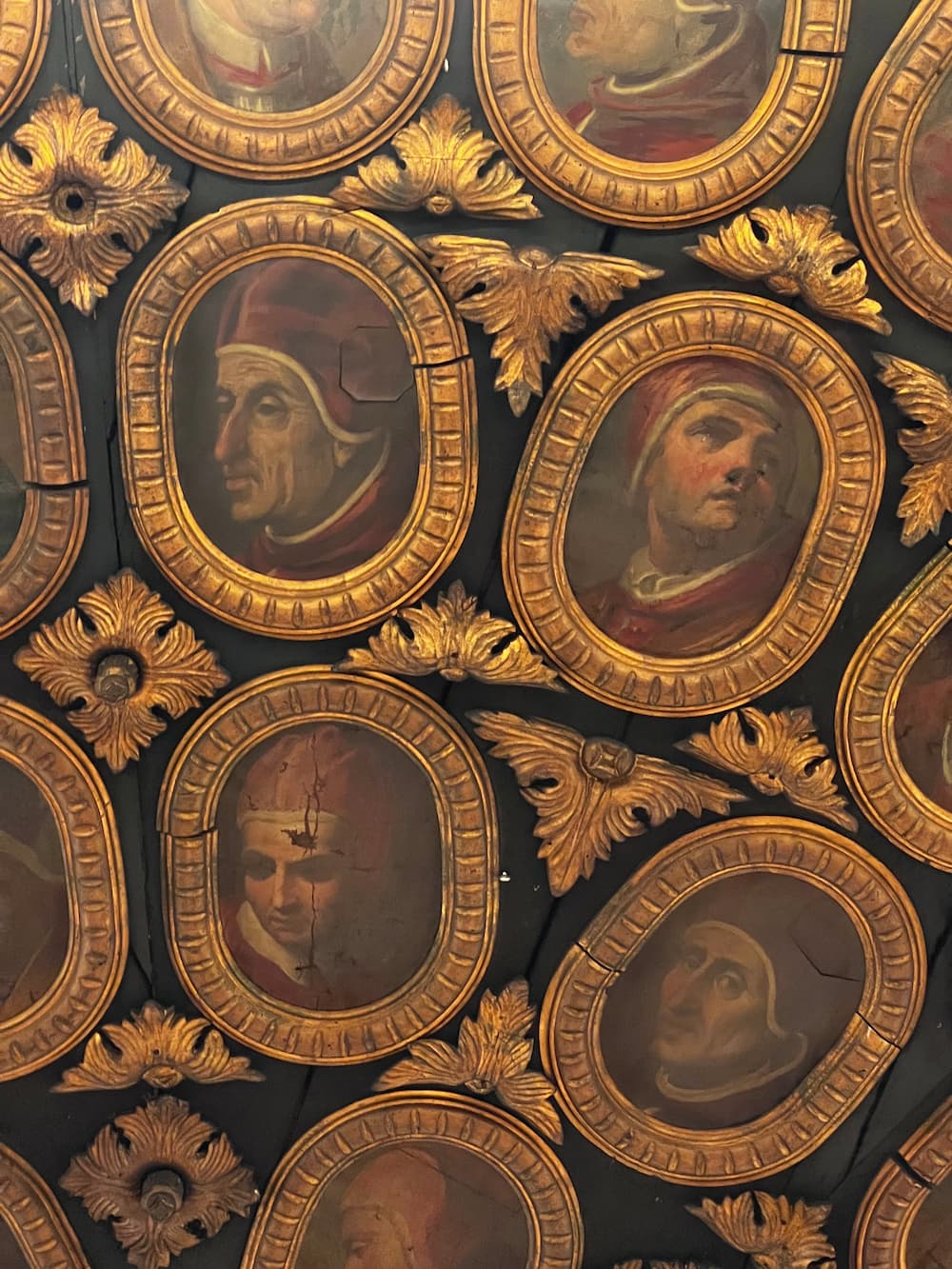
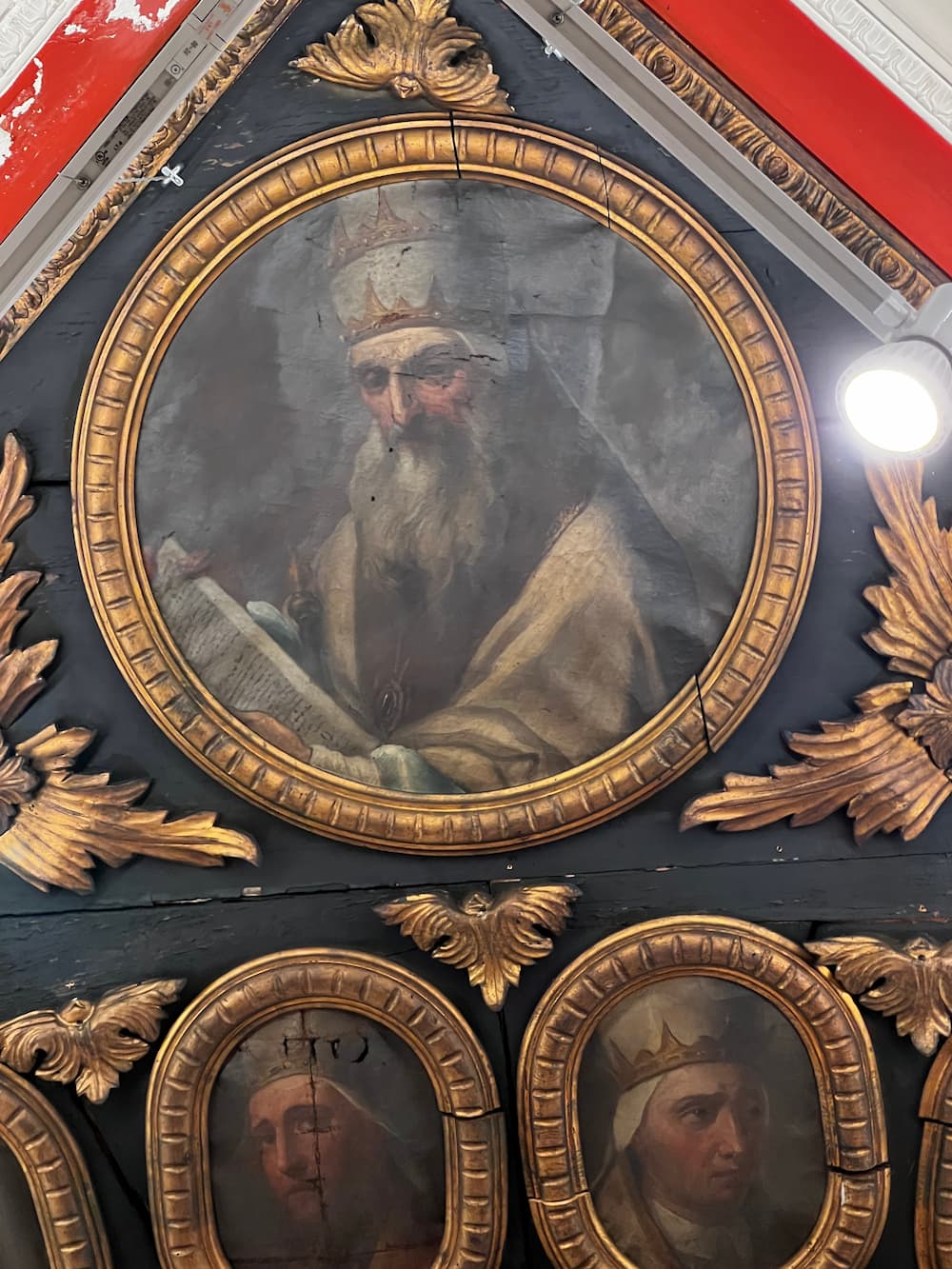
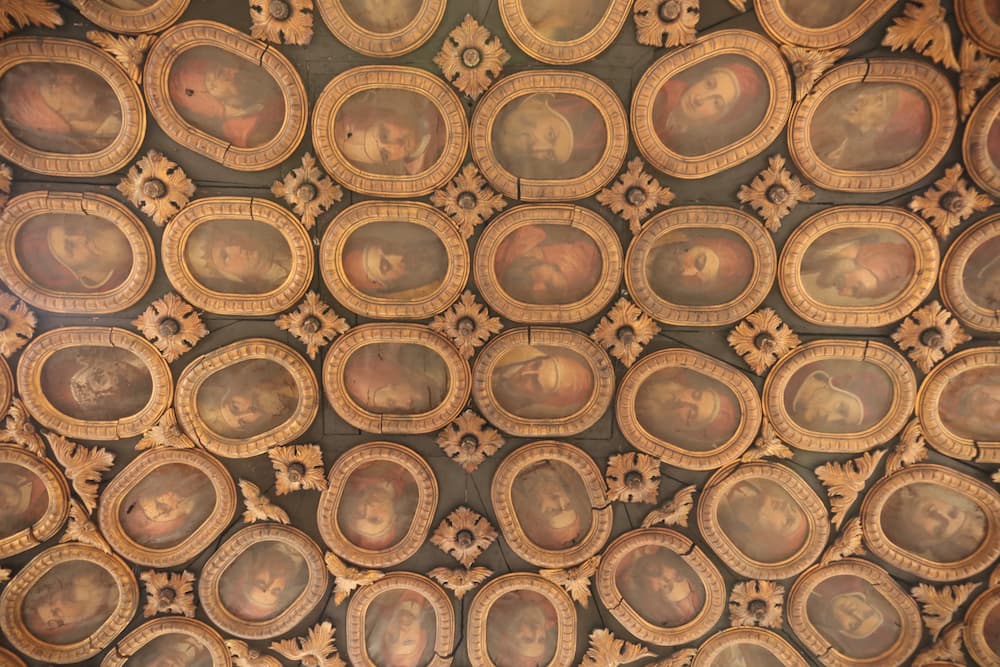
In the drawing room, if you look up, dominating most of the ceiling is a series of close up portraits in oval, gold-leafed frames which are arranged in a series of five rings with gold ornaments taking up the empty space in between each and backed by black paint. The subjects of the ninety-four canvas portraits that make up the ceiling have been a long debated subject (Heinzen 85)(Mariarose). Many sources point to them as doges of Venice but I believe that is wrong for a number of reasons. The garb is not a corno ducale, the traditional headwear of doges, it is distinctly lacking the distinct ducal horn shape and golden banded brim. The bonnet-like hat that is red with white trim instead looks like camauro hats worn by Popes. Similarly, the burgundy vestments with a white collar more closely resemble a mozzetta and priestly collar than the golden cape worn by the doges. At each corner of the square, four larger portraits depict popes wearing the white, tiered papal tiara making me completely sure that these were not doges. The popes seem to range from the early renaissance through the mid-17th century. The portraits draw from many different styles of art such as Baroque, Mannerist, and Neoclassical and were likely painted by multiple artists based on the difference in techniques and composition. Perhaps picked up in Europe on one of the family’s many foreign travels, the unique ceiling brings together the historical nature of the building, the worldliness of the design, and an Italian influence on the house.
A Family House:
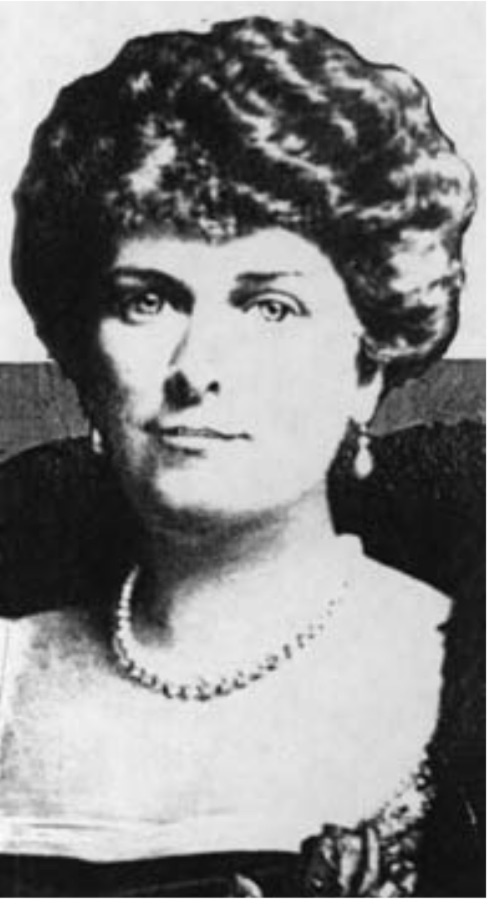
The owner of the house and its name sake is Sarah Drexel Fell Van Rensselaer. Her first husband John R. Fell died in 1885 and left her a significant amount of money, which she used to build the mansion two years later, right after a trip to Europe(Philadelphia Inquirer 1929). Moving out of her residence at 313 S Broad Street, she designed this family home for herself, her four children, and her new husband. Hailed as the finest mansion in Philadelphia, the project used her considerable fortune to erect the grand mansion. As a member of the Drexel Family and one of Philadelphia’s most well known socialites, this display of “new money” was not unfamiliar to Sarah Van Rensselaer. The design was the centerpiece of her network and acted as “one of Philadelphia’s great social centers” (Burt 470).
An Athletic Afterlife:
After Sarah Van Rensselaer passed in 1929 and her children and husband had moved out, the mansion fell into a state of disrepair. In 1942 , the Penn Athletic Club decided to move from down the street to the mansion, paying $115,000 to her descendents in exchange for the 44 x 151 ft lot and house on it. The repairs to the mansions started in the summer of that year and required the large amount of soot and dust that had accumulated to be dealt with (The Philadelphia Inquirer 1942).. The club continued there with middling success, being described as having the “dreariest dining rooms in town” by the early seventies (Marciarose).
A Rental Haven
In 1973, the mansion was bought by Design Research from the athletic club. The company specialized in modern, especially Scandinavian home design and was founded by Ben Thomspon in 1953. They put in over $1.1 million into restoring it to its former glory while updating it for retail purposes, kicking off its modern retail history (Marciarose).
An Anthropological Anthropologie:
Today, the mansion is a flagship Anthropologie store, a Philadelphia based retailer that sells clothing, jewelry, and home goods. Each of the four floors overflows with their unique goods while still letting the old house below it shine. The photos I had been seeing do not do it justice, although I was sad to see the state it was in, with the cracking plaster and rotting wood. Much of the house has been torn down to its studs and a six floor building almost placed within the frame of the building. Still the historic nature shines through, with many of the original fireplaces intact, the ceiling of popes, and stained glass. In person, the Tiffany glass dome almost felt like it was alive,, the flowers growing and flowing in a breeze, the fire in the torch aflame. From an interview with a store associate about what it means to be a flagship store, the brand pays extra attention to the selection of products and the displays and art that accompany it. Being near their headquarters, the company views it as their signature store, and they said that they work to incorporate and highlight the historical nature of the building. The art and displays she described are typical to Anthropologies, being well known for the intricate, large art installations that are added seasonally in their stores. Perhaps in a way these larger than life installations carry on the legacy of the Van Rensselaers, bringing to the house these grand displays of art. The pieces are brought and thus funded by the business that occupies the space like the industry tycoons that built the grand mansion. Anthropologie uses the art and architecture of the past to give an air of authenticity and luxury to the business and its products, like how Mrs. Van Rensselaer used the style to support her social standing in Philadelphia.
Why Did This Mansion Remain Standing?:
The days of Rittenhouse square as a hunting grounds and place for family mansion are long over, now the square is lined with shops and restaurants. In the time since, many of the original homes have been torn down, replaced tall apartment buildings and modern business offices. Now, this mansion remains standing as one of the last original homes on Rittenhouse square. I was surprised in my research to find no mention of ever tearing to down to make way for a taller building or better use of the space. I feel also that just by virtue of being such a masterpiece of a house it has remained standing. But anyone who knows a little about architectural history knows that that doesn’t ensure its survival. It also hasn’t been damaged by fire or rot or natural disaster, which all allow it to still be here. But I think most importantly, owner after owner has been dedicated to the survival and restoration of the building, putting the time, effort, and money in to maintain its upkeep. They are able to see what it means, how it is a part of the story of Philadelphia and one that deserves preservation.
What Does it represent and how does it reflect the Global City
The Van Rensselaer mansion stands as a testament to the many layers of Philadelphia, but more specifically as a peak into the sophisticated upperclass of industry and commerce barons that brought the world to Philadelphia and Philadelphia to the world. This house acts as a private accompaniment to the museums and institutes such as the Philadelphia Art Museum and the Athenium, giving a look behind the curtains to the personal side of a socialite and society benefactor. The house shows the taste of how architecture from Paris and Greece found its way. While Italian popes made their way to its ceiling, looking down over a large family of Drexels, Fells, Van Rennselaers and more who called Rittenhouse Square home, many of whose families come from recent immigrants themselves. Together, it is a truly global house.
Works Cited
“Anthropologie Won’t Be Leaving Rittenhouse Square Location - OCF Realty.”, January 16, 2014, Date Accessed: 2025-11-30 https://www.ocfrealty.com/naked-philly/rittenhouse/anthropologie-wont-be-leaving-rittenhouse-square-location/.
Burt, Nathaniel. The Perennial Philadelphians: The Anatomy of an American Aristocracy, University of Pennsylvania Press, 1999
Cohen, Charles Joseph, 1847-. Rittenhouse Square, Past And Present. [Philadelphia]: Priv. print., 1922.
“February 4, 1929 (Page 1 of 26).” Philadelphia Inquirer (1860-1934), 04 Feb., 1929, pp. 1. ProQuest, https://ezproxy.haverford.edu/login?url=https://www.proquest.com/newspapers/february-4-1929-page-1-26/docview/1831093221/se-2.
King, Moses. Philadelphia and notable Philadelphians, M King, New York, 1902.
Heinzen, Nancy M. “The Encroaching City [ 1884–1913 ].” The Perfect Square: A History of Rittenhouse Square, Temple University Press, 2009, pp. 79–92. JSTOR, http://www.jstor.org/stable/j.ctt14btdxf.9. Accessed 1 Dec. 2025.
“January 29, 1908 (Page 4 of 14).” Philadelphia Inquirer (1860-1934), 29 Jan., 1908, pp. 4. ProQuest, https://ezproxy.haverford.edu/login?url=https://www.proquest.com/newspapers/january-29-1908-page-4-14/docview/1827607009/se-2.
“May 16, 1942 (Page 6 of 58).” The Philadelphia Inquirer Public Ledger (1934-1969), 16 May, 1942, pp. 6. ProQuest, https://ezproxy.haverford.edu/login?url=https://www.proquest.com/newspapers/may-16-1942-page-6-58/docview/1833069824/se-2.
Rivinus, Marion Willis Martin. The Story of Rittenhouse Square- 1682-1951, S.A. Wilson Company Philadelphia, 1951.