Library and Surgeons Hall Item Info
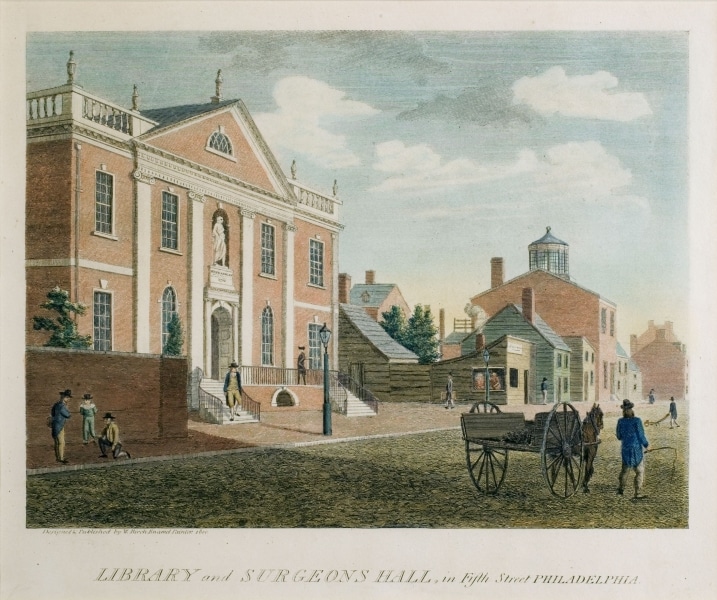
- Title:
- Library and Surgeons Hall
- Creator:
- William Birch
- Date Created:
- 7/1/1800
- Subjects:
- architecture
- Location:
- Library and Surgeons Hall
- Latitude:
- 39.9478
- Longitude:
- -75.1631
- Source:
- https://librarycompany.org/2024/06/24/a-tour-of-the-library-companys-buildings/
- Rights:
- Public domain
Library and Surgeons Hall
The Loganian Library and The Library Company of Philadelphia were originally separate entities, but the founders of these collections, James Logan and Benjamin Franklin, both had similar intentions for each of these library collections. Both men were influential figures in the new revolutionary city of Philadelphia, and they wanted the general population to have equal access to educational books since most individuals would not have otherwise been able to afford to peruse these materials for themselves. By providing access to these book collections to the general population of the city, they hoped it would help educate the citizens and individuals would have the opportunity to advance their class status, resulting in more contributors to the new city. The collection of books that both Benjamin Franklin and James Logan had in their libraries represented many cultures, disciplines, and authors from across the world, both prominently included Italian works. In time, The Library Company of Philadelphia integrated the Loganian Library into its collection and has since acquired many more collections of books and undergone much locational and administrative change. The Library Company still has a presence in the city of Philadelphia and its historical symbolism and significance is not forgotten. The Library Company of Philadelphia not only allowed for the ability to share knowledge through acquired literature, but it also provided some of the very first exposure of knowledge of Italian culture to the general population of the city through Italian literature. Through the different genres of literature and the many different literary cultures the collection represented, the Library Company of Philadelphia played a part in revolutionary Philadelphia’s evolution to a global city.
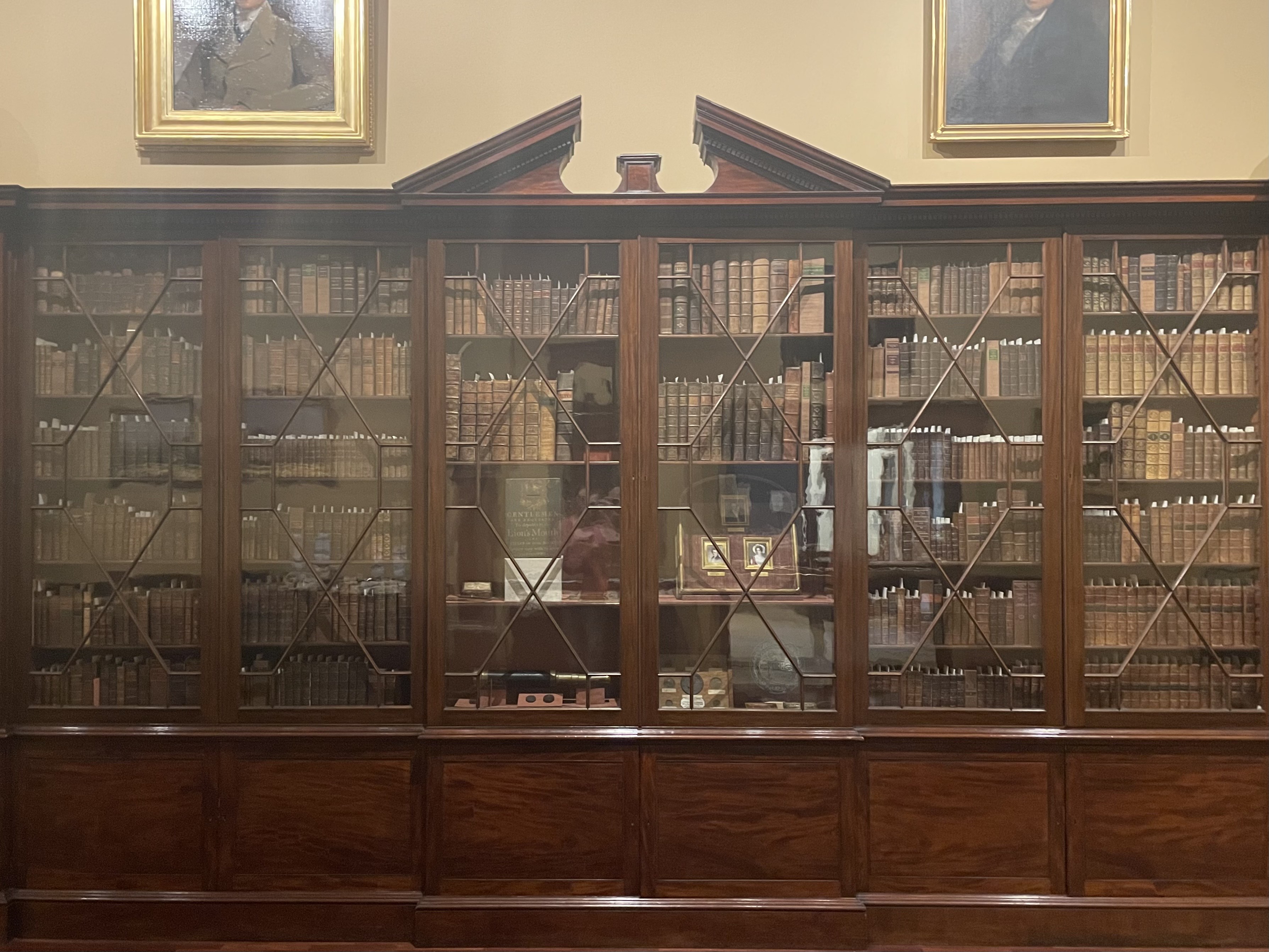
The Loganian Library was a trust originally created in 1754 as James Logan’s wish was for his book collection to be available to the public. James Logan was a wealthy politician who was able to amass a large collection of literary materials through his resources. As stated by Dana Dorman on the Library Company of Philadelphia’s webpage on James Logan, “Logan’s personal wealth allowed him to feed his wide-ranging scholarly interests with an impressive book collection. One biographer observed, “It is not too much to say that James Logan was the greatest bookman of colonial America.”1 His library collection was first housed in his country estate, Stenton, built in 1730 and located at 4601 N. 18th St, Philadelphia, PA 19140 (Dorman, n.d). Designed by James Logan himself, the building is of Georgian style made of red brick, with many large windows on the exterior outlined by white trim. The original building is still standing today in northern Philadelphia, as a museum depicting the life of James Logan (Stenton, n.d.). 2 James Logan was a Scottish-Irish colonial settler, who came to the British Colonies to be the Provincial Secretary to William Penn. He was a well-educated politician and scholar, who held a number of offices in the colonies. He is also a controversial figure for his work to drive the Lenape People from Pennsylvania, and his position as a person who partook in slave ownership (Dorman, n.d). He was determined to create an educated society though and donated his personal collection of reading material to the public use. Due to James Logan’s passing three years prior to the creation of the library, Logan’s two sons and Benjamin Franklin were the trustees of his library (Femia, 2025).3 The Loganian Library was housed at the Stenton estate only from 1754 to 1791, after which the then-trustees, Benjamin Franklin and Logan’s two sons decided to integrate the collection into The Library Company of Philadelphia, which was founded by Benjamin Franklin and the Junto Club.4
The Library Company of Philadelphia was founded from Benjamin Franklin’s Junto Club, a group of like-minded individuals seeking self-improvement to increase their social class position in the city. Together the members were able to collect and share books that they would not otherwise have been able to afford (Strahan, 2021).5 ). Each member contributed 40 shillings a month and were able to have equal access to the collection of books and literary materials (The Library Company of Philadelphia, 2018).6 Evolving from this system, came the first subscription library available for the public in the colonies meant to encourage and support experimental and forward thinking. Benjamin Franklin sought to create a place where anyone would be able to educate themselves without it costing anything but time. The Library Company of Philadelphia was once the only book lending institution in the United States, and still houses the 372 best sellers from the first library catalog in 1731 (The Library Company of Philadelphia, 2018). Additionally, when Philadelphia was the capital of the United States, the Library Company of Philadelphia served as the Library of Congress for the country. As stated in “A Tour of the Library Company’s Buildings Over its First 150 Years” by Dana Dorman, “The Directors of the Library Company voted in August 1774 to offer free use to the [First Continental Congress] delegates of “such Books as they may have occasion for” if they took a “Receipt for them.”7 Over time, the Library Company has expanded immensely, from the donations it has accepted and the merging of outside collections, such as the Loganian Library and the Union Library, and by pivoting from a lending library to a research institution, still with the mission of providing equal access to resources for everyone. When the Free Library of Philadelphia, chartered in 1891, took over as Philadelphia’s main library, the Library Company saw a downturn in patron activity (Finkel, 2022).8 During the mid twentieth century, following the Great Depression and the World Wars, the Library Company transformed from a library into a research institution under Librarian Edwin Wolf II expertise and guidance (B. Reader, Haugaard, n.d.). 9 Today, the Library Company of Philadelphia’s archives and literary materials are still available for use in research at their building on Locust Street. John C. Van is the Library Company director today, and has overseen many curation projects of the Library’s archives and collections.10
An important aspect of the Library Company of Philadelphia’s collection is its Italian literature and influence. When Benjamin Franklin created the Library Company, he did so with the intention to advance the early United States, through equal access to materials and knowledge (Dorman, n.d.).11 Italian art, architecture, and literature was thought to be of the highest knowledge and class, so he collected many works of Italian philosophy and theory to include in the Library Company collection. Benjamin Franklin’s collection is one of the many reasons that the colonies had an understanding and awareness of Italian culture, philosophy, and art, specifically for Philadelphia in its time as the capital of the nation and a revolutionary city. Through letter correspondence between Benjamin Franklin and Gaetano Filangieri, an Italian philosopher, there is an understood admiration and friendship between the two men (University of Virginia Press, n.d.). Filangieri gifts his authored books to Franklin, and offers to send more for Franklin’s associates to peruse. As directly stated from a letter to Benjamin Franklin from Gaetano Filangieri, “I sent a few copies of my work to Signor Pio, Embassy Secretary in Paris of the Court of Naples and I asked him to give you a copy in my name— also to beg you to accept a few more, should you be inclined to give them to some friends.”12 From this correspondence, the integration of Italian culture and literature is evident through Benjamin Franklin’s collection of Italian works. Furthermore, the argument can be made that Benjamin Franklin’s reputation for being a proponent of self-advancement and education influenced immigrants, such as Italian-Americans, to pursue an education and to work to advance their social class (Holte, 1978).13 In Holte’s work, in reference to the success of immigrants in, “Benjamin Franklin and Italian-American Narratives” he states, “ It is quite natural that those who were successful-and those were most often the ones who wrote autobiographies-would see in Franklin’s life a model for their own (101).” Benjamin Franklin’s influence of Italian literature and culture to the colonies did not just influence the colonialist, but also influenced later Italian-American immigrants who were looking for someone to model their life goals after.14
Since its founding in 1731, the Library Company of Philadelphia has had many locations; the librarian’s own homes, the State House (now Independence Hall), Carpenter Hall, Ridgeway Hall, but the two locations that were specifically intended for the Library Company were the Library Company building designed by William Thornton in 1791 at Fifth and Chestnut Street and the current home of the Library Company at 1314 Locust St, Philadelphia, PA 19107 (Dorman, n.d.). The very first location of the Library Company of Philadelphia was in each librarian’s house, starting with Louis Timothee (1732-1733) who served as librarian for a year, then Benjamin Franklin himself (1733-1734) who also served for a year as librarian, then William Parsons who was the final librarian to host the books in his home (1734-1740) and was librarian for twelve years (Dorman, n.d.). In 1740, the books were moved to the second floor of the west wing of the State House until 1773. After immense expansion in the collection from 1740 to 1773, the Library Company began renting from Carpenter Hall a block away from the State House (Dorman, n.d.). Eventually, the Library Company decided to go forward with plans to build a building that was specific to the Library Company to house books and artifacts, and on New Years Day in 1791 their first building opened, designed by William Thornton (Dorman, n.d.). Thornton’s original Library Company of Philadelphia building was Palladian in style, with a red brick exterior, and displayed a statue created in 1792 by Francesco Lazzarini of Benjamin Franklin at the top center wearing Roman-inspired attire (E. Thomas, 2019).15 Almost immediately, the building needed to be expanded to house the newly acquired Loganian Library collection, which was to be kept separate from the rest of the building. In 1794 the Loganian addition was completed on the east side of the building. Due to the ever expanding collection, the Library Company did not stay in this building permanently though, and moved again in 1878 at the reluctance of the board, due to a gift from Dr. James Rush to build the Ridgeway Building (Finkel, 2022)16 As Finkel states in the Encyclopedia of Greater Philadelphia, “Over the next several decades, the collections outgrew the original building. In 1869, a bequest of books and cash from Dr. James Rush (1786–1869), son of Dr. Benjamin Rush (1746–1813), enabled a much-needed new library.” The Library Company moved one final time in 1969, under the guidance of consultant Edwin Wolf II, to Locust Street, adjacent to the Historical Society of Pennsylvania and has been in this location since. The current Library Company building is an eight story, modernistic design, with an exterior of red brick, and the original 1792 Roman-inspired statue by Francesco Lazzarini of Benjamin Franklin is in the window on the first floor (Finkel, 2022). The three arches from the first to second floors on the exterior of the building can be recognized as Palladian in a modern sense, but the best representation of Palladianism in relation to the Library Company of Philadelphia should be viewed at the APS Library in Old City.17
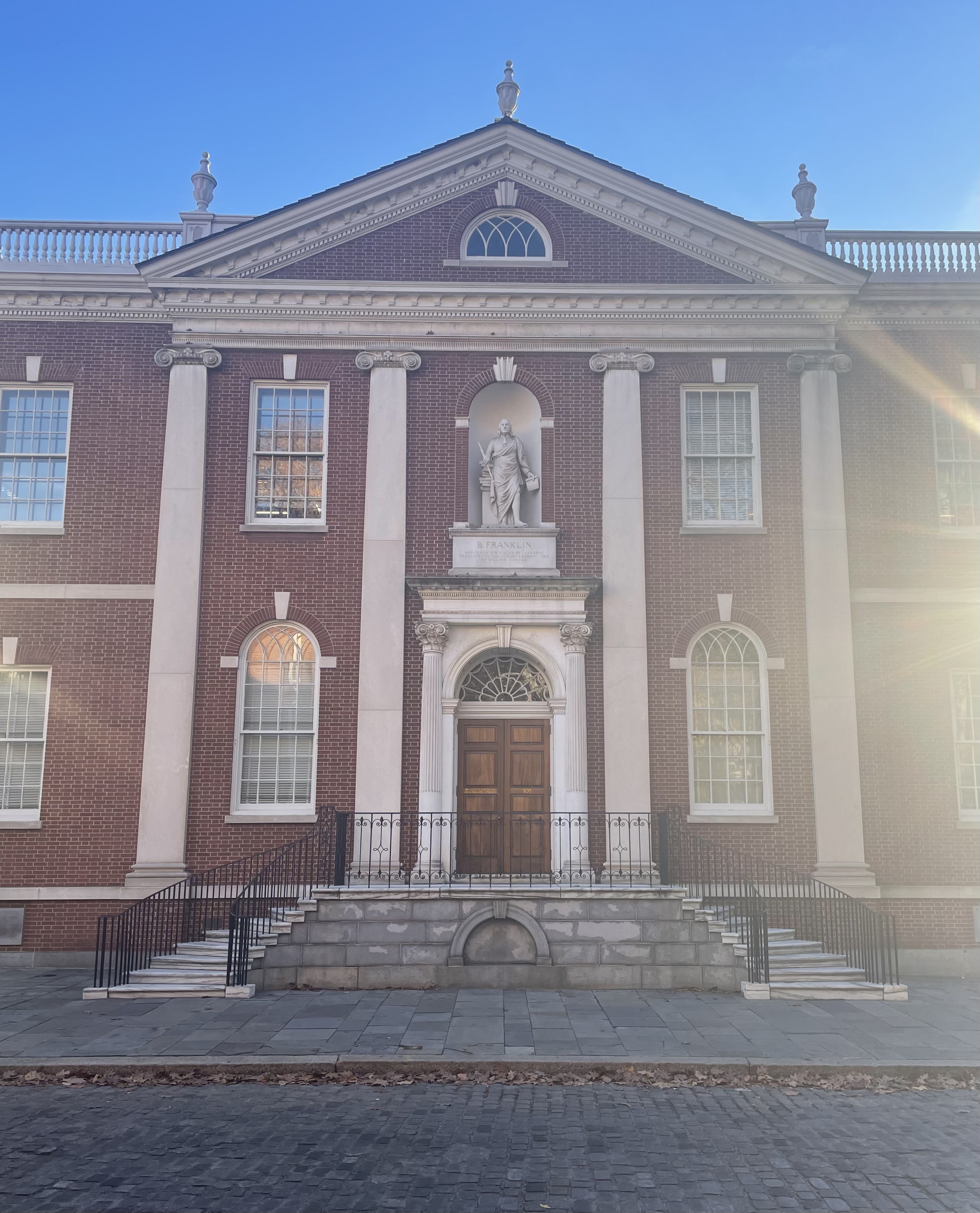
The same exterior of the original building intended for the Library Company of Philadelphia, designed by William Thornton and built in 1791, can be viewed across from the American Philosophical Society building, as the APS designed and rebuilt a replica of the William Thornton original for their library to house their research collections. Unfortunately, when the Library Company moved to the Ridgeway Building, the board sold William Thornton’s designed building to Anthony J. Drexel in 1884 and he demolished Thornton’s building to build his headquarters for the Drexel and Company Bank (Strahan, 2021).18 Eventually, the American Philosophical Society replaced Drexel’s building with a replica of Thornton’s Library Company building, which still stands today. In Strahan’s article, “Library Hall, Philadelphia, Pennsylvania” he examines the loss of William Thornton’s original building and analyzes the replica, as he states, “Most of this cleared land then became open space, but here on Fifth Street the Drexel Building was replaced by a replica of the old Library Hall.” It is important to understand William Thornton’s design of the original Library Company building, for its significance that Italian architecture and culture had on the newly global city of Philadelphia. Benjamin Franklin revered Italian society, culture, and literature, and was gifted literary works by Gaetano Filangieri that he kept in his collection.
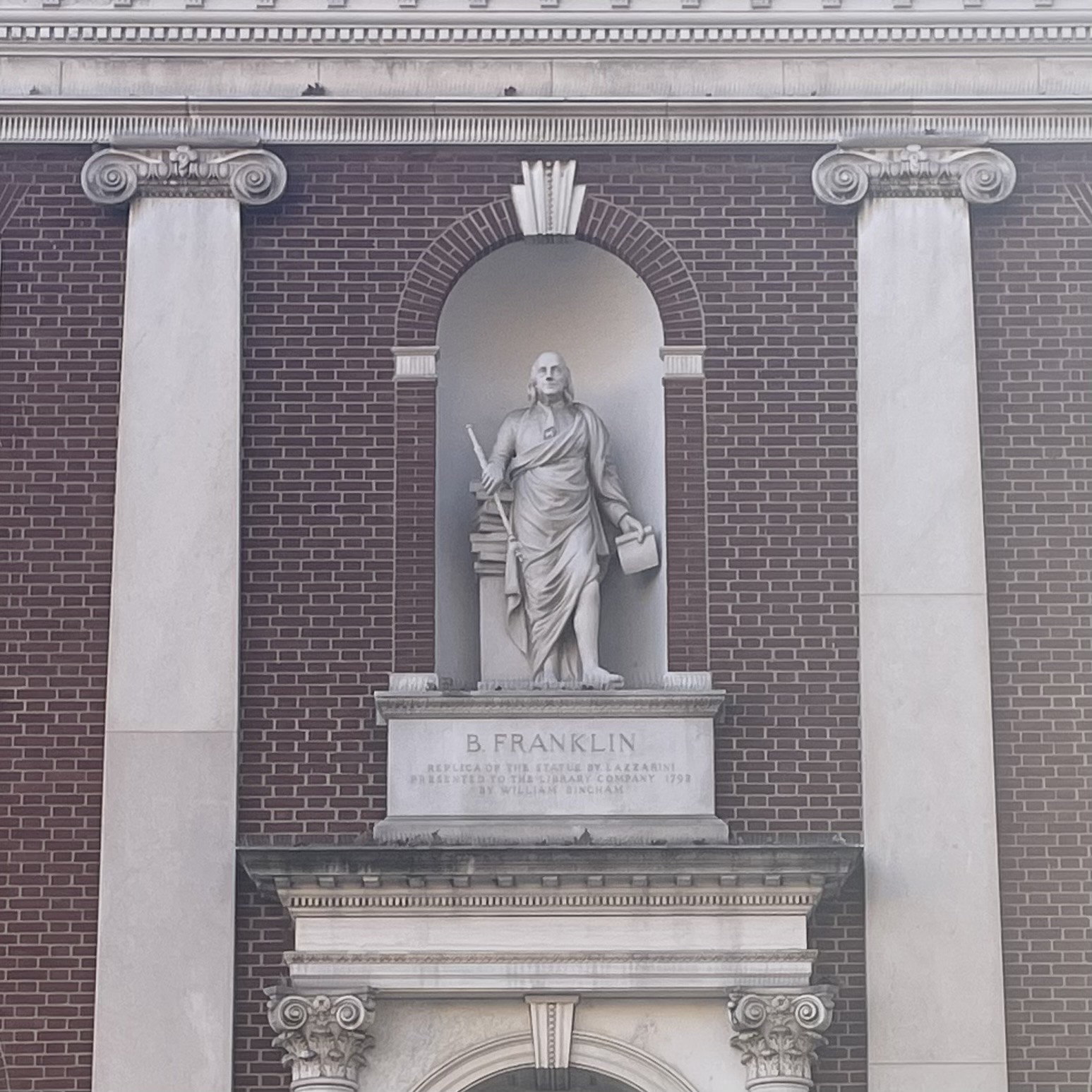
The original statue of Benjamin Franklin, created in 1792 by the Italian sculptor Francesco Lazzarini, now displayed in the window of the modern Library Company building on Locust Street, was at the top-center of William Thornton’s Library Company building at Fifth and Chestnut Street. The statue is important because it holds symbolic meaning for the city and colonies growth from its past towards a new future. Commissioned by William Bingham who was a lawyer and one of Philadelphia’s wealthiest residents at the time, the statue was also Philadelphia’s first public monument. Bingham commissioned and gifted the statue to the Library Company, to immortalize Benjamin Franklin for his founding role with the library (Association for Public Art, 2025).19 ). When analyzing Benjamin Franklin’s attire in the statue, the viewer can see that he is wearing typical colonial attire underneath a Roman toga. He is dressed in this atypical attire for a colonialist, due to his admiration of the Roman Republic and his hope that the new country of the United States would become a republic and not a monarchy, as was the one he had left (Finkel, 2012).20 Similar to his attire, other aspects of the statue point to his hope for a reduction of monarchies around the world. The scepter, a symbol of monarchs, that Benjamin Franklin holds in his left hand is pointed downward, symbolizing that monarchies are on the downturn and republics are on the upturn. His left arm is resting on a stack of books, symbolizing the importance of education and understanding literary material to be free in mind and body (Finkel, 2012). In his right hand, Benjamin Franklin holds a sheet of paper, representing diplomatic relations. Ken Finkel speaks to the Roman representation and what it meant for the political climate at the time, he states, “This Franklin would hold a scepter, inverted to represent his opposition to monarchy; this Franklin would preside over Independence Square when Philadelphia served as the nation’s capital.” After being on display at Thornton’s Library Company building, Francesco Lazzarini’s 1792 statue of Benjamin Franklin was severely damaged due to weather, and was moved from Thornton’s building in 1880, and today is on display in the window at the Library Company building on Locust Street. In the 1980s a replica of Francesco Lazzarini’s original statue of Benjamin Franklin was made by Lewis Iselin, Jr., to be at the top-center of the new American Philosophical Society Library, a replica of William Thornton’s original Library Company building. 21 22
The building that the architect Dr. William Thornton designed for The Library Company of Philadelphia, was chosen in a competition of designs to be the dedicated building for the Library Company. The design was Palladian in style, with a red brick exterior and white pillars. As stated in “A Brief History of The Library Company of Philadelphia”, “An amateur architect, Dr. William Thornton, won it with plans for a handsome Palladian red-brick structure with white pilasters and a balustrade surmounted by urns (7).”23 The board’s decision to choose Thorton’s design, with the building’s display of Palladianism, is synchronous with the buildings that surrounded it on the nearby streets. One of the nearby buildings, the State House (now Independence Hall) is a prominent display of Palladianism in Philadelphia. The building displays three large windows, two on either side of a dimensionally larger window, a very recognizable feature of Palladianism. The building also has three arches on each side of the main building, another recognizable feature of a Palladian styled building. The State House is very symmetric, similar to Thornton’s design of the Library Company building (American Philosophical Society, n.d.).24 The decision to design and build another Palladian style building in Independence Square, reflects on the influence that Italian style and culture had on Philadelphia as a global city. While the exact building is not still standing, the American Philosophical Society replica is able to be viewed in the same place that the original building once stood, to understand what the original building would’ve looked like from the exterior, with Palladian features.25 26
To conclude, many contributors have played a part in where the Library Company is today, such as librarians, consultants, beneficiaries, and the public patrons. The Library Company of Philadelphia is an institution that continues to support Benjamin Franklin’s intended mission to create free, accessible resources for anyone in Philadelphia. The initial message that is being conveyed to those who use or interact with the Library Company is that no one individual should own any knowledge without sharing it with those who do not have the same access to the resources. The Library Company of Philadelphia is an institution that does not have financial gain in ways of allowing members of the public to purchase the materials, it functions as an institution readily available for patrons to use its materials and understand its history. It is important to note that the Library Company does not ignore the fact that some of its founders and collectors did not have inclusive backgrounds, but it celebrates those who were underrepresented during the Library Company’s initial founding through current displayed collections. In today’s world, where outside of a college institution, knowledge is commonly not readily shared, it is important to have organizations that are still willing to allow access to public resources and materials, for the betterment of society. The missions of both Benjamin Franklin and James Logan are being continued today through the current efforts of the Library Company of Philadelphia, and the history of the Library Company reflects the importance of Italian style, culture, and architecture on revolutionary Philadelphia as a global city.
Footnotes
-
Looking Back at the Loganian Library – the Library Company of Philadelphia. 4 Oct. 2024 ↩
-
“Franklin and Logan Stenton” ↩
-
Femia, Vincent. “The Collector: James Logan and His Library.” American Philosophical Society, 18 Aug. 2025 ↩
-
Picture 1 “Stenton House” The National Society of The Colonial Dames of America in the Commonwealth of Pennsylvania at Stenton, n.d. ↩
-
Strahan, Derek. “Library Hall, Philadelphia, Pennsylvania.” Lost New England, 30 Apr. 2021 ↩
-
Treasures From the Library Company of Philadelphia: The Junto. – the Library Company of Philadelphia 24 May 2018 ↩
-
Dorman, Dana. A Tour of the Library Company’s Buildings Over Its First 150 Years – the Library Company of Philadelphia. 24 June 2024 ↩
-
Finkel, Kenneth. “Library Company of Philadelphia.” Encyclopedia of Greater Philadelphia, 6 Apr. 2022 ↩
-
B. Reader, David & Haugaard, David. Edwin Wolf II, the Philadelphia Award ↩
-
Picture 2 Birch, William. “Library Hall and Surgeons Hall, Fifth Street”. The Library Company of Philadelphia 1800 ↩
-
Dorman, Dana. A Tour of the Library Company’s Buildings Over Its First 150 Years – the Library Company of Philadelphia. 24 June 2024 ↩
-
University of Virginia Press. (n.d.). Founders online: Gaetano Filangieri to Benjamin Franklin, 24 August 1782. ↩
-
Holte, J. C. (1978). Benjamin Franklin and Italian-American narratives. MELUS Multi-Ethnic Literature of the United States, 5(4), 99 ↩
-
Picture 3 Johns, Madelynne. Bookcase of Loganian Library Book Collection at The Library Company of Philadelphia. 24 November 2025. ↩
-
E. Thomas, George “Library Hall of the American Philosophical Society.” SAH ARCHIPEDIA, 17 June 2019 ↩
-
Finkel, Kenneth. “Library Company of Philadelphia.” Encyclopedia of Greater Philadelphia, 6 Apr. 2022 ↩
-
Picture 4 The Library Company of Philadelphia. 1314 Locust Street, Philadelphia, PA 19107. 2024 ↩
-
Strahan, Derek. “Library Hall, Philadelphia, Pennsylvania.” Lost New England, 30 Apr. 2021 ↩
-
“Benjamin Franklin - Association for Public Art.” Association for Public Art, 14 Nov. 2023 ↩
-
Finkel, Ken. Poor Richard in a Roman Toga – Philly History Blog. 24 Apr. 2012 ↩
-
Picture 5 Johns, Madelynne. American Philosophical Society Library, replicating Francesco Lazzarini’s original statue of Benjamin Franklin. 24 November 2025. ↩
-
Picture 6 Finkel, Ken “Franklin by Lazzarini, 1791” The Philly History Blog 24 April 2012 ↩
-
“At the Instance of Benjamin Franklin:” A Brief History of the Library Company of Philadelphia_. 2015 ↩
-
“In The Heart of Philadelphia: The Story of Library Hall.” American Philosophical Society, ↩
-
Picture 5 Johns, Madelynne. American Philosophical Society Library exterior, replicating William Thornton’s original Library Company Building. 24 November 2025. ↩
-
Picture 7 Johns, Madelynne. American Philosophical Society Library exterior, replicating William Thornton’s original Library Company Building. 24 November 2025. ↩
Works Cited
“At the Instance of Benjamin Franklin:” A Brief History of the Library Company of Philadelphia_. 2015 https://www.librarycompany.org/about/AttheInstance2015_98709140764695.pdf
“Benjamin Franklin - Association for Public Art.” Association for Public Art, 14 Nov. 2023, www.associationforpublicart.org/artwork/benjamin-franklin-3.
B. Reader, David & Haugaard. “David Edwin Wolf II”, the Philadelphia Award. www.philadelphiaaward.org/winners/edwin-wolf-ii.
Dorman, Dana. “A Tour of the Library Company’s Buildings Over Its First 150 Years” – the Library Company of Philadelphia. 24 June 2024, librarycompany.org/2024/06/24/a-tour-of-the-library-companys-buildings.
Dorman, Dana. “Looking Back at the Loganian Library” – the Library Company of Philadelphia. 4 Oct. 2024,[librarycompany.org/2024/10/04/looking-back-at-the-loganian-library (http://librarycompany.org/2024/10/04/looking-back-at-the-loganian-library)
E. Thomas, George “Library Hall of the American Philosophical Society.” SAH ARCHIPEDIA, 17 June 2019,sah-archipedia.org/buildings/PA-02-PH12.8.
Femia, Vincent. “The Collector: James Logan and His Library.” American Philosophical Society, 18 Aug. 2025, [www.amphilsoc.org/news/collector-james-logan-and-his-library (http://www.amphilsoc.org/news/collector-james-logan-and-his-library).
Finkel, Kenneth. “Library Company of Philadelphia.” Encyclopedia of Greater Philadelphia, 6 Apr. 2022,philadelphiaencyclopedia.org/essays/library-company-of-philadelphia.
Finkel, Ken. “Poor Richard in a Roman Toga” – PhillyHistory Blog. 24 Apr. 2012, blog.phillyhistory.org/index.php/2012/04/poor-richard-in-a-roman-toga/#:~:text=Benjamin%20Franklin%20lived%20in%20the,it%20and%20we%20know%20it
“Franklin and Logan, Stenton.” Stenton, www.stenton.org/franklin-and-logan.
Holte, J. C. (1978). “Benjamin Franklin and Italian-American narratives.” MELUS Multi-Ethnic Literature of the United States, 5(4), 99, https://doi.org/10.2307/467301
“In The Heart of Philadelphia: The Story of Library Hall.” American Philosophical Society, www.amphilsoc.org/museum/exhibitions/heart-philadelphia-story-library-hall.
“James Logan and the Networks of Atlantic Culture and Politics,” 1699-1751. librarycompany.org/jameslogan.
Strahan, Derek. “Library Hall, Philadelphia, Pennsylvania.” Lost New England, 30 Apr. 2021, lostnewengland.com/2021/04/library-hall-philadelphia-pennsylvania
“Treasures From the Library Company of Philadelphia: The Junto.” – the Library Company of Philadelphia 24 May 2018,librarycompany.org/2017/06/09/treasures-from-the-library-company-of-philadelphia-11.
University of Virginia Press. (n.d.). Founders online: Gaetano Filangieri to Benjamin Franklin, 24 August 1782. https://founders.archives.gov/documents/Franklin/01-38-02-0029
View of Benjamin Franklin and Italy by Antonio Pace. scholarworks.iu.edu/journals/index.php/imh/article/view/7878/9470.