"Mario Lanza" Mural Item Info
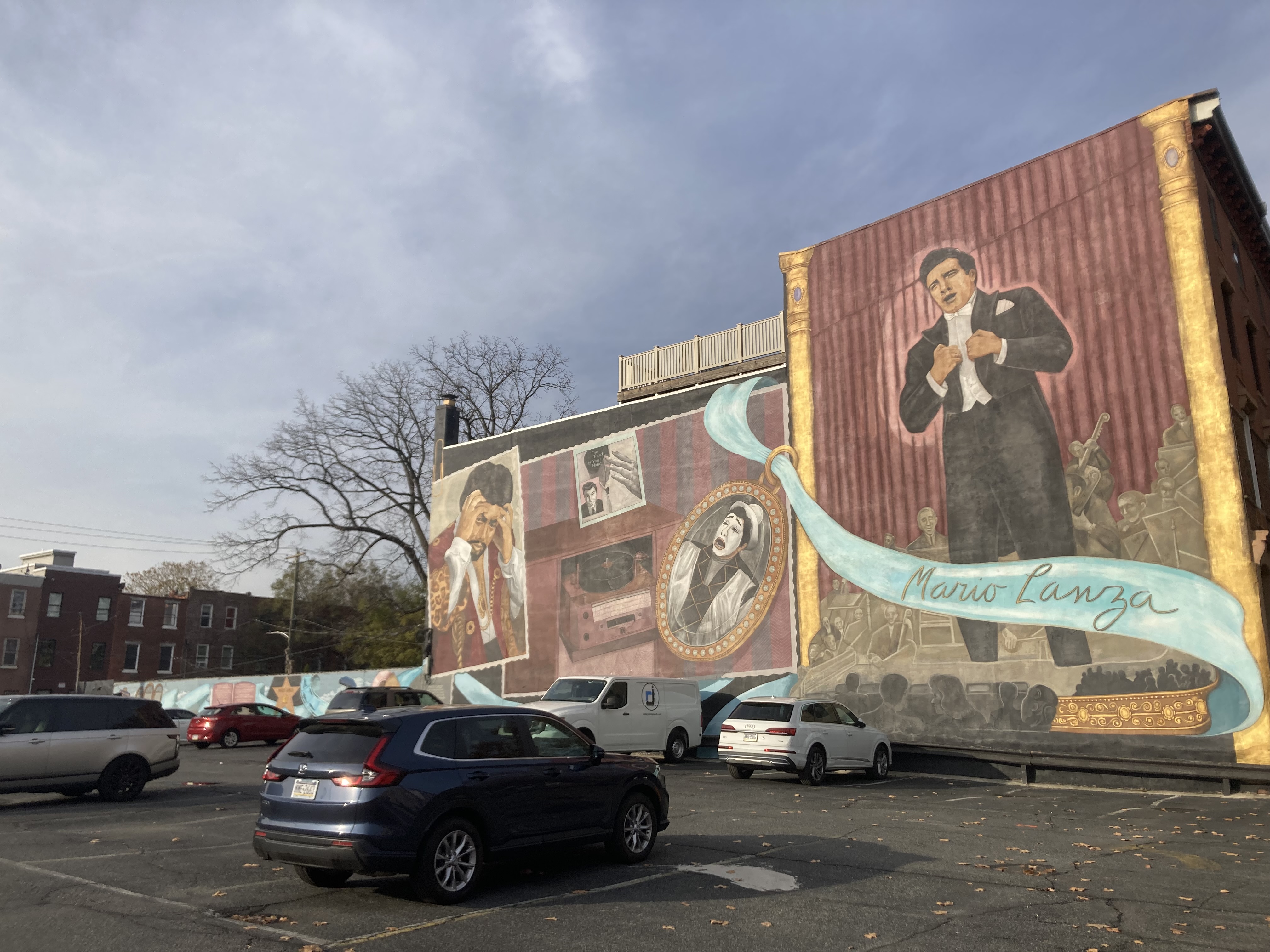
- Title:
- "Mario Lanza" Mural
- Creator:
- Diane Keller (artist); Zakkai Mares-van Praag (photographer)
- Subjects:
- mural
- Location:
- "Mario Lanza" Mural
- Latitude:
- 39.9333521140865
- Longitude:
- -75.1683545372
- Rights:
- Mural Copyright 1997 Diane Keller. Photographs are made available on this site for educational and scholarly purposes and are licensed under CC BY-NC.
- Standardized Rights:
- https://creativecommons.org/licenses/by-nc/4.0/deed.en
Mario Lanza Mural
Introduction and Murualist Background
This project discusses a mural of Mario Lanza, titled as such (“Mario Lanza”). I have walked by this mural often, and recently, it piqued my interest, with the knowledge I would be taking a class focused on Italians and Italian influence in Philadelphia. In addition, I love to sing, and felt this would be a good opportunity to uncover and understand more about Mario Lanza’s influence, as he is a figure I was unaware of prior to viewing this mural.
The project is by Diane Keller, with assistants Joe C. Di Bella and Kathryn Pannepacker. I was unable to find significant information on Keller online, but did find her online website, which is a tad dated. Her resume, which includes the Mario Lanza mural, and those of other Italians in the Philadelphia area, is not updated past 2008 - it seems likely that in recent years, she has retired. I was able to find a Facebook post in 2023 depicting Keller donating a framed painting of this very Mario Lanza mural to the Mario Lanza Institute, so as far as one can tell, she remains part of the community, but not as active as she once was.
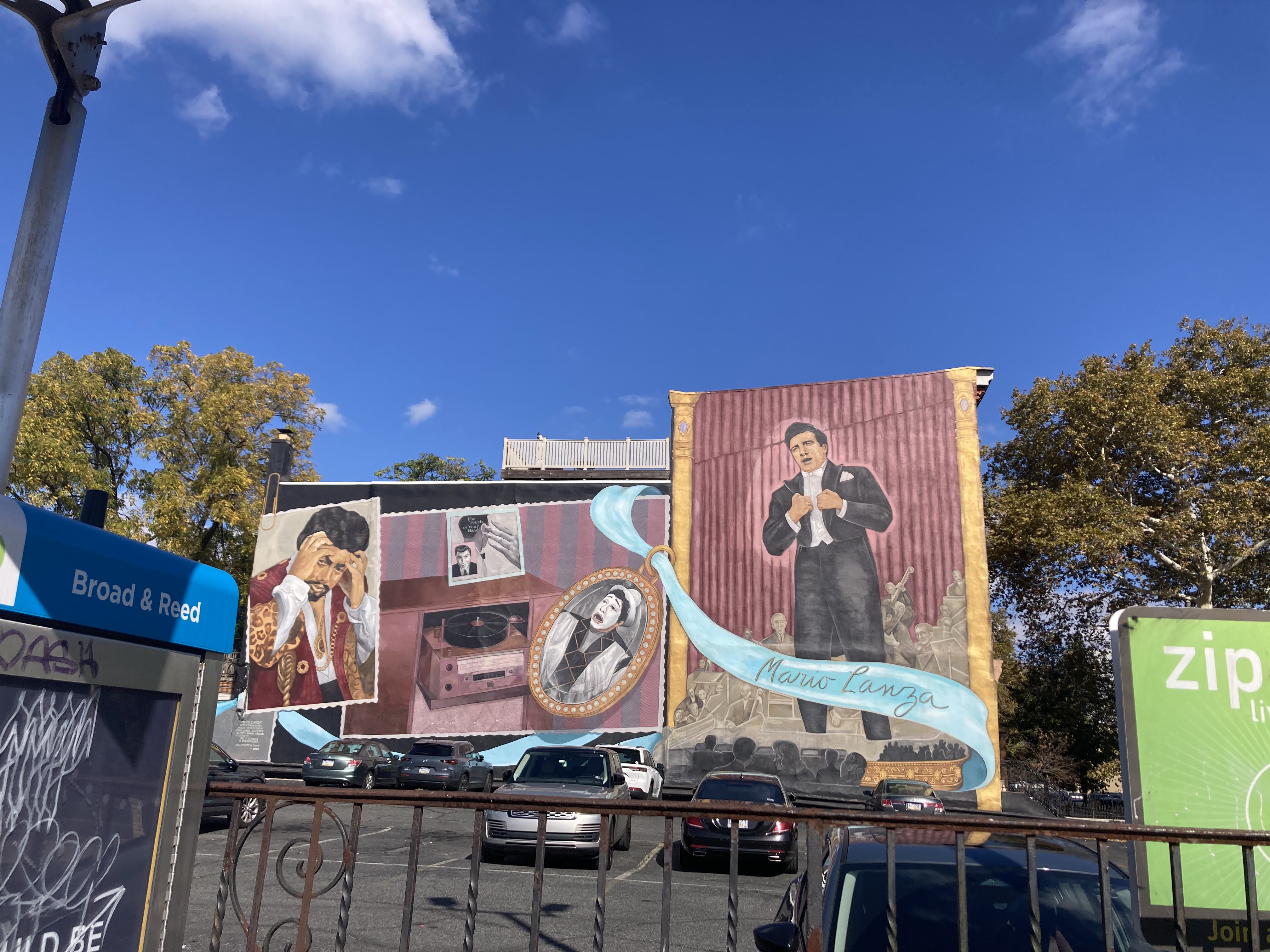
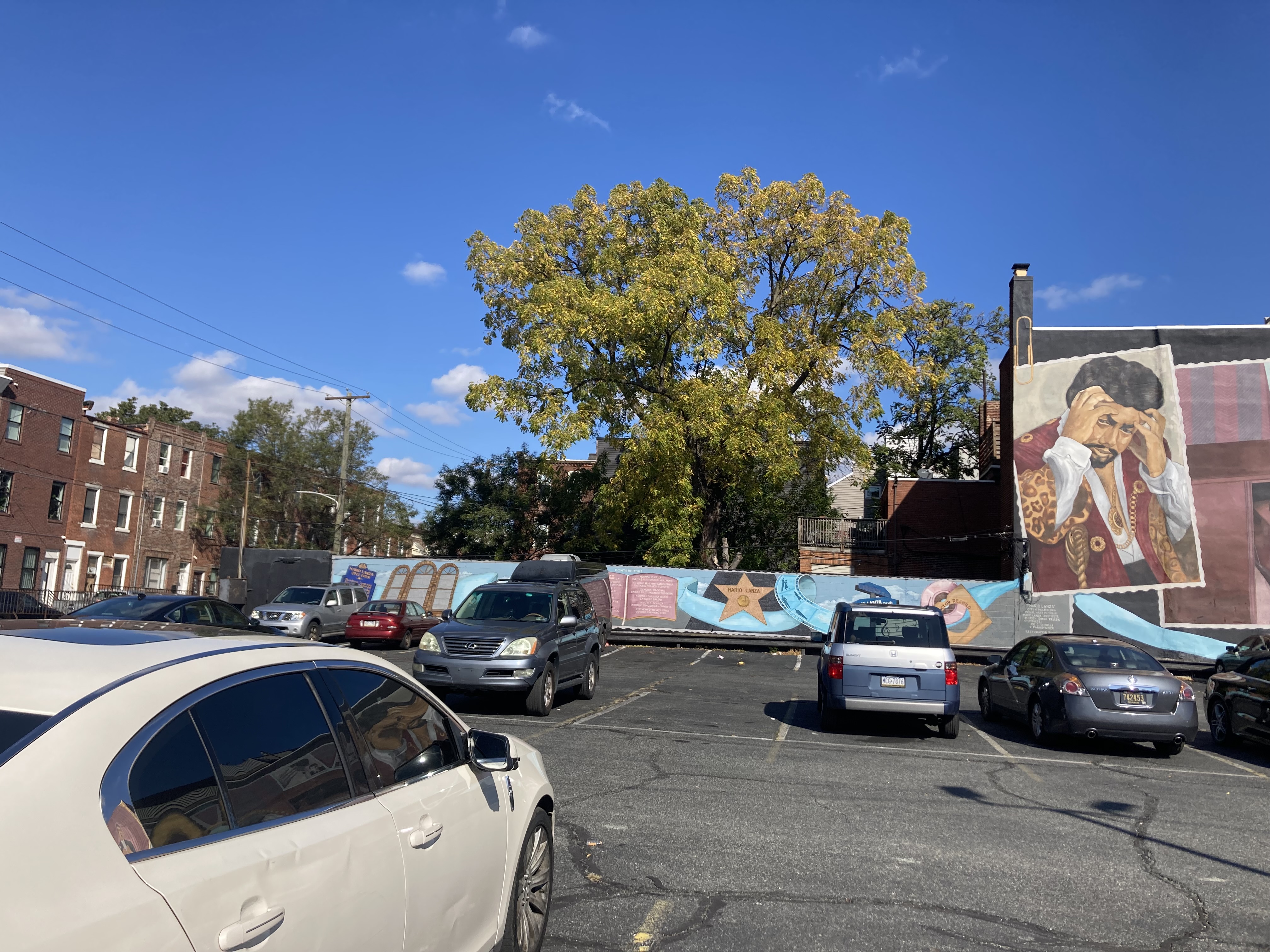
The mural is located at 1326 S Broad St in Philadelphia. It is at the intersection with Reed St, as seen in the below image. It is looking over an outdoor parking lot. The portrait is part of the Newbold neighborhood, but is positioned near the Italian Market neighborhood as well.
Description
From afar, this mural instantly catches your eye. What would otherwise be a boring parking lot has an enthralling Mario Lanza depiction as its background, something that truly stands out in an otherwise unexciting intersection. Lanza’s figure is echoed across various parts of the artwork, with the main image on the right side being of Lanza standing and performing. His expression is emotive, clearly demonstrating the passion he has for singing. A grayscale orchestra lies behind him, and a cyan curtain drags across the background and reaches his legs, spelling his name in cursive lettering. This curtain extends to the left, marking the entire image.
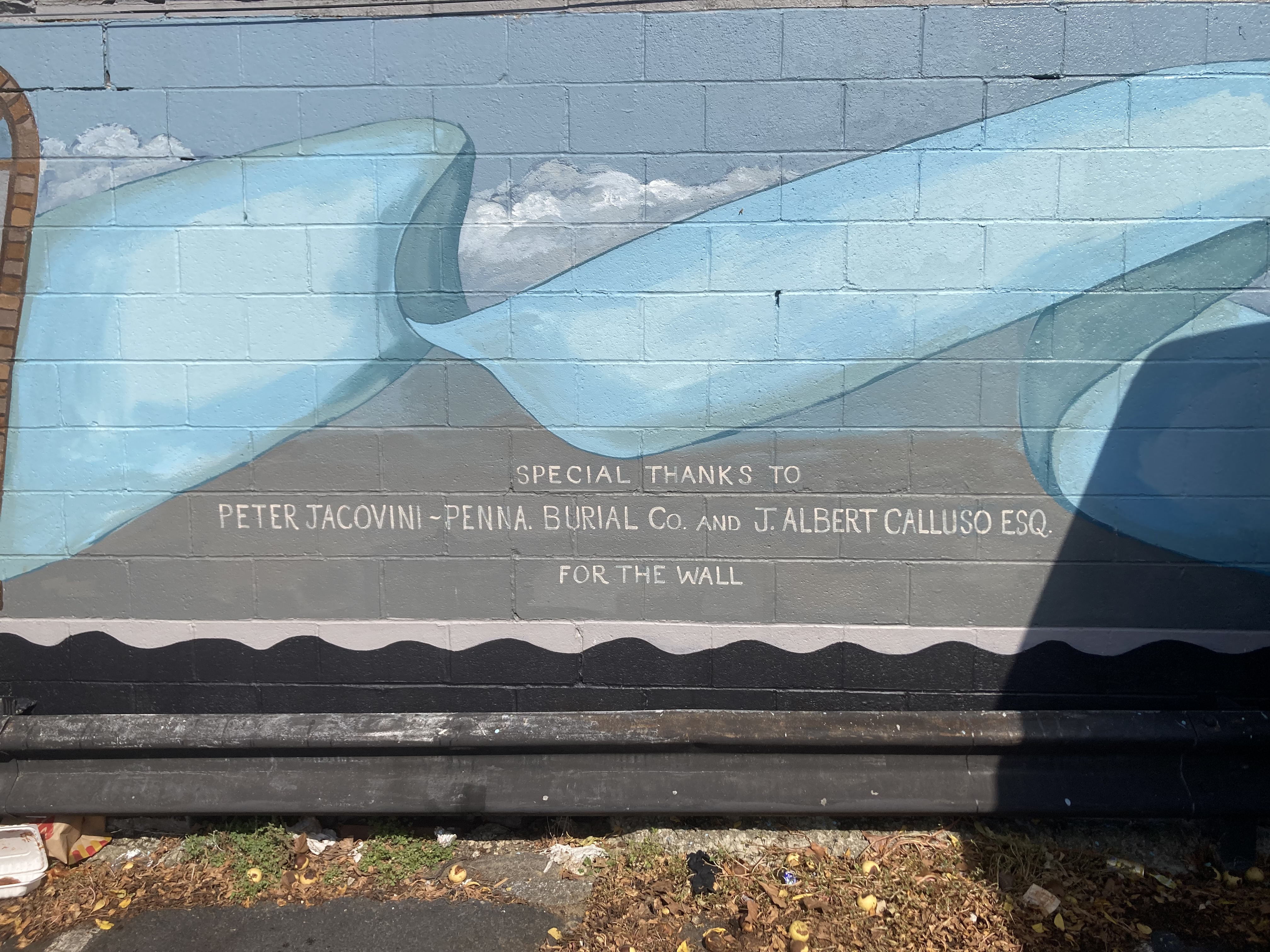
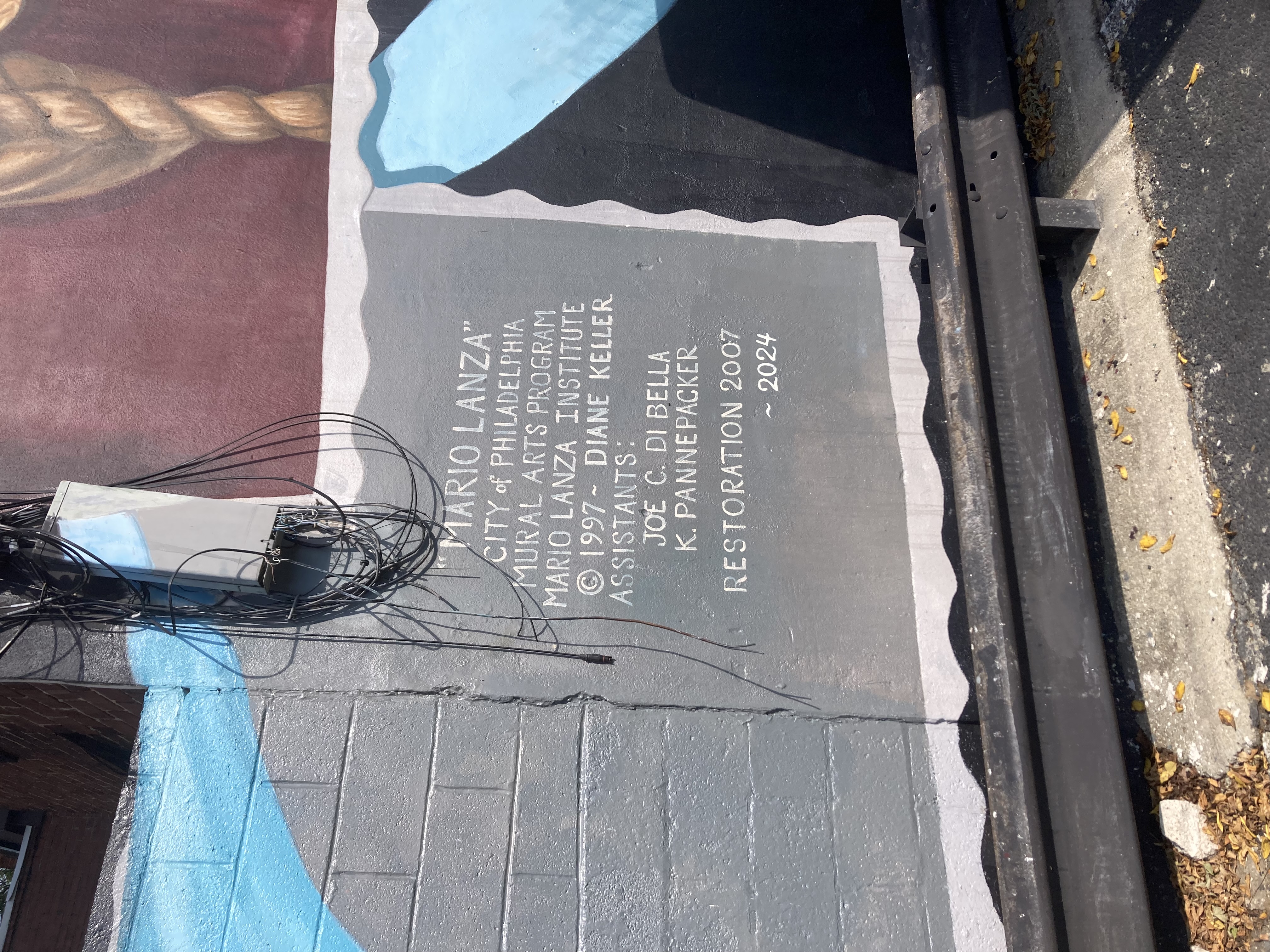
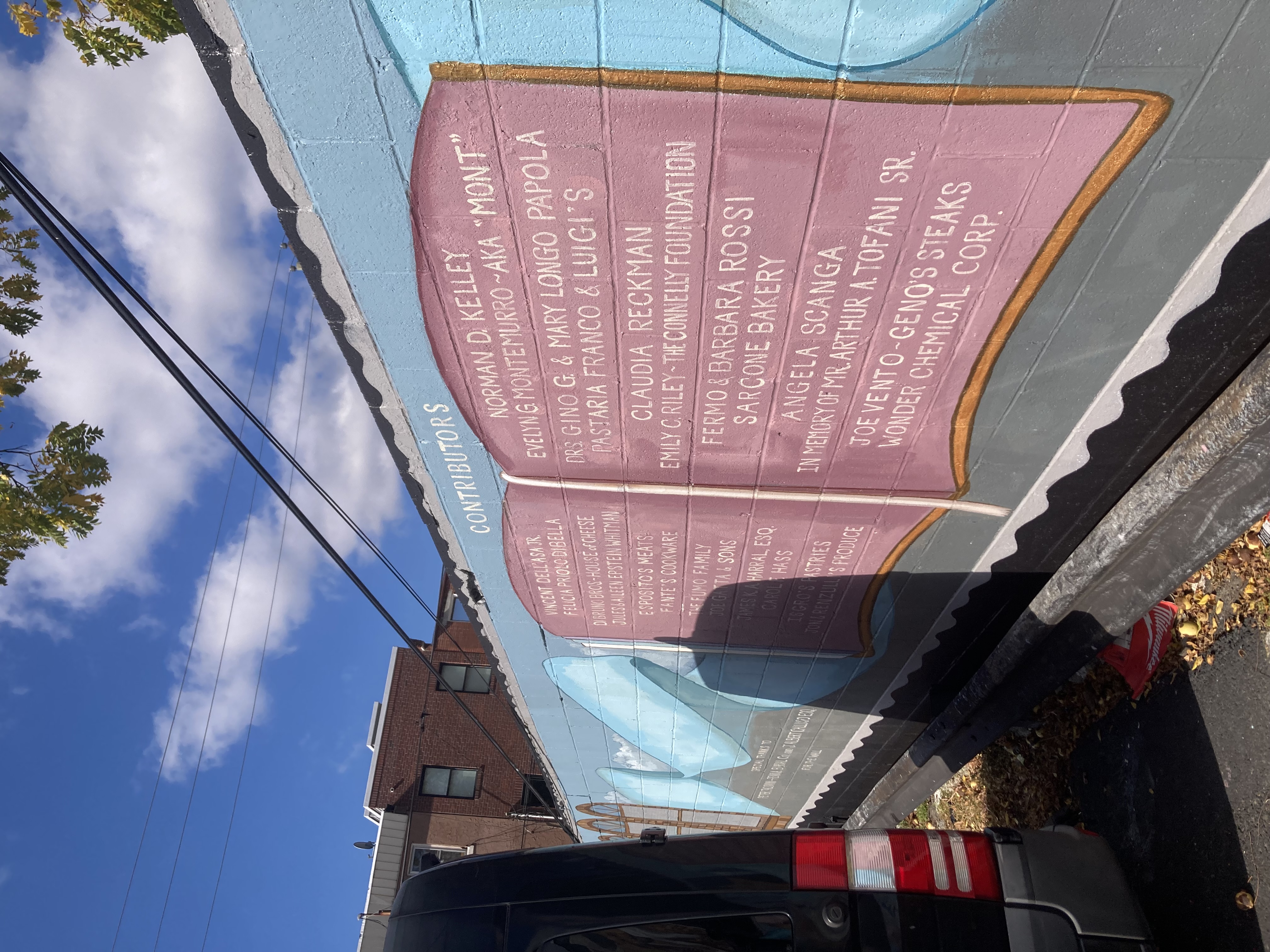
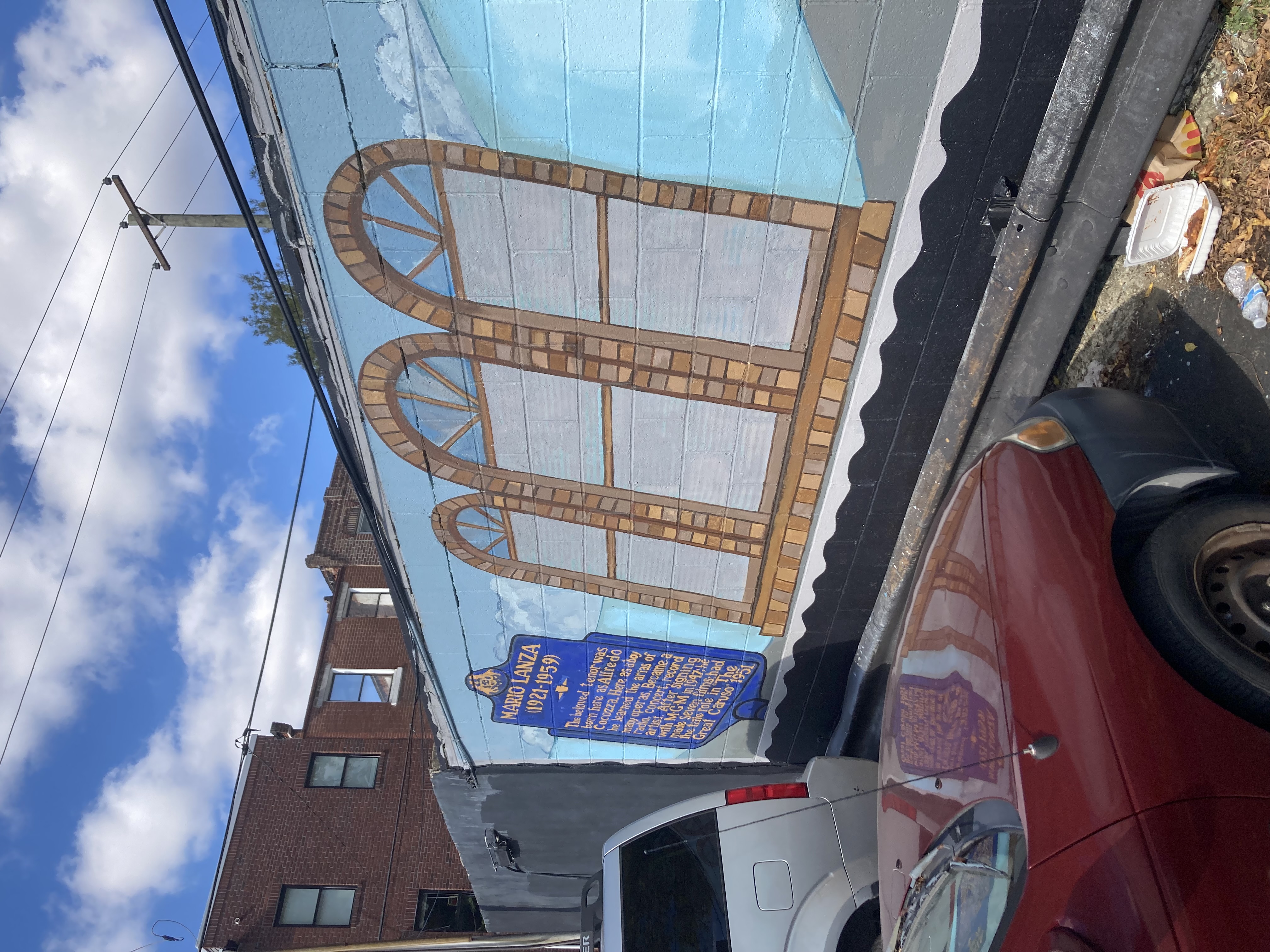
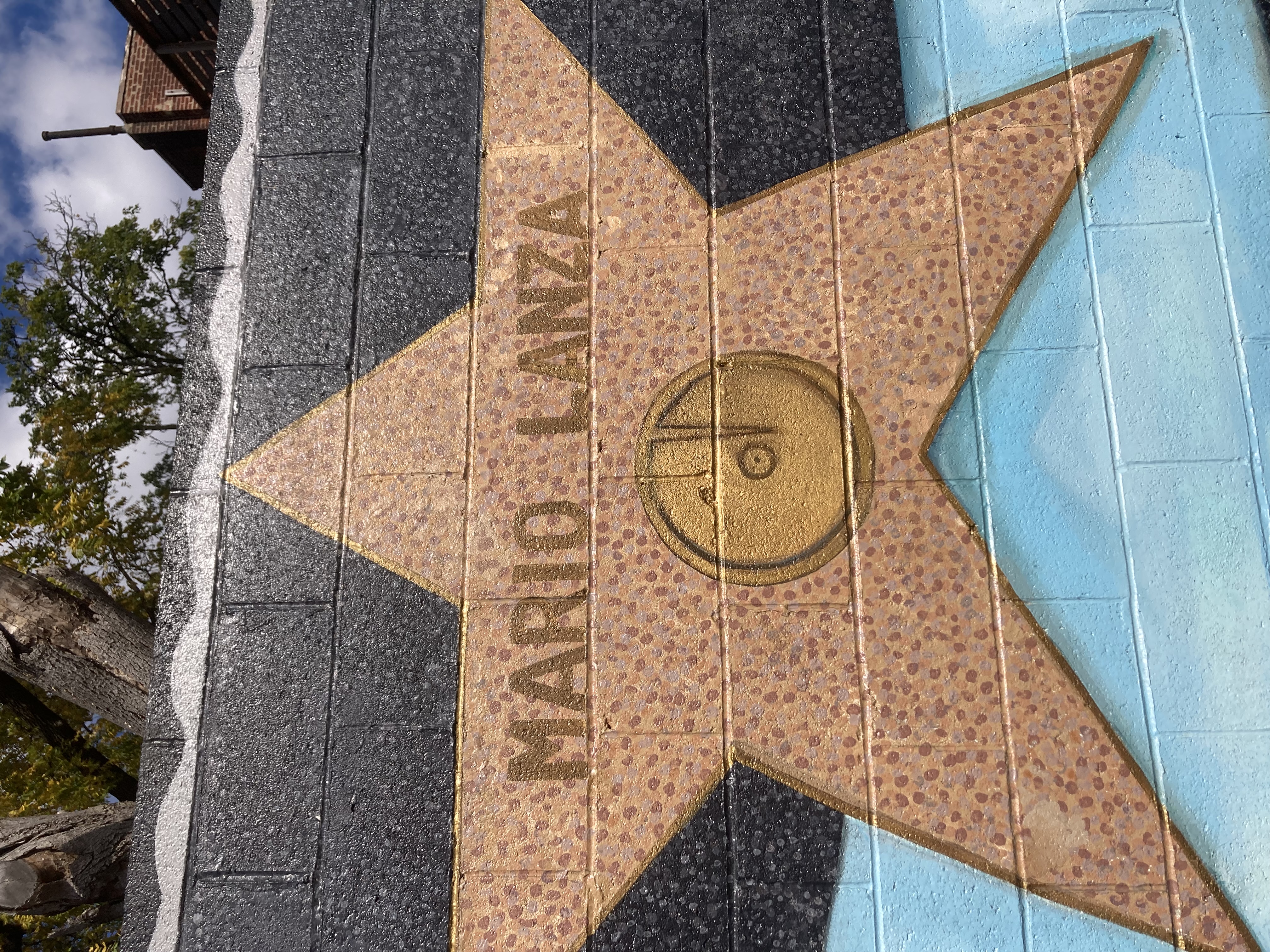
As you look left, another image of Lanza, this time as a mime of sorts, hangs off of the curtain, framed as part of an oval painting. To the frame’s left, there lies a record player, with another smaller square stamp-like piece above, labeled “The Touch of Your Hand.” To its left lies one more image of Lanza looking mildly concerned, wearing more theatrical garb and a necklace. Beneath this, there is a plaque stating the work’s title and creation. The mural extends leftwards to list all of the contributors, a special thanks, a star on the “Walk of Fame” with Lanza’s name, windows, and a plaque briefly explaining Lanza’s accomplishments as a tenor and his connection to Philadelphia.
Mario Lanza
To begin to understand a Mario Lanza mural, one must first understand the man himself. He is not a man that can be explained entirely in a complete book, let alone two paragraphs, but nonetheless, a brief biography is in order.
Mario Lanza was born as Alfedo (Freddy) Arnold Cocozza in 1921, in Philadelphia, Pennsylvania, to a pair of Italian immigrants. Addicted to opera recordings as a young child, primarily those by the great tenor Enrico Caruso, Freddy first studied violin, before his mother recognized his talent as a teenager. Requested to sing at Tanglewood after being identified as skilled by a famous conductor, he changed his name to Mario Lanza after his mother’s first and maiden names, Maria Lanza.
Upon growing up, Lanza became a strong tenor known for his powerful and beautiful voice. Primarily, he was, of course, famous on the opera stage, but also as part of various other projects, including films. “His first motion picture ‘That Midnight Kiss’ was released in 1949 and was a smash hit making Mario Lanza a screen star overnight,” writes the Mario Lanza Institute (Mario Lanza Institute Website, Biography). Lanza tragically died of a heart attack at just thirty-eight years old.
His voice transcends time to this day. Each time I sat down to work on this project, I turned on a playlist featuring his greatest hits. As I listen, I continue to be surprised by how present they feel. Singing in both Italian and English, and even German on at least one occasion, one cannot help but feel emotional and excited to hear his voice, and the power that it expresses. Once, I paused to try to sing notes that he did, and was shocked to realize the octave they were in and how I was forced to enter my falsetto. Lanza is able to make high notes sound effortless and entirely unstrained in a way that is truly spectacular, showing why he was and is still so beloved.
Further Context on the Mural and Mario Lanza Institute and Museum
This mural was initially painted in 1997, with restorations listed as both 2007 and 2024. As shown by past images, the original layout and painting was kept as its original version, but the coloring has been repeatedly restored. The mural demanded a large team to come together, with the project serving as a grand collaboration. The work was commissioned by the Mario Lanza Institute, created by Diane Keller and her assistants, and involved support from the City of Philadelphia’s Mural Arts Program. Other contributors, as listed on the mural itself, include restaurants, bakeries, produce stands, cookware, meat and cheese vendors, and a chemical corporation, largely Italian community members who wanted to support the preservation of this important figure in Philadelphia history.
The Mario Lanza Institute took the lead in this project as a way to honor Lanza’s memory further, continuing to forefront the piece on their website to this day. To provide background on the Institute and Museum, which is located just down the road from the mural, it is the centerpiece of “a continuous effort [which] forges forward to make sure [Lanza] won’t be forgotten,” (South Philly Review). The Institute has moved across Philadelphia on five occasions, but has continued to persevere. The organization hosts events monthly, including presentations on Lanza or affiliated opera artists and an upcoming Christmas Luncheon on December 22nd. In addition, the Institute runs an annual scholarship program for young opera artists.
Controversies, Further Interpretations, and Reflections
Lanza himself was not without his dissenters. According to one blog post, he was violent when drunk, did not pay his taxes, broke drivers’ licensing laws, and associated with the Mafia (Wgboroson), among other controversies. Being a celebrity makes one more prone to these types of rumors, however, that does not necessarily make them completely unsubstantiated.
Among her other projects, Diane Keller created a mural of Frank Rizzo. As our class discussed as part of the “Beyond the Bell” tour, Rizzo was an incredibly controversial figure: a family man and beloved member of the Italian community, who created some of the most harsh policing laws Philadelphia had ever seen. These laws targeted Black communities. In the wake of the George Floyd protests, the Frank Rizzo mural was ultimately erased. This makes one wonder whether Philadelphia residents are aware of the connection between these two murals, and if that colors any opinions on this mural, in spite of the figure being much less controversial.
In spite of this, Mario Lanza is clearly important, and this mural demonstrates his grip over audiences through the depiction of its central portrait. He stares out with deep emotion in his eyes and his expression, and even without hearing his voice live, you know he would have captivated you. I am struck by the effect this mural can have in portraying who he was even without that aspect of him which stood out the most, the auditory piece.
This project was a great opportunity to learn more about a man who, in spite of his dedicated following across the globe (as listed on the Institute’s website, there are numerous Fan Clubs), largely is not looked into in a college environment. I am grateful for the opportunities that it gave me to listen to and read about Mario Lanza. I wonder whether the Institute and the devotion to Lanza will continue through time - of course, interest in opera music persists, but as, unfortunately, older fans die, less and less people will have invested interest. I am hoping that someday soon, I will be able to stop by the Mario Lanza Institute and uncover more while this history remains prevalent.
Works Cited
“A Lanza Scrapbook.” Derek McGovern and Lee Ann Cafferata. 2011. https://www.mariolanzatenor.com/a-lanza-scrapbook1.html.
“Biography” and “Mural.” Mario Lanza Institute and Museum. https://www.mariolanzainstitute.org/.
“Diane Keller Studio Website.” Diane Keller, http://theoriginaldianekellerstudio.com/newmain2.html.
Facebook Post. Mario Lanza Institute. Facebook.com. May 13, 2023. Facebook.com. https://www.facebook.com/MarioLanzaInstitute/posts/diane-keller-the-artist-that-created-and-painted-the-mario-lanza-mural-on-reed-a/643946241105326/.
“Keeping Mario Lanza’s Memory Alive and Well.” Guillaume. South Philly Review. June 21, 2021. https://southphillyreview.com/2021/06/02/keeping-mario-lanzas-memory-alive-and-well/.
Ralph, Pat. 2020. Review of Frank Rizzo Mural in South Philly Officially Comes Down, Painted over with Blank Canvas. Philly Voice. June 7, 2020. https://www.phillyvoice.com/frank-rizzo-mural-italian-market-south-philadelphia-removal-mural-arts-former-mayor-police-commissioner-blank-canvas/.
“Street Art Mural of Mario Lanza.” LindArtz. Deviantart.com. November 20, 2020. https://www.deviantart.com/lindartz/art/Street-Art-Mural-of-Mario-Lanza-861593140.
“The Italian Legacy in Philadelphia: History, Culture, People, and Ideas.” Edited by Andrea Canepari and Judith Goode. Philadelphia: Temple University Press, 2021.